
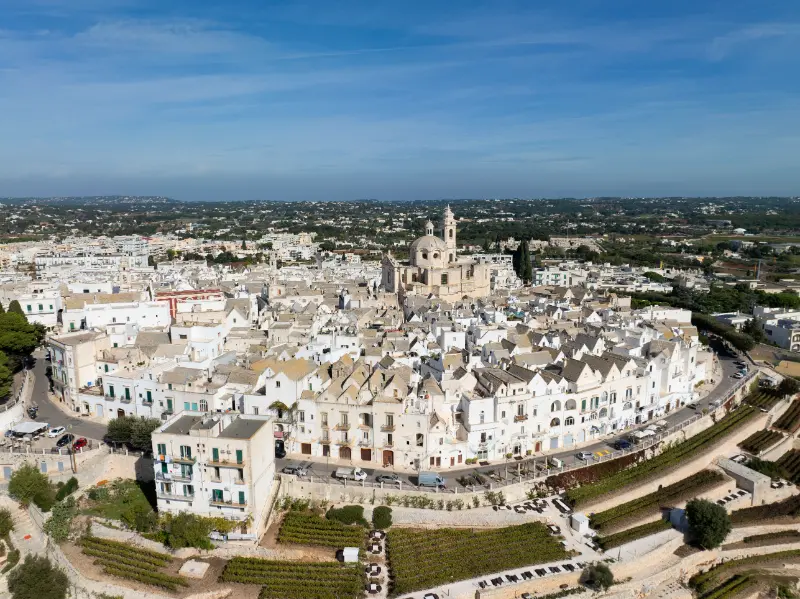
There are places in Puglia that impress you with famous monuments, and others that win you over simply by making you want to slow down. Locorotondo belongs firmly to the second group.
Perched above the Valle d’Itria, surrounded by vineyards, olive groves and scattered trulli, Locorotondo is a compact maze of whitewashed houses, flower-filled balconies, tiny churches and quiet stone lanes.
Its name comes from the Latin Locus Rotundus, meaning “round place”, a reference to the circular layout of its historic centre. Standing about 410 metres above sea level, Locorotondo is also included among I Borghi più belli d’Italia, the association of Italy’s most beautiful villages.
Locorotondo does not require a long checklist of attractions. Much of its appeal lies in the details: an arch framing a white alley, a balcony overflowing with flowers, the unusual roofs of the cummerse and sudden views opening across the Valle d’Itria.
You can see the main sights in a few hours, but spending half a day or a full day in Locorotondo allows you to enjoy the village at the relaxed pace it deserves.
Is Locorotondo Worth Visiting?
Yes, especially if you are exploring the Valle d’Itria.
Locorotondo fits naturally into a Puglia itinerary that also includes Alberobello, Martina Franca and Cisternino. Unlike some of the region’s most famous destinations, however, the village is not centred around one major landmark.
The historic centre itself is the main attraction.
Its narrow streets wind between whitewashed houses with green shutters, stone staircases, small courtyards and colourful balconies. Many buildings are topped with the distinctive cummerse, steep roofs covered with local limestone slabs.
The best way to experience Locorotondo is not to rush from one monument to another. Give yourself time to wander, stop for coffee or an aperitivo and take a few unexpected turns through the quieter streets.
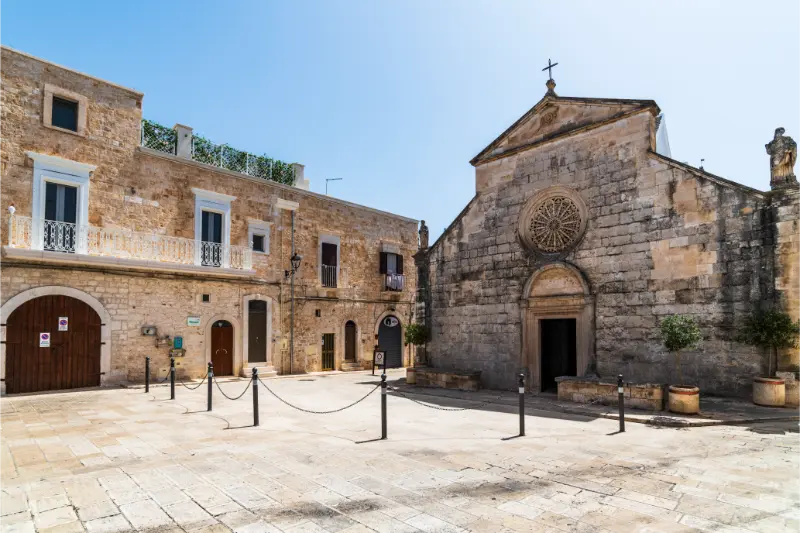
Best Things to See in Locorotondo
For bookable tours and activities, check current experiences on GetYourGuide.
1. Wander Through the Historic Centre
Your first priority should simply be to walk through Locorotondo’s old town without worrying too much about following a fixed route.
The streets curve between white houses decorated with green shutters, stone doorways, arches, wrought-iron balconies and pots filled with colourful flowers.
Locorotondo is extremely photogenic, but some of its nicest corners are found away from the most obvious streets. Look into small courtyards, notice the traditional stone staircases and take time to explore the side alleys.
Early morning is one of the best times to explore Locorotondo, especially during July and August, when temperatures are cooler and the streets are generally quieter.
2. Look Up at the Cummerse
Although trulli are scattered throughout the countryside surrounding Locorotondo, the architectural feature most closely associated with the historic centre is the cummersa.
These traditional houses have steeply pitched roofs covered with grey limestone slabs. Their shape is very different from the cone-shaped trulli found in nearby Alberobello.
The contrast between the bright white façades and dark stone rooftops is one of the details that gives Locorotondo its distinctive appearance.
3. Piazza Vittorio Emanuele II
A good place to begin exploring the historic centre is Piazza Vittorio Emanuele II.
Nearby you can see the two 19th-century columns that mark the former entrance of Porta Napoli, one of the traditional gateways into the old town.
From here, you can easily continue toward Palazzo Morelli, the Church of San Giorgio and the narrow lanes in the heart of Locorotondo.
4. Admire Palazzo Morelli
Among the elegant historic buildings in Locorotondo, Palazzo Morelli deserves a closer look.
Built in 1819, the palace is one of the most interesting examples of civil architecture in the town. Its decorative stone portal and wrought-iron balconies stand out among the surrounding white houses.
You do not need much time here, but the building and the surrounding street form one of the prettiest corners of the historic centre.
5. Visit the Church of San Giorgio Martire
The Chiesa Madre di San Giorgio Martire is Locorotondo’s main church and one of the most important landmarks in the historic centre.
The present building was constructed between the end of the 18th century and the first decades of the 19th century, replacing earlier churches that stood on the same site.
Its dome and bell tower are easy to spot while walking through the old town. If the church is open, it is worth stepping inside for a few minutes.
6. See the Church of Madonna della Greca
A short walk from the centre brings you to the Church of Madonna della Greca, considered the oldest church in Locorotondo.
Its precise origins are uncertain, although historical documents mention the church as early as the 16th century and some architectural elements suggest even older roots.
Inside you can see interesting stone details and religious sculptures. Because it stands slightly outside the tight circular centre, travellers making a very quick visit sometimes overlook it.
It is worth the short detour.
7. Walk Along Via Nardelli
After exploring the narrow streets, head toward Via Nardelli, one of the most scenic areas of Locorotondo.
The atmosphere changes completely here. Instead of being surrounded by white walls and narrow alleys, the landscape suddenly opens toward the Valle d’Itria.
From Locorotondo’s elevated position you can admire vineyards, olive groves, dry-stone walls, traditional farmhouses and trulli scattered across the countryside.
This is particularly pleasant in the late afternoon and around sunset.
8. Enjoy the View from the Villa Comunale
Close to Via Nardelli, the Villa Comunale Giuseppe Garibaldi is another excellent place to stop and enjoy the panorama.
On a clear day, the landscape stretches across the green hills of the Valle d’Itria, dotted with olive trees, vineyards and traditional rural buildings.
If you are travelling through Puglia on a busy itinerary, this is a good place to sit for a few minutes and enjoy the slower rhythm of the village.
9. Try Locorotondo DOC Wine
Locorotondo is also surrounded by an important wine-growing area.
The local Locorotondo DOC is best known for fresh, dry white wines traditionally produced using grapes such as Verdeca and Bianco d’Alessano.
You can try local wines in restaurants and wine bars around town, while several wineries are located in the surrounding countryside.
A chilled local white wine pairs particularly well with seafood, cheeses, vegetables and many traditional Puglian dishes.
Locorotondo in One Day: Suggested Itinerary
Although the historic centre is small, a relaxed half-day or full-day visit is much more enjoyable than rushing through Locorotondo.
Morning
Arrive reasonably early and begin around Piazza Vittorio Emanuele II.
Enter the historic centre and spend some time wandering through the white streets before continuing toward Palazzo Morelli, the Church of San Giorgio and the Church of Madonna della Greca.
Do not worry about following an exact route. Locorotondo is small enough that getting slightly lost is part of the experience.
Lunch
Stop for lunch in or around the historic centre and look for traditional dishes connected to the Valle d’Itria and Puglian cuisine.
- Orecchiette
- Fava beans and chicory
- Local cheeses
- Seasonal vegetables
- Focaccia barese
- Bombette
- Local Locorotondo DOC wine
Menus vary by restaurant and season, and choosing dishes made with local ingredients is usually the best option.
Afternoon
After lunch, return to the quieter lanes before walking toward Via Nardelli and the Villa Comunale.
If you have a car and more time available, continue into the surrounding countryside, where vineyards, olive groves, masserie and trulli create one of the most characteristic landscapes in Puglia.
Evening
Locorotondo becomes particularly atmospheric toward sunset.
The white façades take on warmer colours, summer temperatures become more comfortable and cafés and wine bars begin to fill for the evening passeggiata.
If your itinerary allows it, do not leave immediately after lunch. The village has a completely different atmosphere in the late afternoon and evening.
How Long Do You Need in Locorotondo?
You can see the basic historic centre in around two hours, but that would be a relatively quick visit.
- 2–3 hours: enough for the historic centre and main viewpoints.
- Half a day: ideal if you also want lunch, coffee or an aperitivo.
- One day: best for exploring slowly and seeing some of the surrounding countryside.
- One night: a good option if you want to experience Locorotondo after many day visitors have left.
Locorotondo can also be a convenient base for exploring other destinations in the Valle d’Itria.
Where to Stay in Locorotondo
Staying overnight is not essential, but it allows you to experience the village early in the morning and in the evening, when the streets are generally quieter.
For current accommodation options, compare hotels and apartments on Booking.com.
Stay in the Historic Centre
Choose the historic centre if atmosphere and convenience are your priorities.
You will be able to step outside in the morning and immediately find yourself among Locorotondo’s white lanes, cafés and historic buildings.
This option works particularly well for couples and travellers who enjoy evening walks, restaurants and wine bars.
Stay in a Trullo or Masseria
For a more rural experience, consider staying outside town in a trullo, masseria or countryside accommodation.
The surrounding landscape is one of the most beautiful parts of the Valle d’Itria, with olive groves, vineyards and trulli spread across the hills.
This is especially convenient if you have a car and plan to explore several towns during your stay.
How to Get to Locorotondo
If you are flying to Puglia, compare flights to Bari and Brindisi with Skyscanner.
By Car
For a wider trip through the Valle d’Itria, travelling by car is usually the most flexible option.
It allows you to combine Locorotondo easily with Alberobello, Martina Franca, Cisternino, Ostuni and the surrounding countryside.
When arriving in town, look for legal parking outside or near the historic centre and complete the final part of the journey on foot. Always pay attention to current parking restrictions and ZTL signs.
If you plan to drive, compare rental-car prices with DiscoverCars.
From Bari by Public Transport
Locorotondo can also be reached from Bari using regional public transport services operated in the Valle d’Itria.
Depending on the period, connections may involve trains, buses or integrated rail-and-bus services. Always check the latest timetable before travelling because schedules and connections can change.
From Alberobello
Locorotondo is located less than 10 kilometres from Alberobello, making the two villages very easy to combine.
The experience is also surprisingly different. Alberobello is famous for its dense concentration of trulli, while Locorotondo is characterised by white houses, cummerse and panoramic views across the Valle d’Itria.
Best Time to Visit Locorotondo
Spring
April, May and early June are excellent months for visiting Locorotondo.
The countryside is green, temperatures are generally comfortable for walking and the village is usually less busy than during peak summer.
Summer
June, July and August are lively months, with events, concerts and cultural activities taking place around Locorotondo and the Valle d’Itria.
If you visit in July or August, try to explore the historic centre early in the morning or later in the afternoon, avoiding the hottest hours whenever possible.
Autumn
September and October are another excellent period, particularly if you want to enjoy the surrounding wine country and slightly cooler temperatures.
Winter
Winter is much quieter. Some tourist-oriented businesses may operate reduced hours, but the atmosphere can be particularly peaceful.
What to See Near Locorotondo
Locorotondo’s location makes it an excellent starting point for exploring some of the most beautiful destinations in central Puglia.
Alberobello
Alberobello is the obvious companion to Locorotondo and one of Puglia’s most famous destinations.
Its extraordinary districts filled with trulli are very different from Locorotondo’s white houses and cummerse, so visiting both towns does not feel repetitive.
Martina Franca
For more elaborate architecture, continue to Martina Franca, known for its elegant historic centre, Baroque buildings and beautiful churches.
Cisternino
Cisternino is another charming white village in the Valle d’Itria and is particularly enjoyable around lunchtime or in the evening.
The town is also famous for its traditional butcher shops and grilled meat, including the local bombette.
Ostuni
The famous White City of Ostuni offers a larger and more dramatic version of Puglia’s whitewashed architecture.
Visiting both Ostuni and Locorotondo is worthwhile because their atmosphere and urban layout are quite different.
Monopoli
For a change of scenery, head toward the Adriatic coast and visit Monopoli, where a picturesque old harbour, historic centre and nearby beaches provide a pleasant contrast to the countryside of the Valle d’Itria.
Locorotondo or Alberobello: Which Should You Visit?
If this is your first trip to Puglia and you can visit only one, Alberobello is the more iconic destination because of its unique concentration of trulli.
Locorotondo, however, often appeals to travellers looking for a quieter and more relaxed atmosphere.
Choose Alberobello if seeing the famous trulli is your priority.
Choose Locorotondo for whitewashed streets, viewpoints, local wine and a slower village atmosphere.
Whenever possible, visit both. They are close enough to fit easily into the same itinerary and different enough to make both stops worthwhile.
Practical Tips for Visiting Locorotondo
- Wear comfortable shoes. The historic centre is best explored entirely on foot.
- Do not over-plan your route. Wandering through side streets is part of the Locorotondo experience.
- Visit early or late in summer. The middle of the day can be very hot in July and August.
- Do not miss the viewpoints. The countryside surrounding the village is one of Locorotondo’s main attractions.
- Try the local wine. Locorotondo DOC is one of the products most closely associated with the town.
- Consider staying overnight. Early mornings and evenings offer a quieter atmosphere.
- Check public transport schedules before travelling. Services and connections may change depending on the season.
Frequently Asked Questions About Locorotondo
Is Locorotondo worth visiting?
Yes. Locorotondo is one of the prettiest small towns in the Valle d’Itria and is an excellent destination for travellers interested in traditional villages, photography, local food, wine and Puglian architecture.
How much time do you need in Locorotondo?
Around 2 to 3 hours is enough to walk through the historic centre and see the main viewpoints. Half a day is better if you also want to stop for lunch or an aperitivo.
Is Locorotondo walkable?
Yes. The historic centre is compact and is best explored on foot. Once you reach the centre, you do not need a car for sightseeing.
What is Locorotondo famous for?
Locorotondo is famous for its circular historic centre, whitewashed houses, cummerse roofs, panoramic views over the Valle d’Itria and local white wine.
Are there trulli in Locorotondo?
Yes. Trulli are common in the countryside surrounding Locorotondo. Inside the historic centre, however, the steep-roofed cummerse are more characteristic.
Can you visit Locorotondo and Alberobello on the same day?
Yes. The towns are less than 10 kilometres apart and are one of the easiest combinations for a day trip through the Valle d’Itria.
A particularly good option is to visit Alberobello in the morning and Locorotondo in the afternoon, staying until the early evening to enjoy the views and atmosphere around sunset.
Is it better to stay in Locorotondo or Alberobello?
It depends on your itinerary. Alberobello is ideal if staying among or close to the famous trulli is a priority, while Locorotondo can be a quieter base for exploring the wider Valle d’Itria.
Why Locorotondo Deserves a Place on Your Puglia Itinerary
Locorotondo may not be the place in Puglia where you spend the most time, but it can easily become one of the villages you remember most clearly.
There is no single enormous monument that defines the visit. Instead, Locorotondo is about white streets, grey stone roofs, flower-covered balconies, local wine and beautiful views across the Valle d’Itria.
Walk through the historic centre without rushing. Look up at the cummerse, step inside the churches, stop at the panoramic edge of town and then sit down for something to eat or a glass of local wine before continuing your journey through Puglia.
That slower rhythm is precisely what makes Locorotondo one of the most enjoyable villages to visit in Puglia.