

Cisternino is one of the best places in the Valle d’Itria for travellers who want a white hill town that feels lived-in rather than staged. It is smaller than Martina Franca, less famous than Alberobello and less polished than nearby Locorotondo, but that is exactly why it works so well for a late-afternoon visit or a two-night stay.
The historic centre is compact enough to explore without a checklist. Whitewashed lanes open unexpectedly onto tiny courtyards, arches frame views toward the countryside, and the public gardens near Piazza Garibaldi provide one of the easiest panoramas over the Valle d’Itria. In the evening, butchers that cook meat to order become part of the town’s identity, making Cisternino particularly appealing for travellers interested in food.
You can see the essentials in two or three hours, but Cisternino is much better if you stay through dinner. It is not a destination that rewards rushing from monument to monument.
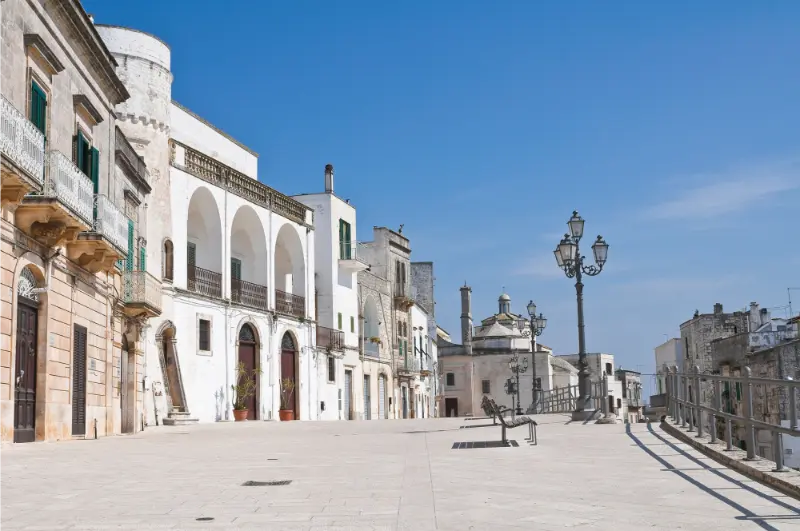
Why Visit Cisternino?
Cisternino offers three things particularly well: atmosphere, food and location.
Its old town is one of the most pleasant in central Puglia for aimless walking. Unlike Alberobello, where most visitors follow the same trulli streets, Cisternino works precisely because there is no single mandatory route.
It is also one of the classic places to try bombette, small rolls of pork usually filled or seasoned in different ways and cooked by local fornelli pronti. The experience is more specific to this part of the Valle d’Itria than a generic list of “Puglian foods”.
Finally, Cisternino sits in an excellent position between Ostuni, Locorotondo and Martina Franca. With a car, it can be part of a very efficient Valle d’Itria route.
Best Things to Do in Cisternino
For bookable tours and activities, check current experiences on GetYourGuide.
Start at Piazza Garibaldi and the public gardens
Piazza Garibaldi is the most useful starting point because it sits beside the historic centre and the public gardens.
Walk first toward the panoramic edge rather than going straight into the lanes. The view opens across trulli, dry-stone walls and olive-covered countryside. Late afternoon gives softer light and makes the valley easier to photograph than the harsh middle of the day.
This is one of those viewpoints where moving only a few metres changes the composition. The side closer to the gardens gives you more foreground and a stronger sense of height, while openings farther along the edge reveal wider countryside.
Allow 15 to 20 minutes before entering the old town.
Enter the historic centre slowly
Cisternino’s historic core is built for wandering rather than for following a straight route. The lanes around Via Santa Maria di Costantinopoli, Via Duca d’Aosta and the small passages behind Piazza Vittorio Emanuele III are the most rewarding.
Do not worry if you circle back to the same square. The town is small and that repetition is part of the experience.
The best time is from around 17:00 onward in summer, when the white walls are less glaring and restaurants begin preparing for the evening. Around midday, many lanes can feel quiet and the stone reflects the heat.
Piazza Vittorio Emanuele III and Torre dell’Orologio
Piazza Vittorio Emanuele III is one of the focal points of the old town. The clock tower gives the square a strong visual identity and the surrounding alleys are among the most photographed corners of Cisternino.
Spend time here rather than simply taking one photo and leaving. The square changes character as day visitors disappear and residents gather in the evening.
If you want photographs with fewer people, come early in the morning. If you want atmosphere, come after sunset.
Chiesa Madre di San Nicola
The Mother Church of San Nicola is one of the main religious buildings in Cisternino. It stands within the historic centre and is worth entering when open.
As with many churches in small Italian towns, visiting hours may be influenced by services and local events. Treat opening times as something to check locally rather than planning your entire day around a fixed schedule found online months earlier.
You need around 15 to 20 minutes unless you are particularly interested in religious art and architecture.
Torre Grande
The Torre Grande, also known as the Norman-Swabian or civic tower in local descriptions, forms part of the historic identity of the centre.
It is not a separate attraction requiring a ticketed visit in the way a large castle would. See it as part of your walk between the principal squares and lanes.
Chiesa di Santa Maria di Costantinopoli
This small church is easy to miss if you only follow the busiest route. It is one of the details that makes a slow walk through Cisternino more rewarding.
A deviation of five or ten minutes is enough. If the church is closed, the surrounding lanes are still worth exploring.
Santuario della Madonna d’Ibernia
The Sanctuary of Madonna d’Ibernia lies outside the historic centre in the countryside.
This is a better stop for travellers with a car, cyclists or walkers who have more time. The setting is part of the appeal: it connects the town with the rural landscape of the Valle d’Itria.
Do not include it in a two-hour first visit if reaching it would force you to rush the centre.
The Best Walk Through Cisternino
A simple loop works well.
Start at Piazza Garibaldi and the public gardens, pause at the panorama, then enter the old town through the nearest lanes toward Piazza Vittorio Emanuele III.
Continue slowly through the white streets toward the Chiesa Madre di San Nicola, then loop through Via Santa Maria di Costantinopoli and the quieter alleys on the edge of the centre.
Return toward Piazza Garibaldi in time for aperitivo or dinner.
The entire route is short. With photo stops and a church visit, allow 90 minutes. Add dinner and Cisternino becomes an excellent half-day outing.
Best Viewpoints and Photo Spots
The public gardens by Piazza Garibaldi are the easiest panoramic point. Visit in late afternoon for warm light across the countryside.
Inside the historic centre, the strongest photographs are not of one monument but of layered arches, staircases, balconies and white facades. Look for narrow lanes where a bright opening at the end frames the valley or another building.
Piazza Vittorio Emanuele III is best photographed early or late. In the middle of the evening it can be crowded, but that is also when it feels most alive.
For sunrise, the town is extremely quiet and the white streets are almost empty. Sunset is more social and atmospheric.
What to Eat in Cisternino
Bombette
Bombette are the food most closely associated with a Cisternino evening. They are small pork rolls, usually seasoned or filled with ingredients such as cheese, herbs or cured meat.
The important part is the fornello pronto tradition. Some butcher shops operate with a cooking service: you choose meat at the counter, it is cooked, and you eat nearby.
This is not a formal fine-dining experience. The attraction is the direct connection between butcher, grill and table.
Gnummeredd
You may also encounter gnummeredd or related preparations made from lamb offal, part of a deeper local meat tradition.
They are more challenging for visitors unfamiliar with organ meats, so do not order them simply because they are “traditional”. Ask what they contain and choose them if the description actually appeals to you.
Local cheeses, vegetables and wine
Cisternino also works well for simple starters built around local cheeses, seasonal vegetables, olives and cured meats.
The Valle d’Itria has a strong wine tradition, including white wines around Locorotondo and Martina Franca. Ask for a local bottle rather than defaulting to a generic national label.
Where to Eat: How to Choose
The most atmospheric places are inside and immediately around the historic centre, but do not assume the restaurant with the most visible terrace is automatically the best.
For meat, look for a fornello pronto where the butcher counter is still central to the experience. Ask how ordering works before sitting down because the process varies.
In July and August, reserve if you want dinner at a specific time. Cisternino is small and popular; a few busy restaurants can fill quickly.
For lunch, the town is quieter. If you are coming mainly for the evening atmosphere, have a light lunch elsewhere and save your main meal for Cisternino.
Parking in Cisternino
Do not attempt to drive into the historic centre. Cisternino has a ZTL and narrow streets that are not useful to visitors even when access appears physically possible.
Use marked parking outside the old core and walk in.
The municipality lists official parking information and operates paid blue spaces. Practical parking areas used for events and busy periods include Via Francesco Clarizia, the cemetery parking area on Via Ostuni, Via Monte la Croce and Via Miravalle. Availability and restrictions can vary with markets, festivals and seasonal traffic.
A good approach is to aim for the outer streets rather than circling Piazza Garibaldi repeatedly. The town is small enough that an extra five-minute walk is usually faster than waiting for the closest space.
In 2026, paid parking service was active from the beginning of March. Rates can change, so check signs at the meter rather than relying on an old online price.
ZTL
Cisternino maintains restricted traffic rules for the historic centre and provides a municipal permit system for authorized vehicles.
For ordinary visitors, the simplest rule is not to enter the old town by car.
If your accommodation lies inside the ZTL, ask the property exactly where to stop and whether they need your licence plate in advance. Do not follow another vehicle through a restricted access point.
How to Get to Cisternino
If you are flying to Puglia, compare flights to Bari and Brindisi with Skyscanner.
By car
A car is the most flexible option because Cisternino combines naturally with Locorotondo, Martina Franca and Ostuni.
The roads through the Valle d’Itria are scenic but can be narrow. Do not rush between towns simply because the distances look short.
If you are planning several countryside days, compare rental cars with DiscoverCars.
By train
This is where travellers need to pay attention to station names.
Cisternino has rail connections on different networks, and the Trenitalia station known as Cisternino is on the coastal plain, not beside the historic centre. You need a road connection for the final section.
In summer 2026, Cisternino introduced a trial STP bus service between the town and the FS station from late July into September. This is useful evidence that car-free access is improving, but such seasonal services should always be verified for your actual dates.
Ferrovie del Sud Est services also connect the Valle d’Itria area. Timetables can be less frequent than the main Adriatic rail line.
From Bari
By car, Cisternino works as part of a full Valle d’Itria day.
Without a car, the trip is possible but requires more planning. If you only have one day from Bari, Alberobello or Monopoli may be simpler choices depending on the current timetable.
From Brindisi
Brindisi is relatively close to the southeastern side of the Valle d’Itria. If you land at Brindisi Airport and plan to stay in Cisternino, a car or pre-arranged transfer is much simpler than relying on multiple connections with luggage.
Where to Stay in Cisternino
Historic centre
Stay in the old town if your priority is atmosphere, dinner and being able to walk home after an evening out.
The downside is parking. Ask your accommodation where guests should leave the car and how far you will need to carry luggage.
Just outside the centre
For drivers, this is often the best compromise. You can walk into the old town in minutes while keeping easier access to parking.
Countryside and masserie
The countryside around Cisternino is one of the most attractive places to stay in the Valle d’Itria. Trulli, masserie and converted rural houses offer a completely different experience from sleeping in town.
A car is essential for most rural properties. Check the exact road location before booking: a property described as “Cisternino” may be several kilometres from the centre.
Compare places to stay in Cisternino.
Cisternino with Children
The old town is small, which makes it easier than large cities, but there are steps, uneven stone and narrow lanes.
A compact stroller is more practical than a large one. Families with toddlers should be careful around stairs and polished paving.
The public gardens provide a useful break, and an early dinner can avoid the busiest late-evening restaurant period.
Children who enjoy simple grilled food may find a fornello pronto more engaging than a formal restaurant.
Accessibility
Cisternino is not completely flat. The main squares and viewpoints are manageable, but the historic centre includes steps and irregular surfaces.
Travellers with limited mobility should approach from the side that gives the most direct access to Piazza Garibaldi and avoid planning a route that tries to cover every lane.
Ask accommodation providers specifically about stairs. “In the historic centre” can mean a room reached through several steep steps.
Best Time to Visit
May, June and September are excellent for walking and eating outdoors.
July and August are lively but much busier. In summer, arrive in the late afternoon rather than at noon. The town is at its best when the heat drops and the dinner atmosphere begins.
Autumn is attractive for food-focused trips and quieter countryside. Winter can be very atmospheric, especially around festive events, but opening hours are more limited.
Cisternino’s patronal celebrations for Saints Quirico and Giulitta are an important local event in summer. If your dates coincide, expect processions, events and changed traffic conditions.
How Long to Spend in Cisternino
Two hours is enough for the historic centre and viewpoint.
Half a day is better because you can walk slowly and eat.
One or two nights are ideal if you want Cisternino to be a Valle d’Itria base rather than a stop between other towns.
More than two nights makes sense if you are staying in a countryside property and using it to explore the region.
A Half-Day Itinerary
Arrive around 17:00 in summer.
Park outside the historic centre and start at the public gardens for the valley view.
Enter the old town, explore Piazza Vittorio Emanuele III, the Chiesa Madre and the surrounding lanes.
Take an aperitivo around sunset, then have dinner at a fornello pronto.
Finish with a short walk through the centre after dark, when the white walls and small squares feel completely different from the daytime.
Combining Cisternino with Other Towns
Locorotondo
Cisternino and Locorotondo make the most natural pair. Both are compact, attractive in the evening and close together.
If you have one day, visit Locorotondo in the morning and Cisternino in the late afternoon for dinner.
Martina Franca
Martina Franca is larger and more architecturally substantial. Give it more sightseeing time and use Cisternino for atmosphere and food.
Ostuni
Ostuni provides a dramatic white-city setting and broader views toward the Adriatic plain. Cisternino feels smaller and more intimate.
Combining both in one day is possible by car, but avoid trying to add Alberobello and Martina Franca as well.
Alberobello
Alberobello is unique for its concentration of trulli but is far more tourism-focused.
A good Valle d’Itria itinerary uses Alberobello for the iconic sight and Cisternino for a slower evening.
Cisternino or Locorotondo?
Choose Cisternino for food, a slightly more informal atmosphere and the classic fornello pronto experience.
Choose Locorotondo for its circular old-town layout, cummerse houses and polished viewpoints.
They are close enough that you do not really need to choose unless time is extremely short.
Frequently Asked Questions
Is Cisternino worth visiting?
Yes. It is one of the best small towns in the Valle d’Itria for an evening walk and dinner, especially if you prefer a lived-in atmosphere to a major tourist attraction.
How long do you need in Cisternino?
Allow two to three hours for sightseeing, or half a day if you want dinner.
What food is Cisternino famous for?
Bombette and the fornello pronto butcher-grill tradition are the most distinctive experiences.
Can you visit Cisternino without a car?
Yes, but it requires more timetable planning than Bari, Monopoli or Lecce. The main FS station is outside the town centre, and seasonal shuttle connections may operate.
Where is the best view in Cisternino?
The public gardens beside Piazza Garibaldi provide the easiest panoramic view across the Valle d’Itria.
Is Cisternino Worth Staying Overnight?
Yes, especially if your Valle d’Itria trip is not built around ticking off towns.
The old centre is most enjoyable after day visitors leave, and dinner is a central part of the experience. Staying overnight also gives you a quiet early morning before moving on to Locorotondo, Martina Franca or Ostuni.
Cisternino does not need to compete with Alberobello on landmarks. Its strength is that it gives you a very believable version of everyday Valle d’Itria life in a setting that is still exceptionally beautiful.