

Puglia rewards travellers who resist the temptation to treat it as a checklist of white villages and famous beaches. The region is long, geographically varied and surprisingly diverse: Romanesque cathedrals face the Adriatic in the north, trulli and olive-covered countryside fill the Valle d’Itria, Baroque streets dominate Lecce, while the Salento peninsula alternates between rocky Adriatic coves and long Ionian beaches.
That geography matters when planning a trip. Driving from the Gargano to Santa Maria di Leuca is not a casual day trip; it means crossing almost the entire region. A good Puglia itinerary therefore works best as a sequence of bases rather than a series of long returns to the same hotel.
For a first visit, seven days is enough to see many of the essentials without rushing every stop. Ten to fourteen days is much better if you want beaches, small towns, food, caves and the Gargano as well as the major sights.
These are 25 of the best things to do in Puglia, chosen not simply because they are famous, but because together they show how varied the region really is.
1. Walk Through Bari Vecchia
Bari is sometimes treated simply as Puglia’s airport and railway hub, but skipping the city would mean missing one of the region’s most lived-in historic centres.
Start from Piazza del Ferrarese and Piazza Mercantile, then enter Bari Vecchia rather than immediately following the seafront. A useful route takes you through Strada Arco Basso, traditionally associated with the women who prepare orecchiette outside their homes, before continuing towards the Basilica di San Nicola, the Cathedral of San Sabino and the Castello Svevo.
The old town is compact enough to explore in two or three hours, although half a day is better if you want to enter the basilica, visit the castle and stop for food.
Early morning is one of the best times to walk around Bari Vecchia. The streets are quieter, temperatures are more comfortable in summer and you see more of the neighbourhood’s everyday rhythm before the largest groups of visitors arrive.
In the evening, the atmosphere shifts towards Piazza Mercantile and Piazza del Ferrarese, which become some of the liveliest parts of central Bari.
For photographs and a view back towards the city, continue towards Molo San Nicola or walk along Lungomare Araldo di Crollalanza. Late afternoon generally gives softer light than the middle of the day.
If you arrive by car, there is little reason to attempt to drive into Bari Vecchia. Restricted traffic areas and narrow streets make parking outside the historic centre a far better solution. Park-and-ride facilities can also be useful, but current operating arrangements should always be checked before travelling.
Allow around 3 to 5 hours.
2. See Polignano a Mare From the Cliffs
Lama Monachile is one of the most photographed places in Puglia, but the best experience in Polignano a Mare is not simply standing on the beach.
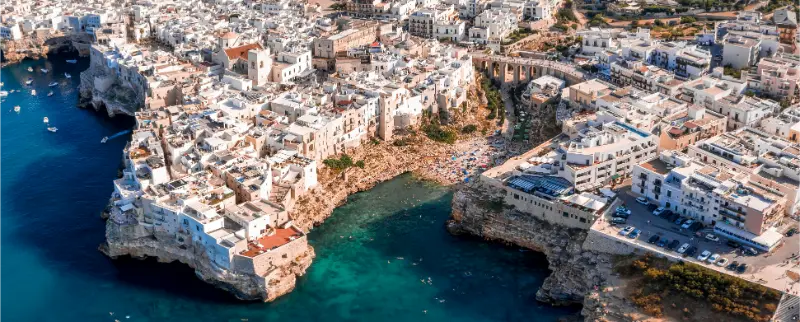
Begin on Ponte Lama Monachile, where you get the classic view down into the narrow cove. Then enter the historic centre through Arco Marchesale and continue towards Piazza Vittorio Emanuele II.
From here, follow the small lanes that lead towards the cliff edge. Several terraces suddenly open above the Adriatic and provide better views of Polignano’s coastline than the crowded beach itself.
The historic centre can be explored in around 90 minutes, but half a day is more realistic if you want to stop for lunch, walk along the cliffs or swim.
Lama Monachile is a pebble beach rather than a broad sandy beach and becomes extremely crowded in July and August. For photographs, early morning is far better. If swimming is your priority, there are more comfortable beaches elsewhere along the coast.
A boat trip is one of the experiences that genuinely adds something to a visit to Polignano. The sea caves and high limestone cliffs are much easier to appreciate from water level.
Polignano is also particularly convenient without a car because the railway station is within walking distance of the historic centre.
Allow half a day, or a full day if you include a boat tour and swimming.
3. Spend an Evening Around Monopoli’s Porto Antico
Monopoli is less theatrical than Polignano a Mare but often more enjoyable if you want to spend several hours in a real coastal town rather than simply visit a famous viewpoint.
Start around Piazza Garibaldi before walking down towards Porto Antico. The small harbour, with its traditional blue fishing boats, is one of the most attractive corners of the town.
Continue towards Castello Carlo V and follow the waterfront around the defensive walls. From here you eventually reach Cala Porta Vecchia, a small urban beach immediately below the old town.
Do not miss the Basilica Cattedrale Maria Santissima della Madia, located only a short walk inland.
Monopoli works particularly well in late afternoon. Visit the cathedral and historic lanes first, then reach the harbour as the light begins to soften. The waterfront becomes increasingly lively towards dinner time without feeling quite as compressed as central Polignano.
If beaches are a priority, continue south of Monopoli towards Capitolo, where the coastline offers more sandy coves and beach facilities.
Allow around 4 to 6 hours.
4. Explore Alberobello Before the Crowds Arrive
Alberobello deserves its international reputation, but the time of day makes an enormous difference.
Begin at Belvedere Santa Lucia, where you get one of the classic views across the conical roofs of Rione Monti. From there, descend into the district and walk Via Monte San Michele and the smaller streets around it.
Rione Monti contains the largest concentration of trulli but is also the most commercial part of Alberobello. Many buildings now house souvenir shops and small businesses.
For a different atmosphere, cross towards Rione Aia Piccola. This district contains fewer shops and feels considerably more residential. Visitors who see only Rione Monti often leave without experiencing this quieter side of Alberobello.
If you want to understand how a larger trullo is organised internally, continue towards Trullo Sovrano.
Two to three hours is usually sufficient for Alberobello. Arriving before around 9:00 is one of the best strategies in summer. Late afternoon can also be pleasant after some organised tours have left.
Parking demand becomes very high in peak season. Rather than trying to stop as close as possible to Rione Monti, choose an authorised parking area outside the most congested streets and walk into the centre.
Allow around 2 to 4 hours.
5. Explore the Valle d’Itria
One of the most rewarding things to do in Puglia is not a single monument but a slow drive through the Valle d’Itria.
The countryside between Alberobello, Locorotondo, Cisternino and Martina Franca is characterised by trulli, dry-stone walls, olive trees and small rural roads.
Locorotondo is an excellent short stop. Walk through the white historic centre and continue along Via Nardelli, often compared to a seafront promenade despite being surrounded by countryside. From here there are wide views over the valley.
Cisternino is smaller and particularly enjoyable around Piazza Vittorio Emanuele II and the lanes leading towards Via San Quirico.
Martina Franca deserves more time. Piazza Roma, Palazzo Ducale, Piazza Plebiscito and the Basilica di San Martino form a compact but elegant historic centre with a noticeably different character from the smaller white villages.
If you have only one day, avoid attempting Alberobello, Locorotondo, Cisternino and Martina Franca all at speed. Alberobello plus Locorotondo and Martina Franca is already a full and satisfying day.
Allow one full day.
6. Visit Ostuni in the Late Afternoon
Ostuni is one of those places whose position is almost as impressive as its historic centre. The white town rises above an extensive plain of olive trees with the Adriatic visible in the distance.
Begin at Piazza della Libertà and follow Via Cattedrale uphill. This creates a logical route through the historic centre without unnecessary backtracking.
The street eventually reaches the Cathedral of Santa Maria Assunta, one of the main landmarks of the upper town.
From the cathedral, explore the narrow lanes around the summit and follow sections of the outer walls for views across the surrounding countryside.
Ostuni is particularly beautiful from late afternoon into sunset. In July and August, walking uphill through the old town during the middle of the day can be tiring and the intense light tends to flatten the views.
The railway station is outside the historic centre, so travellers arriving by train need to use a bus or taxi connection to reach the hilltop town.
If driving, do not waste time searching for parking in the upper streets. Park below the historic centre and walk uphill. Some areas close to the centre are subject to traffic restrictions.
Allow around 3 to 5 hours.
7. Explore the Grotte di Castellana
The Grotte di Castellana are one of Puglia’s most impressive natural attractions and particularly useful on a very hot summer day.
There are normally different visit itineraries, including a shorter route and a complete route that reaches the famous Grotta Bianca.
The complete itinerary extends for roughly 3 kilometres and normally takes around 100 minutes, while the shorter visit takes around 50 minutes.
If time and mobility allow, the complete itinerary is the better choice. The experience changes considerably as you move deeper into the cave system and the Grotta Bianca is one of the highlights.
Wear comfortable shoes with good grip. Surfaces can be damp and there are steps and long underground sections.
Arrive before your scheduled entry rather than planning to reach the ticket office at the exact starting time. Opening hours, ticket prices and available tours can change, so check the official information before travelling.
Allow around 2 to 3 hours in total.
8. Visit Castel del Monte
Castel del Monte is one of the most distinctive buildings in southern Italy. The 13th-century castle associated with Frederick II stands isolated above the Alta Murgia landscape and is famous for its unusual octagonal design.
The most important thing to understand before visiting is that this is not a castle filled with royal furniture, decorated rooms or elaborate collections.
The interest lies in its architecture, mathematical proportions, stonework, historical interpretation and position within the landscape.
Most travellers need around one hour inside. Spend some additional time walking around the exterior because the building changes noticeably depending on the angle from which you view it.
Castel del Monte is considerably easier to reach by car than by public transport. It combines naturally with Andria, Trani, Gravina in Puglia or other stops in the Alta Murgia area.
Allow around 2 hours on site and approximately half a day including travel.
9. Walk From Trani Harbour to the Cathedral
Trani has one of the most beautiful waterfront settings in Puglia.
Rather than driving directly to the cathedral, begin at the harbour and walk around the waterfront. Fishing boats, restaurants and pale stone buildings create a relaxed approach towards the historic centre.
Continue towards the Cathedral of San Nicola Pellegrino, positioned almost directly beside the Adriatic.
The cathedral is one of the great examples of Puglian Romanesque architecture and its location makes it particularly striking late in the day.
Nearby stands Castello Svevo. After visiting the waterfront monuments, continue through the historic streets behind them before eventually returning towards the harbour.
Late afternoon is the best time for this route. The cathedral’s pale stone becomes warmer as the sun lowers, and the harbour is a natural place to remain for an evening walk or dinner.
Trani is also convenient without a car because the railway station is within reasonable walking distance of the waterfront.
Allow around 3 to 5 hours.
10. Discover Baroque Lecce
Lecce is a city to explore slowly. Its Baroque architecture is full of small sculptural details that are easily missed when moving quickly between monuments.
A useful walking route begins at Porta Napoli and continues along Via Palmieri towards Piazza Duomo.
From Piazza Duomo, walk towards the Church of Sant’Irene and then Piazza Sant’Oronzo before continuing to the Basilica di Santa Croce.
Santa Croce deserves more than a quick photograph. Move close to the façade to appreciate the decorative stonework before stepping back to see the whole composition.
In summer, avoid scheduling the entire historic-centre walk between midday and 16:00. Lecce’s pale stone streets can become extremely hot and shade is limited.
The city is excellent in the evening. Piazza Sant’Oronzo, Via Trinchese and the surrounding streets become lively after sunset, while quieter lanes remain only a few minutes away.
Drivers should park outside the historic core and pay close attention to ZTL signs. Access regulations can change and electronic signs at the entrance to restricted areas should always take priority over old information found online.
Allow one full day.
11. Explore Otranto’s Old Town and Sea Walls
Otranto is compact enough to explore in half a day but has more to offer than its waterfront.
Enter through Porta Alfonsina and head towards the Cathedral of Santa Maria Annunziata.
The cathedral’s enormous medieval mosaic floor is one of the most important works of its type in southern Italy and deserves time rather than a quick stop.
Continue towards Castello Aragonese and then follow the sea walls before descending towards Lungomare degli Eroi.
If you only have a couple of hours, prioritise the cathedral, historic lanes and sea views. The castle interior can be omitted if necessary.
Late afternoon into evening is particularly pleasant as some day visitors leave and temperatures fall.
Allow around 4 to 6 hours.
12. Swim at Baia dei Turchi
Baia dei Turchi, north of Otranto, is one of the most popular sandy beaches on the Adriatic side of Salento.
It combines pale sand, clear water and Mediterranean vegetation, but it should not be treated as a hidden beach.
In July and August, arrive early. By late morning parking areas and access routes can become busy.
Cars do not simply park beside the water. Visitors generally use designated parking areas closer to the SP366 and continue on foot or use seasonal transport where available.
The sandy entry and relatively shallow water make the area attractive for families compared with many rockier sections of the Adriatic coast.
If you are sightseeing rather than spending an entire day at the beach, two or three hours here followed by Otranto creates a very good combination.
Allow around 2 to 4 hours.
13. Visit Grotta della Poesia and Roca Vecchia
Grotta della Poesia is one of the most photographed natural pools in Salento, but old images online can create the wrong expectation.
The grotto is part of the archaeological landscape of Roca Vecchia, between San Foca and Torre dell’Orso, and visitor access is managed to protect the site.
Do not plan the visit around swimming or cliff jumping. The value of the stop is now the combination of coastal scenery, geology and archaeology.
After visiting, continue to one of the nearby beaches if you want to swim.
One hour is normally enough for the main archaeological area, although guided visits naturally require longer.
Check current admission conditions before visiting because access rules can change.
14. Spend an Evening in Gallipoli
Gallipoli’s historic centre occupies an island connected to the modern city by a bridge.
Cross towards the old town and begin around Castello Angioino-Aragonese before entering the maze of streets behind it.
Visit the Cathedral of Sant’Agata and continue around the perimeter of the island towards Spiaggia della Purità, the small beach directly beneath the historic walls.
Gallipoli is considerably more enjoyable in late afternoon and evening than during the hottest hours of a summer day.
As temperatures fall, residents and visitors return to the waterfront and restaurants begin filling the streets.
Gallipoli is also one of the strongest choices in Puglia for summer nightlife. Travellers looking for quiet evenings may prefer Otranto, Nardò or smaller coastal towns.
Allow half a day and ideally stay through dinner.
15. Walk Through the Pine Forest to Porto Selvaggio
Porto Selvaggio is very different from a conventional resort beach.
The bay lies within a protected natural area and cannot be reached by simply parking beside the sea.
Visitors leave their cars outside the protected zone and follow walking paths through Mediterranean vegetation and pine forest towards the coast.
The shore itself is predominantly rocky rather than sandy. Freshwater springs enter the sea in the area, creating noticeably colder patches of water.
Wear proper sandals or trainers for the walk. Flip-flops are less practical, particularly on the return climb.
Avoid carrying unnecessary beach equipment. The walk feels considerably longer when transporting umbrellas, coolers and bags in high summer temperatures.
Families with very small children should consider whether the walking approach and rocky access suit their needs before choosing Porto Selvaggio over an easier sandy beach.
Allow half a day.
16. Spend a Beach Day at Torre Guaceto
Torre Guaceto offers one of the most attractive protected stretches of the central Adriatic coast.
The reserve combines dunes, Mediterranean vegetation, wetlands and a protected marine environment.
Access is managed rather than allowing unrestricted parking immediately beside the beach. Depending on the season and chosen access point, visitors may use designated parking areas and continue towards the coast on foot or with seasonal services.
This slightly less convenient access is part of what prevents Torre Guaceto from feeling like a completely urbanised beach resort.
It works especially well for travellers looking for a natural coastal environment rather than rows of restaurants and beach clubs.
Check the official reserve information before visiting because summer access arrangements can vary.
Allow half a day to a full day.
17. Watch the Evening Light at Santa Maria di Leuca
Santa Maria di Leuca sits at the southern end of Salento and works particularly well as the final stop on a coastal road trip.
Begin above the town around the Basilica di Santa Maria de Finibus Terrae and the lighthouse, where you get a wide view over the coastline.
Then descend towards the seafront and continue towards Punta Ristola.
The popular idea that the Adriatic and Ionian seas can always be seen as two dramatically different colours meeting in a clear line is exaggerated, but Leuca still has a strong sense of being at the geographical end of the peninsula.
Late afternoon is the best time to visit the exposed viewpoints around the lighthouse and Punta Ristola, particularly in summer.
Leuca is also a useful departure point for boat excursions along coastal caves.
Allow around 3 to 5 hours or stay overnight if taking a boat tour.
18. Drive the Gargano Coast Between Vieste and Peschici
The Gargano feels distinctly different from central and southern Puglia.
Instead of relatively flat countryside, roads climb between wooded hills before descending towards limestone cliffs, coves and beaches.
Vieste is the most versatile base for first-time visitors. Its historic centre extends towards Punta San Francesco and the town gives easy access to beaches, boat trips and inland Gargano excursions.
Peschici is smaller and particularly attractive in the evening.
The coastal drive between the two towns looks short on a map but takes longer than expected because of bends, changes in elevation and summer traffic.
Do not treat the route as a simple transfer. Leave time for scenic stops at official parking areas and viewpoints.
At least two nights are needed for the Gargano. Three or four nights are much better if you also want Foresta Umbra and a boat excursion.
19. Take a Boat Trip Along the Gargano Coast
The limestone coast south of Vieste is one of the best areas in Puglia to explore by boat.
High cliffs conceal sea caves and small coves that are difficult to appreciate from the road.
Boat excursions generally depart during the warmer months, with itineraries depending on sea conditions.
A morning departure is often preferable because temperatures are lower and sea conditions can be calmer, although this is never guaranteed.
Do not build an inflexible itinerary around a specific boat trip. Strong wind or rough sea can alter or cancel departures.
After the excursion, spend the rest of the day in Vieste rather than immediately committing to a long drive across the region.
Allow half a day.
20. Walk Through Foresta Umbra
After several days on the coast, Foresta Umbra reveals a completely different side of Puglia.
The dense woodland forms part of Gargano National Park and includes large areas of beech forest.
There are short walking routes suitable for a relaxed excursion as well as longer hiking and cycling options.
The forest is particularly appealing during a summer heatwave because temperatures under the trees can feel considerably more comfortable than on exposed beaches and city streets.
Driving distances inside the Gargano can again be deceptive. Forest roads are winding, so do not schedule too many unrelated stops on the same day.
Allow around 2 to 5 hours.
21. Visit the Tremiti Islands
The Tremiti Islands lie offshore from the Gargano and offer one of Puglia’s most distinctive marine landscapes.
San Domino is the greener island and is generally the better choice for swimming, small coves and coastal scenery.
San Nicola has greater historical interest, with its fortified settlement and abbey complex.
A day trip is possible, but travellers who stay overnight have far more time to appreciate the islands after the busiest excursion boats leave.
August can be extremely busy. June and September generally provide a better balance between warm weather and visitor numbers.
Sea conditions should always be checked before departure, particularly for anyone sensitive to boat movement.
Allow one full day at minimum.
22. Visit Monte Sant’Angelo
Monte Sant’Angelo is one of the most historically significant towns in the Gargano.
Its main attraction is the Sanctuary of San Michele Arcangelo, where the sacred space is partly built around a natural grotto below ground level.
The experience is very different from visiting a conventional church and explains the town’s long association with pilgrimage.
Afterwards, walk through the white historic centre and take time to appreciate the elevated views over the Gargano landscape.
Expect slopes, steps and irregular paving. Travellers with mobility difficulties should check access information before arriving.
Monte Sant’Angelo combines naturally with other Gargano attractions rather than as a separate trip from central or southern Puglia.
Allow around 2 to 3 hours.
23. Discover Gravina in Puglia
Gravina in Puglia reveals an inland landscape that many first-time visitors never associate with the region.
The town sits beside a deep ravine in the Alta Murgia area and combines historic streets with caves, rock-cut structures and dramatic views.
Walk through the old centre and cross the stone bridge spanning the ravine. The view from the opposite side gives a much better understanding of Gravina’s unusual geography.
This is particularly rewarding in spring and autumn, when temperatures make walking around the exposed ravine landscape more comfortable.
Gravina combines well with Altamura and can also form part of a wider inland itinerary including Castel del Monte.
Allow half a day.
24. Visit the MArTA Museum in Taranto
Taranto is often omitted from first-time Puglia itineraries, but travellers interested in archaeology should seriously consider the Museo Archeologico Nazionale di Taranto, commonly known as MArTA.
The museum contains major collections connected with Magna Graecia and the ancient history of southern Italy, including the famous gold objects known as the Ori di Taranto.
Allow at least two hours rather than attempting to rush through the collections.
Afterwards, continue towards the swing bridge and the old city.
Taranto feels very different from carefully restored tourist towns such as Alberobello or Polignano a Mare. It remains a large working city, and that contrast is part of its interest.
Allow half a day to one full day.
25. Explore the Ceramics District of Grottaglie
Grottaglie is one of the best places in Puglia to buy ceramics directly in a town where they are actually produced.
Its Quartiere delle Ceramiche is centred around workshops near Via Francesco Crispi and the area below Castello Episcopio.
Do not simply choose the first shop you see. Walk through several workshops because styles vary considerably, from rustic traditional pieces to contemporary designs.
Grottaglie makes an excellent two or three-hour stop when travelling between the Valle d’Itria and Taranto.
It is also a useful alternative on a day when weather conditions make the beach less appealing.
Allow around 2 to 3 hours.
Best Beaches in Puglia: Which Coast Should You Choose?
Puglia does not have one uniform type of beach.
The Adriatic coast around Bari and Polignano a Mare frequently alternates between rocky areas, small coves and limited stretches of sand.
Farther south, the coast around Otranto combines sandy beaches such as Baia dei Turchi and Alimini with rocky sections towards the southern Adriatic.
The Ionian side of Salento generally offers more long sandy beaches and shallow water. Areas around Porto Cesareo and the coast towards Pescoluse are particularly popular with families.
Travellers who prefer rocky swimming and natural scenery may enjoy Porto Selvaggio more.
In the Gargano, beaches sit beneath higher limestone cliffs and wooded promontories, creating some of the region’s most dramatic coastal landscapes.
Wind is worth considering in Salento. Conditions on the Adriatic and Ionian sides can differ substantially on the same day. If you have a car, check the morning weather and wind forecast before deciding where to swim rather than fixing every beach several days in advance.
Where to Eat and What to Try in Puglia
The most interesting way to eat in Puglia is to try foods in the areas where they are most strongly associated rather than ordering the same generic regional menu in every town.
In Bari, focaccia barese, panzerotti and fresh pasta deserve particular attention. Strada Arco Basso in Bari Vecchia remains strongly associated with handmade orecchiette.
In the Valle d’Itria, especially around Cisternino, butcher shops with traditional fornelli are part of the local food culture. Bombette, small rolls of seasoned meat, are one of the characteristic dishes to try here.
Around Altamura and Gravina, bread and focaccia become particularly important.
In coastal towns such as Monopoli, Trani, Gallipoli and Otranto, fresh seafood naturally plays a larger role.
Restaurants facing the most famous square or viewpoint are not automatically bad, but it is worth walking one or two streets away from the main tourist route before deciding where to eat. This is particularly useful in heavily visited destinations such as Alberobello and Polignano.
Summer dinners begin relatively late. Many historic centres become more attractive after 20:00, when temperatures drop and locals return to the streets.
Where to Stay in Puglia
For current accommodation options, compare hotels and apartments on Booking.com.
Bari: Best for Public Transport
Bari is one of the most practical bases if you do not want to rent a car.
Regional trains provide convenient connections to Polignano a Mare, Monopoli and other towns along the Adriatic corridor.
Bari Vecchia is the most atmospheric area, while the Murat district is generally more convenient for Bari Centrale, shops and luggage transfers.
Valle d’Itria: Best for Couples and Road Trips
Locorotondo, Martina Franca, Cisternino and the countryside between them are excellent choices for travellers with a car.
Staying in a countryside masseria gives you the classic rural Puglia atmosphere but usually means driving for dinner and evening walks.
Staying inside Locorotondo or Martina Franca is more practical if you want restaurants and cafés within walking distance.
Lecce: Best Base for Exploring Salento
Lecce combines architecture, restaurants, nightlife and good access to much of Salento.
Choose Lecce if sightseeing and evening atmosphere matter more than being directly beside the sea.
If you want to walk to the beach every morning, Otranto, Gallipoli or another coastal base will be more suitable.
Gallipoli: Best for Nightlife
Gallipoli is particularly popular with travellers interested in beaches and summer nightlife.
Families or couples seeking quieter evenings may prefer accommodation outside the busiest central areas.
Vieste: Best for the Gargano
Vieste is the most versatile Gargano base for combining beaches, boat excursions, Foresta Umbra and coastal drives.
Do not attempt to see the Gargano as a day trip from Bari, the Valle d’Itria or Salento. The distances and roads make at least two nights far more sensible.
How to Get to Puglia
Puglia’s main airports are Bari Karol Wojtyła Airport and Brindisi Airport.
Bari is generally the most convenient gateway for Bari itself, Polignano a Mare, Monopoli, Alberobello, the Valle d’Itria and northern Puglia.
Brindisi is particularly convenient for Lecce and southern Salento.
Long-distance trains connect Puglia with major Italian cities, including services towards Foggia, Bari, Brindisi and Lecce.
If you are flying to Puglia, compare flights to Bari and Brindisi with Skyscanner.
Do You Need a Car in Puglia?
You can organise a good Puglia trip without a car if your itinerary focuses on major towns along the railway network.
Bari, Polignano a Mare, Monopoli, Trani and Lecce are particularly straightforward by train.
A car becomes much more useful for the Gargano, rural masserie, Torre Guaceto, Porto Selvaggio, smaller Salento beaches, Alta Murgia and multi-stop days through the Valle d’Itria.
Do not underestimate driving time. Puglia is a long region and roads in the Gargano are often winding.
If you plan to drive, compare rental-car prices with DiscoverCars.
Parking and ZTLs in Puglia
Many historic centres contain pedestrian areas or restricted traffic zones known as ZTLs.
Do not follow a navigation app blindly into an old town. Always pay attention to road signs and electronic displays marking active restricted areas.
This is particularly important in larger historic centres such as Bari and Lecce and in busy tourist towns where access rules may change seasonally.
In Alberobello, Polignano a Mare, Ostuni and other highly visited destinations, parking 10 to 20 minutes on foot from the main attraction is often less stressful than driving around central streets searching for a slightly closer space.
Best Time to Visit Puglia
May, June and September offer the best overall balance for most travellers.
May
May is excellent for cities, countryside, walking and road trips. Temperatures are generally comfortable, although the sea can still feel cool.
June
June combines long days, increasingly reliable beach weather and lower visitor numbers than August.
July
July is excellent for the coast but hot for sightseeing. Visit towns early in the morning, take a slower break during the hottest part of the afternoon and return outside from around 17:00 onwards.
August
August is the busiest period, particularly around Ferragosto. Beaches, Alberobello, Polignano a Mare and the main Salento resorts can become extremely crowded.
Accommodation should be booked well in advance and famous attractions are best visited early.
September
September is one of the best months for Puglia. The sea remains warm, temperatures are generally more comfortable and visitor numbers begin to fall.
October
October is attractive for food, cities, countryside and road trips but less reliable if the main purpose of the holiday is swimming.
How Many Days Do You Need in Puglia?
Four days is enough only if you concentrate on one section of the region.
With four days, focus on Bari, Polignano a Mare, Monopoli, Alberobello and part of the Valle d’Itria.
Seven days allows you to combine central Puglia with Lecce and part of Salento.
Ten days creates a much more comfortable itinerary.
If you also want to visit the Gargano, plan around 12 to 14 days rather than attempting to cross the entire region every day.
A Realistic 7-Day Puglia Itinerary
Day 1: Bari and Bari Vecchia.
Day 2: Polignano a Mare and Monopoli.
Day 3: Alberobello, Locorotondo and the Valle d’Itria.
Day 4: Ostuni and transfer to Lecce.
Day 5: Lecce.
Day 6: Otranto, Baia dei Turchi and Roca Vecchia.
Day 7: Porto Selvaggio or Gallipoli.
Do not add the Gargano to this itinerary unless you remove several destinations from central or southern Puglia.
A 10-Day Puglia Itinerary
With ten days, spend the first three or four nights around Bari or the Valle d’Itria.
Continue with three nights in Lecce or elsewhere in Salento.
Use the remaining days for either the Gargano or an inland itinerary through Alta Murgia, Gravina, Grottaglie and Taranto.
For most first-time visitors, adding two or three nights in the Gargano creates more variety than visiting another series of similar white villages.
Visiting Puglia With Children
Puglia works well for families, but the easiest places are not always the most famous.
Monopoli is generally easier than Polignano a Mare for combining a historic centre with a simple swim.
Long sandy beaches along the Ionian coast are often more practical with small children than rocky swimming areas along parts of the Adriatic.
The Grotte di Castellana can be an excellent summer activity because temperatures underground are cooler, although the longer itinerary involves considerable walking.
Porto Selvaggio is beautiful but requires walking with whatever beach equipment you bring.
Historic centres such as Ostuni and Monte Sant’Angelo include steep sections, steps and irregular stone surfaces that can make pushchairs inconvenient.
Accessibility in Puglia
Many of Puglia’s most attractive historic centres were not designed for easy modern accessibility.
Ostuni, Locorotondo, Monte Sant’Angelo and several Gargano towns contain steep streets or uneven paving.
Porto Selvaggio requires a walking approach.
Individual beaches may involve sand, rocks, steps or informal access paths.
Travellers with reduced mobility should check the individual accessibility arrangements for caves, castles, archaeological sites and beaches before travelling rather than assuming that all major attractions are step-free.
Is Puglia Worth Visiting?
Yes, but Puglia is not worth visiting because of one single spectacular attraction.
Its strength lies in the contrast between different experiences: walking through Bari Vecchia in the morning, seeing Trani’s Romanesque cathedral beside the Adriatic, driving through the trulli countryside of the Valle d’Itria, exploring Baroque Lecce, swimming along the Salento coast and spending several days among the cliffs and forests of the Gargano.
The biggest mistake is trying to see everything.
Choose fewer bases, minimise unnecessary driving, visit the most famous towns early and leave part of the itinerary unstructured enough to stop at smaller places along the way.
Frequently Asked Questions About Puglia
What are the best things to do in Puglia for a first visit?
For a first trip, prioritise Bari Vecchia, Polignano a Mare, Monopoli, Alberobello, the Valle d’Itria, Ostuni, Lecce and at least one section of the Salento coast. Add the Gargano if you have around ten days or more.
For bookable tours and activities, check current experiences on GetYourGuide.
Is Alberobello worth visiting?
Yes. The key is to arrive early or later in the afternoon and explore Rione Aia Piccola as well as the much more commercial Rione Monti. Around two to three hours is enough for most visitors.
Is Polignano a Mare or Monopoli better?
Polignano a Mare is more dramatic and better for cliff views, sea caves and photographs. Monopoli is better for a longer walk, harbour atmosphere, restaurants and easy access to beaches.
If you have a full day, the two towns combine very well.
Is Lecce worth staying overnight?
Yes. Lecce is particularly enjoyable in the evening after the temperature falls and many day visitors have left. It is also one of the most practical bases for exploring Salento.
Can you visit Puglia without a car?
Yes, particularly if you focus on Bari, Trani, Polignano a Mare, Monopoli and Lecce.
A car is much more useful if you want beaches, countryside accommodation, the Gargano, rural Valle d’Itria and a flexible Salento itinerary.
Which part of Puglia has the best beaches?
For long sandy beaches and shallow water, the Ionian coast of Salento is one of the strongest choices.
For dramatic cliffs, sea caves and smaller coves, consider the Gargano and southern Adriatic coast.
How many days are ideal for Puglia?
Seven days is a good minimum for a first trip. Ten days allows a much better balance between towns and beaches. Twelve to fourteen days is ideal if you also want to include the Gargano without rushing.
Is August a good time to visit Puglia?
August offers excellent beach weather but is the busiest period of the year. Visit famous towns early, book accommodation in advance and expect particularly heavy crowds around Ferragosto.
Where should first-time visitors stay in Puglia?
A combination of two or three bases works best. Use Bari or the Valle d’Itria for central Puglia, Lecce for Salento and Vieste if you include the Gargano.
“`