

Few buildings are as immediately associated with Puglia as the trulli of Alberobello. Their whitewashed walls and conical limestone roofs have become one of southern Italy’s most recognisable images, but seeing them in person is considerably more interesting than simply photographing a picturesque street.
Alberobello contains entire neighbourhoods built around this unusual architectural tradition. Some trulli are now shops, small museums, restaurants or holiday accommodation; others remain private homes. Understanding that difference is essential, because the town changes character dramatically from one street to another.
The Trulli of Alberobello have been a UNESCO World Heritage Site since 1996. UNESCO recognises them as exceptional examples of dry-stone construction, a building technique in which roughly worked limestone is assembled without mortar. Their characteristic roofs are formed from overlapping limestone slabs arranged in a corbelled structure.
For most travellers, the mistake is not spending too little time in Alberobello but spending that time almost entirely in the busiest streets of Rione Monti. A better visit combines the famous commercial district with residential Aia Piccola, the panoramic terraces around Santa Lucia, at least one trullo interior and the quieter northern side of town around Trullo Sovrano.
Why the Trulli of Alberobello Are So Special
Trulli exist throughout central Puglia, particularly across the Valle d’Itria and the countryside around Locorotondo, Martina Franca, Cisternino and Alberobello. What makes Alberobello exceptional is not simply the existence of individual trulli, but their concentration.
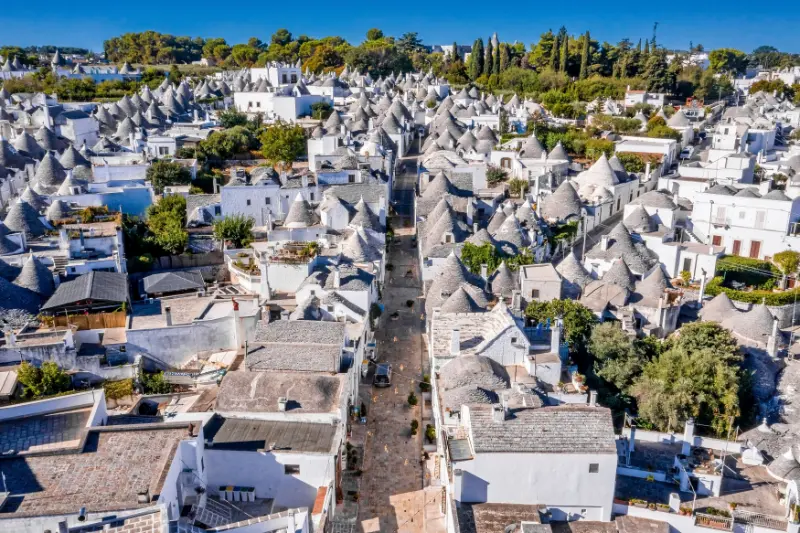
Instead of encountering an isolated trullo surrounded by olive groves, you can walk through streets where conical roofs extend across an entire hillside.
The UNESCO area preserves groups of trulli constructed principally from local limestone using a dry-stone building tradition with very old Mediterranean roots. The thick walls and progressively overlapping stone rings used to create the roofs are deceptively simple but technically sophisticated.
A trullo may look basic from outside, yet its design is closely connected to the local landscape, available materials and climate. The thick stone walls help moderate indoor temperatures, although anyone booking a restored trullo in midsummer should still check carefully whether modern air conditioning is provided.
The History of Alberobello’s Trulli
The history of Alberobello is more complicated than the popular story often repeated in quick tourist guides.
Dry-stone architecture existed in this part of Puglia long before Alberobello developed into the settlement visitors see today. Trulli therefore were not simply invented as a way to avoid taxes.
Alberobello’s unusual urban development is closely connected to the Acquaviva d’Aragona family, the feudal lords who controlled the area for centuries. Buildings constructed without mortar could theoretically be dismantled more easily than permanent masonry structures, and this characteristic became associated with attempts to circumvent restrictions and taxation connected with the establishment of permanent settlements.
The architectural technique itself was much older. What happened at Alberobello was that local political and economic circumstances encouraged an unusually large concentration of dry-stone buildings.
A major turning point came towards the end of the 18th century, when Alberobello was freed from feudal rule. Permanent construction using mortar became possible and the architecture of the town gradually changed.
Casa d’Amore, close to Piazza del Popolo, is traditionally associated with this transition and represents an important moment in Alberobello’s development.
Understanding the Roofs, Pinnacles and Painted Symbols
Look closely at the roofs and Alberobello becomes considerably more interesting.
The outer covering consists of thin limestone slabs, while many cones finish with a decorative pinnacle. These vary in shape and are sometimes interpreted as stylistic marks connected with individual builders.
You will also notice white symbols painted onto several roofs, particularly in Rione Monti. Crosses, hearts, celestial shapes, religious monograms and other motifs appear repeatedly.
They are sometimes presented to visitors as though every symbol had one ancient and universally accepted meaning. Reality is less straightforward. Some clearly have religious associations, while others are later decorative or symbolic additions, and interpretations can vary.
Rather than trying to decode every roof, look at the structure itself: the way adjoining cones fit together, how several rooms can form a single dwelling and how much stone is required to construct what initially appears to be a very simple house.
The Two Trulli Districts You Should See
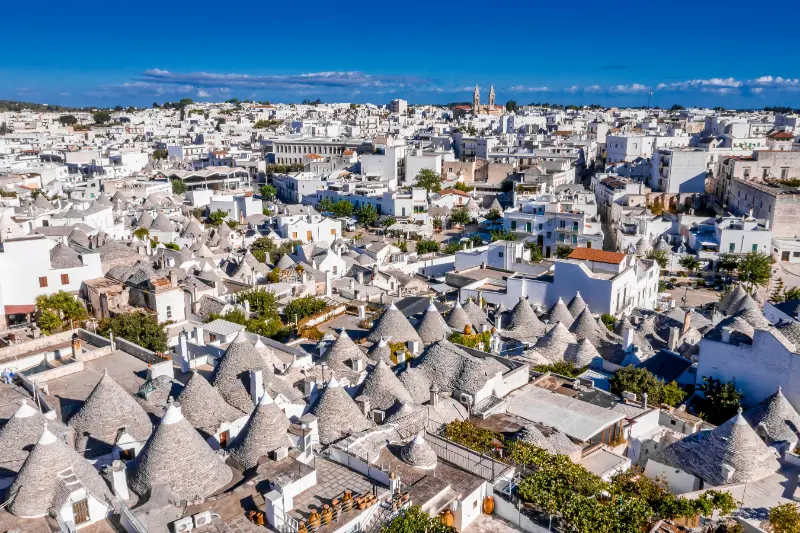
Alberobello is best understood through its two most important historic trulli districts: Rione Monti and Rione Aia Piccola.
You should visit both because they offer very different experiences.
Rione Monti
Rione Monti is the Alberobello most travellers recognise from photographs.
The neighbourhood rises opposite the modern centre and contains roughly a thousand trulli, forming the largest and most visually impressive concentration in town.
Some of the principal streets include Via Monte San Michele and Via Monte Sabotino, with numerous smaller lanes running between them.
This is Alberobello at its most theatrical: white façades, tightly packed conical roofs, stepped streets and small shops occupying former trulli.
It is also the most commercial part of town.
Many buildings contain souvenir shops, tasting rooms and small businesses. That does not make Rione Monti less worthwhile, but visitors who see only these streets may leave with a distorted impression of Alberobello.
Rather than walking straight up the busiest street and returning along the same route, climb one principal lane, move sideways through the connecting streets and descend through another. The side lanes often provide better photographs because several layers of trulli roofs can be framed together without shop entrances dominating the foreground.
Allow around 45 to 75 minutes if you enjoy photography and slow exploration.
Early morning is the best time to see Rione Monti with relatively empty streets. By late morning in summer, the main lanes can become crowded with organised groups and day visitors.
Rione Aia Piccola
Aia Piccola is quieter and, for many travellers, ultimately more rewarding.
The district contains hundreds of trulli, many of which remain private residences rather than souvenir shops or tourist businesses.
The difference is noticeable almost immediately. There are fewer commercial signs, less foot traffic and more evidence of ordinary neighbourhood life.
From the area around Piazza XXVII Maggio and Belvedere Santa Lucia, walk into Aia Piccola and explore its network of narrow streets at an unhurried pace. Via Giuseppe Verdi and the surrounding lanes are a useful starting point.
You do not need to follow a rigid route here. Part of the pleasure comes from taking the smaller streets and noticing how individual trulli are connected to courtyards, gardens and more recent buildings.
Allow around 30 to 45 minutes.
Remember that many trulli are real homes. Doorways, staircases and courtyards that look perfect for photographs may belong to private residents.
Best Viewpoints in Alberobello
Belvedere Santa Lucia
If you want the classic panorama of Alberobello, this is the place to start.
The terrace beside the Church of Santa Lucia looks directly across towards Rione Monti and offers one of the best views of dozens of conical roofs layered across the opposite slope.
It is also extremely convenient because it sits between the modern centre and Aia Piccola.
Morning usually provides easier photographic conditions and fewer people. Around sunset the atmosphere can be excellent, although the viewpoint generally becomes busier.
Do not necessarily take your photograph from the exact centre of the terrace. Walk a few metres along the railing and watch how the roofs overlap. Small changes in position can remove modern rooftops or distracting foreground objects from the frame.
Allow 10 to 15 minutes, or longer around sunset.
The Steps Below Santa Lucia
Many visitors photograph the panorama from Belvedere Santa Lucia and immediately leave.
Instead, descend towards Largo Martellotta and pause partway down. The lower angle gives a more intimate perspective of Rione Monti and can be particularly useful when the main terrace is crowded.
It is a small detour that takes only a few minutes.
The Upper Streets of Rione Monti
Continue all the way uphill through Rione Monti rather than spending your entire visit around its lowest streets.
Near the Church of Sant’Antonio, the upper lanes provide attractive views back over the trulli roofs. These are not wide panoramic viewpoints like Santa Lucia. Their appeal comes from the way roofs, pinnacles, chimneys and whitewashed walls overlap at close range.
Late afternoon can be particularly attractive here.
The Best Walking Route Through Alberobello
A logical walking route makes a significant difference because it prevents unnecessary climbing and backtracking.
Start around Piazza del Popolo and walk towards the Church of Santa Lucia and Belvedere Santa Lucia.
After enjoying the panorama, explore nearby Aia Piccola while the streets are still relatively quiet.
Return towards Largo Martellotta and cross into Rione Monti.
Walk uphill through Via Monte San Michele or one of the parallel streets, making occasional sideways deviations into quieter lanes.
Continue towards the Church of Sant’Antonio at the top of the district.
Instead of retracing your steps, descend through a different street.
From the modern centre, continue north past Piazza del Popolo and Casa d’Amore towards the Basilica dei Santi Medici Cosma e Damiano and Trullo Sovrano.
This route gives you a natural progression from panoramic views to residential trulli, commercial Rione Monti and finally the quieter northern part of town.
Church of Sant’Antonio
At the upper end of Rione Monti stands the Church of Sant’Antonio da Padova, built during the 20th century using forms deliberately inspired by trullo architecture.
Its large conical roof makes it instantly recognisable.
The church is interesting because it shows how the visual language of traditional trulli was adapted to a much larger religious building.
You do not need a long visit. Around 10 to 15 minutes is sufficient for most travellers.
The walk to the church is just as important as the building itself because it encourages you to explore the entire slope of Rione Monti instead of turning around after its first few commercial streets.
Trullo Siamese
Among the individual trulli of Rione Monti, Trullo Siamese is one of the most unusual.
Its structure is composed of adjoining cones associated with two connected sections of the building. A well-known local legend links the unusual layout with two brothers and a romantic dispute.
The story is entertaining, although the building itself is the real reason to make the detour.
You do not need to structure your visit around it. If you are already walking through Rione Monti, allow five to ten minutes.
Trullo Sovrano
If you enter only one historic trullo in Alberobello, Trullo Sovrano is one of the best choices.
Located near Piazza Sacramento, north of the Basilica dei Santi Medici Cosma e Damiano, it is unusual because of its size and two-level structure.
The building dates mainly from the 18th century and today functions as a small museum illustrating domestic life inside a trullo.
Its interior is more informative than simply entering another trullo converted into a souvenir shop, because it helps visitors understand how these buildings functioned as real homes.
Allow around 20 to 30 minutes.
Opening times and admission prices can change, so check the current information before organising your day around the visit.
Trullo Sovrano is slightly removed from Rione Monti, which is actually an advantage. The walk there takes you through a quieter section of Alberobello and shows you more of the ordinary town beyond the main tourist streets.
Basilica of Saints Cosmas and Damian
The Basilica dei Santi Medici Cosma e Damiano stands on the northern side of central Alberobello and offers a striking architectural contrast with the trulli.
If you are already walking towards Trullo Sovrano, it makes sense to stop here rather than treating the basilica as a separate attraction.
The church is closely associated with Alberobello’s devotion to Saints Cosmas and Damian, whose religious celebrations are among the town’s most important traditions.
Even if you do not spend long inside, the square and façade help place the trulli within a town that continued to evolve after the period of traditional dry-stone construction.
Allow around 10 to 20 minutes.
Casa d’Amore
Casa d’Amore is easy to overlook because visually it cannot compete with the trulli of Rione Monti.
Historically, however, it is an important building.
Located close to Piazza del Popolo, it is associated with Alberobello’s liberation from feudal rule and the transition towards permanent construction using mortar.
This is one of those sights that becomes much more interesting once you understand the history behind it. Without that context, it is easy to walk past.
Allow five to ten minutes.
Museo del Territorio – Casa Pezzolla
Casa Pezzolla, in Piazza XXVII Maggio, is a complex of interconnected trulli associated with the history, architecture and rural culture of Alberobello.
The structure is particularly useful for understanding how individual trullo units could be connected to form a larger dwelling.
If open during your visit, it is worthwhile for travellers who want to go beyond photography and understand how trulli actually functioned.
Opening arrangements can change, so verify the current status before relying on the museum as a fixed part of your itinerary.
Allow around 30 to 45 minutes.
If you have very limited time and need to choose only one interior visit, Trullo Sovrano is generally the more straightforward introduction.
What Can You Skip If You Have Limited Time?
You do not need to enter every trullo advertising a panoramic terrace, tasting room or small museum.
Some commercial trulli allow visitors onto rooftops or terraces, often while encouraging them to browse the shop below. These can be pleasant, but after one good interior and the main public viewpoints, the experience becomes repetitive.
If you have only two hours, prioritise Belvedere Santa Lucia, Aia Piccola, Rione Monti and one historic trullo interior.
Reaching Sant’Antonio is worthwhile because it gives the Rione Monti walk a natural endpoint.
Casa d’Amore, Casa Pezzolla and the basilica become more worthwhile if you have at least half a day.
Best Time of Day to Visit the Trulli
Early Morning
Early morning is the best period for quiet streets and photography.
Rione Monti is much more enjoyable before organised groups and day visitors fill the main lanes. The white walls also photograph better before the summer light becomes extremely harsh.
If you are sleeping in Alberobello, take advantage of it and walk through Rione Monti before breakfast.
Late Morning and Early Afternoon
This is generally the least enjoyable time during summer.
Crowds increase, the limestone reflects intense sunlight and the uphill streets of Rione Monti can become very hot.
Use the hottest hours for lunch, a museum visit or a break rather than trying to cover every lane at midday.
Late Afternoon and Evening
Alberobello becomes pleasant again as temperatures fall.
The main streets remain lively, but many day-trip groups gradually leave town.
After dinner, Rione Monti looks completely different under artificial lighting. Staying into the evening is one of the strongest reasons not to treat Alberobello as a quick two-hour stop.
How Long Do You Need in Alberobello?
For the main trulli districts and attractions, three to four hours is enough for a satisfying first visit.
Two hours works if you concentrate on the essential sights.
Half a day allows you to explore both districts, visit Trullo Sovrano, see the main churches and stop for food without rushing.
A full day makes sense if you are particularly interested in architecture or photography, or if you want to take a long lunch and return to the streets in softer evening light.
One night is especially worthwhile in summer because you can experience Alberobello after many day visitors have left and again early the following morning.
You generally do not need two complete days exclusively for central Alberobello. A second day is better used to explore the surrounding Valle d’Itria.
Half-Day Alberobello Itinerary
Start at Belvedere Santa Lucia for the classic panorama.
Spend around 30 minutes walking through Aia Piccola.
Return towards Largo Martellotta and enter Rione Monti.
Walk gradually uphill through Via Monte San Michele and the surrounding lanes.
Continue to the Church of Sant’Antonio.
Descend through a different street towards the modern centre.
Walk through Piazza del Popolo, stop briefly at Casa d’Amore and continue towards the Basilica dei Santi Medici and Trullo Sovrano.
Allow approximately three to four hours including photographs and short visits.
One-Day Alberobello Itinerary
With a full day, do not try to stretch the same Rione Monti walk for hours.
Visit Rione Monti early in the morning while it is still relatively quiet.
Continue through Aia Piccola and visit Casa Pezzolla if open.
Walk through Piazza del Popolo, see Casa d’Amore, continue to the basilica and visit Trullo Sovrano before lunch.
During the hottest summer hours, stop for a long lunch or return to your accommodation.
Come back outside in late afternoon and revisit the Santa Lucia viewpoint under different light.
Have dinner in Alberobello and finish the day with a walk through the illuminated trulli.
This evening walk is one of the experiences most day visitors miss.
Parking in Alberobello
Do not try to drive directly into the historic trulli districts.
The central area contains pedestrian streets, traffic restrictions, narrow roads and large numbers of visitors. Leaving your car outside the busiest centre and walking is far easier.
Useful parking areas indicated by the municipality include Via Indipendenza, Via Colombo, Viale Morea, Piazzale Biagio Miraglia, Piazzale Piccinni and Piazzale Pietra Ficcata.
Via Indipendenza and Piazzale Biagio Miraglia are particularly useful names to consider when approaching the UNESCO districts rather than setting your navigation system directly for Rione Monti.
Parking charges and operating hours vary according to area and season, so always read the signs when you arrive rather than relying on an old online tariff.
Summer parking demand is considerably higher, especially from late morning onwards. Arriving before the main influx of day visitors makes both parking and sightseeing easier.
Before leaving the car, take a quick photograph of the parking sign showing the applicable hours and restrictions.
How to Get to Alberobello Without a Car
Alberobello can be visited without driving.
Ferrovie del Sud Est provides public transport connections with Bari and other towns in Puglia, although the exact combination of trains and buses can vary according to the timetable and engineering works.
Alberobello station is at Piazzale Kennedy.
From the station, allow approximately ten minutes on foot to reach the central area and around 10 to 15 minutes to reach the main trulli districts.
A day trip from Bari by public transport is realistic, but a car becomes much more useful if you intend to combine Alberobello with Locorotondo, Cisternino, Martina Franca or rural masserie on the same day.
Check the Ferrovie del Sud Est timetable for your exact travel date because schedules can change.
If you plan to drive, compare rental-car prices with DiscoverCars.
If you are flying to Puglia, compare flights to Bari and Brindisi with Skyscanner.
Getting Around Alberobello
Once you arrive, walking is the best way to explore.
The main attractions are concentrated within a relatively compact area and there is little reason to move your car between sights.
However, Alberobello is not completely flat.
Rione Monti rises uphill and some streets can be tiring during the hottest part of the day. Historic paving is also uneven in places, so comfortable footwear is important.
Accessibility
Alberobello is not uniformly easy for travellers with reduced mobility.
The main central streets and squares are relatively straightforward, but gradients, steps and irregular paving complicate some routes through the historic districts.
The direct connection between Belvedere Santa Lucia and Largo Martellotta includes steps. Visitors who need to avoid stairs can reach the upper area through the surrounding streets instead.
Historic trulli themselves can have narrow interiors and architectural constraints that make access difficult.
If accessibility is important, plan the route around the flatter central streets and accessible panoramic areas rather than trying to follow a standard walking itinerary exactly.
Visiting Alberobello with Children
Alberobello works well with children because its architecture is immediately recognisable and different from an ordinary historic town.
Seeing the interior of a trullo can be particularly useful because it helps children understand that these unusual buildings were real homes rather than simply decorative structures.
Trullo Sovrano is therefore a good stop for families.
The main problem in summer is heat rather than walking distance.
Avoid a long uphill walk through Rione Monti around midday with younger children. Early morning and late afternoon are much more comfortable.
Strollers can be used along many of the central streets, although steps and rough paving make a compact stroller easier to manage than a large one.
Where to Eat in Alberobello
The busiest streets of Rione Monti are not automatically the best place to choose a restaurant.
They are convenient and atmospheric, but restaurants directly along the strongest tourist flow naturally cater heavily to visitors.
Walk a few minutes towards Piazza del Popolo and the streets outside the UNESCO core and you will find a broader mix of places to eat.
For a quick lunch, a bakery serving focaccia or panzerotti can be more practical than committing to a long meal during sightseeing.
For dinner, look for a trattoria serving dishes genuinely associated with central Puglia and the Valle d’Itria.
What to Eat in Alberobello
Orecchiette are an obvious choice, but Alberobello is also well positioned for exploring the cooking of the Valle d’Itria.
Look for seasonal vegetable dishes, local cheeses, grilled meats and traditional preparations using legumes and greens.
One particularly characteristic speciality of the wider Valle d’Itria is the bombetta, a small roll of pork usually filled and grilled. Bombette are especially associated with the butcher-shop and fornello tradition of towns such as Martina Franca and Cisternino.
Do not choose a restaurant purely because the dining room is inside a trullo. The unusual setting can be enjoyable, but it says little about the quality of the food.
Where to Stay in Alberobello
For current accommodation options, compare hotels and apartments on Booking.com.
Rione Monti
Choose Rione Monti if atmosphere is your main priority and you want to step directly outside into the most famous trulli streets.
The disadvantage is the volume of visitors and commercial activity during the day.
Aia Piccola and Nearby Streets
This area is better for travellers looking for a quieter historic atmosphere.
It is particularly attractive for couples and anyone who wants to stay close to the trulli without being surrounded by souvenir shops.
Modern Centre
The modern centre is often the most practical option if easy luggage access, parking and restaurants matter more than sleeping directly among the trulli.
The historic districts remain within easy walking distance.
Alberobello Countryside
The countryside is the best choice if you imagine staying in a restored trullo surrounded by olive trees, gardens or a swimming pool rather than neighbouring rooftops.
A car is normally advisable.
When booking a historic trullo, check air conditioning, parking arrangements, access with luggage, stairs and room layout carefully. Attractive architecture does not automatically mean practical accommodation.
Best Time to Visit Alberobello
April, May, late September and October offer an excellent balance between comfortable temperatures and manageable visitor numbers.
June is also a very good month, although visitor numbers begin to increase.
July and August are the busiest and hottest periods. Alberobello remains worth visiting, but your schedule becomes much more important. Explore early in the morning and again in late afternoon rather than concentrating everything around midday.
Winter is much quieter. Days are shorter and some tourism businesses may operate reduced schedules, but the atmosphere is completely different from summer.
December can be particularly atmospheric when seasonal illumination and Christmas events are organised among the trulli, although programmes vary from year to year.
Best Places to Visit Near Alberobello
Locorotondo
Locorotondo is one of the most natural destinations to combine with Alberobello.
Its circular historic centre, whitewashed houses and panoramic position provide an excellent contrast with the trulli.
If Alberobello feels particularly busy, Locorotondo can make a calmer second half of the day.
Martina Franca
Choose Martina Franca if you want a larger historic centre, Baroque architecture and a stronger sense of an active local town.
Alberobello has more unusual architecture, while Martina Franca offers greater stylistic variety.
Castellana Grotte
The Castellana Caves are an excellent complement to Alberobello if you want to combine architecture with one of Puglia’s major natural attractions.
Do not treat the caves as a quick photographic stop. Allow enough time for the actual underground visit.
Monopoli
Monopoli is a good choice if you want to combine the Valle d’Itria with an Adriatic harbour, historic streets and an evening by the sea.
Polignano a Mare
Polignano a Mare can also be combined easily with Alberobello, but both destinations receive large numbers of visitors in summer.
Avoid scheduling both exclusively during the busiest middle hours of the day.
A better combination is Alberobello early in the morning followed by Polignano in late afternoon and evening.
Alberobello or Locorotondo: Which Is Better?
If you have never seen trulli and can visit only one town, Alberobello is the more distinctive choice.
There is nowhere else in Puglia with the same concentration of this architecture in an urban setting.
If your priority is a quieter historic centre, cafés and relaxed wandering without large tourist groups, you may prefer Locorotondo.
Ideally, visit both. They are close enough to complement each other naturally.
Is Alberobello Too Touristy?
Parts of Alberobello are undeniably very tourist-oriented, particularly the busiest streets of Rione Monti.
That is not a good reason to skip the town.
The mistake is assuming that the commercial section around the principal Rione Monti streets represents the whole destination.
Visit early, spend time in residential Aia Piccola, look carefully at the architecture and remain in town beyond the standard day-trip hours.
The experience becomes considerably more rewarding.
Frequently Asked Questions About the Trulli of Alberobello
Are the trulli of Alberobello free to visit?
Yes. Walking through Rione Monti and Aia Piccola is free. Individual museums, historic trulli and private attractions may charge admission.
What is the best viewpoint over the trulli?
Belvedere Santa Lucia is the easiest and most complete public viewpoint over Rione Monti. Visit early for quieter conditions or return towards sunset for a different atmosphere.
What is the best street to see trulli in Alberobello?
Via Monte San Michele is one of the best-known streets in Rione Monti, but the smaller connecting lanes often provide better views and fewer repetitive shopfronts.
Which is better, Rione Monti or Aia Piccola?
Rione Monti has the largest concentration of iconic trulli and is visually more dramatic. Aia Piccola is quieter and more residential. A good first visit should include both.
Can you go inside a trullo?
Yes. Many trulli contain shops, accommodation or small attractions. Trullo Sovrano is one of the most useful historic interiors for understanding how people actually lived inside these buildings.
How much time should I spend in Alberobello?
Allow at least three hours. Half a day is better. Staying one night is worthwhile if you want to see the town after the day-trip crowds leave and again early the following morning.
Is Alberobello worth visiting in August?
Yes, but timing matters. Visit early in the morning or from late afternoon onwards. The combination of crowds, steep streets and reflected heat makes midday the least comfortable time.
Can I visit Alberobello without a car?
Yes. Alberobello has public transport connections, and the railway station at Piazzale Kennedy is around a 10-minute walk from the central area.
Can you drive through the trulli area?
You should not plan to. Pedestrian areas, traffic restrictions, narrow streets and crowds make walking the practical way to explore the historic districts.
Is it worth sleeping in a trullo?
Yes, especially if you want to experience Alberobello early in the morning and after the day visitors leave. Before booking, check practical details such as air conditioning, parking, stairs and luggage access.
Is Alberobello Worth Visiting?
Alberobello deserves more than a quick photograph from the first street of trulli.
The architecture becomes much more meaningful once you understand how the buildings were constructed, why dry-stone techniques became so widespread here and how the town developed around them.
Start with the panorama from Santa Lucia, spend time in residential Aia Piccola, cross into the famous lanes of Rione Monti and climb towards Sant’Antonio. Then leave the most photographed streets behind and continue through the town towards Trullo Sovrano.
This route reveals two different sides of Alberobello: the internationally famous landscape of white conical roofs and the real town that has continued to develop around them.
That contrast is what makes Alberobello more interesting than the postcard image suggests.