
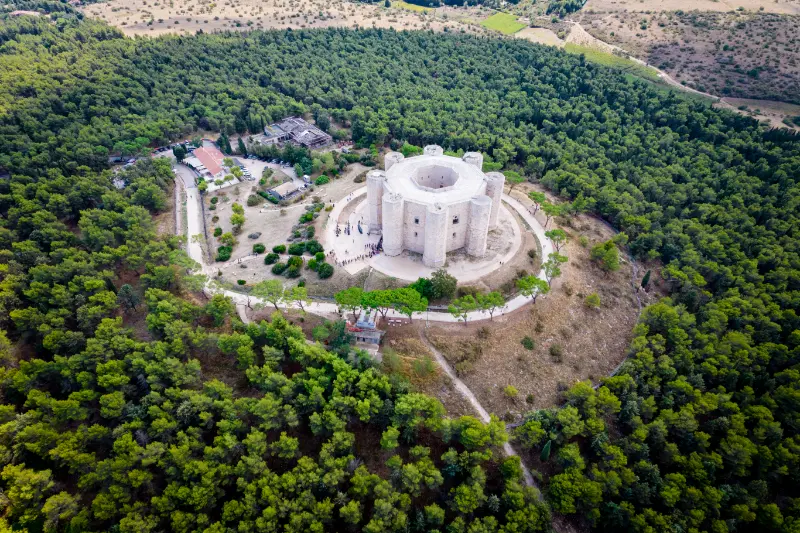
Rising alone above the rolling countryside of the Alta Murgia, Castel del Monte is one of those buildings that looks almost too geometrically perfect to belong to the Middle Ages. Eight sides, eight towers, an eight-sided courtyard and a position chosen to dominate an enormous sweep of inland Puglia give Frederick II’s castle an appearance unlike any other fortress in the region.
It is also one of Puglia’s most misunderstood attractions.
Visitors expecting furnished royal apartments, vast museums or a conventional medieval fortress may initially find the interior surprisingly bare. Castel del Monte is fascinating for different reasons: its proportions, the way light enters the rooms, its mixture of architectural traditions, its relationship with the surrounding landscape and the questions that still surround its original purpose.
UNESCO inscribed Castel del Monte on the World Heritage List in 1996, recognizing the monument as an exceptional fusion of classical antiquity, influences from the Islamic world and northern European Gothic architecture. The castle stands within the municipality of Andria, on an isolated hill overlooking the Murgia countryside.
If you organize the visit properly, allow time outside as well as inside and avoid arriving in the hottest part of a summer afternoon, Castel del Monte becomes one of the most rewarding historical stops in Puglia.
Why Visit Castel del Monte?
Castel del Monte is not Puglia’s largest castle, nor the one with the richest collection of objects. What makes it exceptional is the building itself.
The castle is arranged around a perfectly regular octagonal courtyard. Each of the eight corners of the main structure is marked by an octagonal tower, creating a geometry that is immediately visible from outside but becomes even more intriguing as you move through the rooms.
Its architecture brings together influences from different parts of medieval Europe and the Mediterranean, reflecting the cultural world surrounding Frederick II.
That distinction matters when deciding whether to visit.
If your priority is furnished interiors and dramatic military fortifications, other castles in Puglia may feel more immediately impressive. If you are interested in Frederick II, medieval architecture, geometry, symbolism and landscape, Castel del Monte is considerably more unusual.
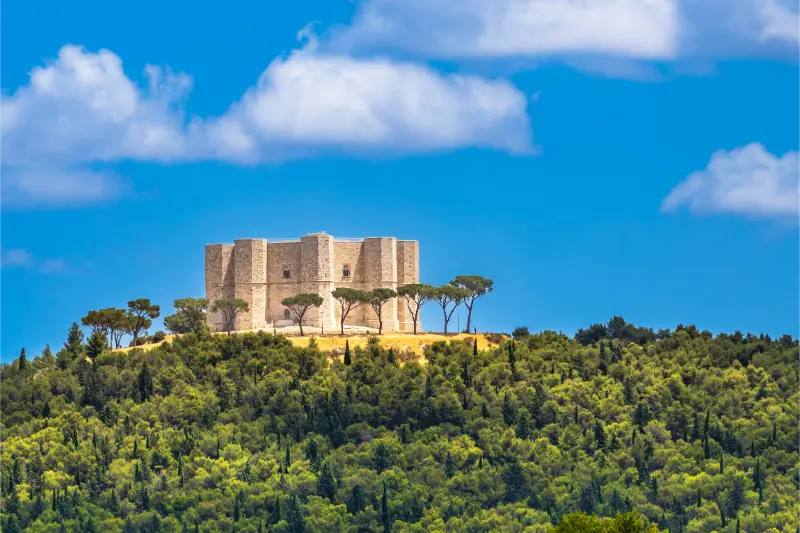
It also works particularly well as a half-day excursion from Bari, Trani, Andria or the central Puglia countryside.
A Short History of Castel del Monte
Castel del Monte was constructed for Frederick II of Hohenstaufen in the 13th century and was completed around 1240. Frederick II was Holy Roman Emperor and one of the most intellectually curious rulers of medieval Europe, with a court influenced by Latin, Greek, Jewish and Arab scholarship.
The exact function of Castel del Monte continues to generate debate.
Its commanding position suggests authority and territorial control, yet several characteristics distinguish it from a conventional defensive castle. The layout is unusually refined, and the building combines military-looking architecture with architectural and decorative elements associated with a prestigious residence.
The interiors were once considerably richer than they appear today. Marble, mosaics and other decorative elements have largely disappeared over the centuries, which explains why today’s rooms can initially seem austere.
Rather than looking for a single definitive explanation of the castle as a fortress, hunting lodge, imperial residence or symbolic structure, it is more useful to see Castel del Monte as a sophisticated expression of Frederick II’s cultural and political ambitions.
The Number Eight: What Makes Castel del Monte So Unusual
You do not need to accept every symbolic theory surrounding Castel del Monte to appreciate how deliberately the number eight shapes the building.
The main structure is an octagon. There are eight octagonal towers. The internal courtyard is octagonal, and the rooms are arranged around this central geometry on two principal levels.
The effect is strongest when you stand in the courtyard and look upward. Instead of the irregular angles common to many medieval castles, the architecture feels controlled, symmetrical and almost abstract.
Many theories have been proposed to explain the symbolism of the number eight, but visitors should be cautious about interpretations presented as unquestionable facts. The geometry is undeniable; the precise meaning intended by Frederick II is much harder to establish.
Best Things to See at Castel del Monte
For bookable tours and activities, check current experiences on GetYourGuide.
The First View of the Castle
Do not rush directly from the parking or shuttle area to the entrance.
One of the best moments of the visit comes before you go inside, when the complete octagonal form is still visible against the sky.
Walk far enough away from the walls to understand the relationship between the main octagon and the eight towers. From very close range, the towers visually merge into the facade and the geometry becomes harder to appreciate.
Morning is usually more comfortable during the warmer months, while late-afternoon light can give the pale stone considerably more texture.
If photography is important to you, allow at least 15 to 20 minutes for the exterior rather than treating it as a quick photograph on the way inside.
The Monumental Entrance
The main portal deserves more attention than it usually receives.
Its architecture combines classical references with medieval elements and immediately suggests that Castel del Monte was conceived as something more sophisticated than a purely functional fortress.
Stand back first to see how the entrance fits into the otherwise severe facade, then move closer to examine the carved architectural details.
This is one of those monuments where photographing only the entire castle means missing much of what makes the architecture interesting.
The Octagonal Courtyard
The courtyard is the visual heart of Castel del Monte.
Once inside, stop here rather than moving immediately into the sequence of rooms. The geometry becomes much easier to understand from the centre, where the walls and towers create a remarkably controlled vertical composition.
Look upward as well as around you.
Changing sunlight alters the shadows across the stone during the day, making the courtyard particularly interesting for photography. Around midday the light can be harsh, while earlier and later hours tend to produce more depth.
The Interior Rooms
The rooms are comparatively restrained today, and it is useful to know this before arriving.
Do not expect furniture-filled royal chambers or detailed reconstructions of medieval life.
Instead, pay attention to the proportions of the rooms, the stonework, vaulting, windows, fireplaces, doorways and the way the spaces communicate with each other.
Much of the original decoration has disappeared, but the architectural structure remains the real attraction.
A visitor who slows down and studies the building will generally get much more from Castel del Monte than someone simply walking quickly from room to room.
Staircases and Towers
The internal circulation is one of the most interesting elements of the building.
Notice how staircases are incorporated into the towers and how movement between the two floors has been organized around the octagonal plan.
Some passages and stairways can feel narrow, and the historic nature of the monument means that visitors with limited mobility should check current accessibility arrangements before travelling.
The Windows and Views Across the Murgia
Do not focus exclusively on the architecture.
Part of the power of Castel del Monte comes from its position.
The castle rises on a hill above the Murgia countryside, surrounded by an open landscape that reinforces the impression of isolation and control over the territory.
The countryside is particularly attractive when the sun is lower, when fields, woodland and low hills develop more contrast.
On clear days, the sense of openness is one of the strongest parts of the visit.
Best Places for Photos at Castel del Monte
For the classic photograph, take your picture from the approach rather than directly beside the entrance. A little distance allows the octagonal proportions to become much clearer.
A good photographic sequence is to start with a full exterior view while approaching the castle, then photograph architectural details around the main portal, followed by symmetrical compositions in the courtyard.
Inside, look for windows and openings that frame the surrounding countryside. After completing the visit, it is worth photographing the exterior again because you will have a better understanding of the geometry of the building.
Late afternoon often produces warmer, more directional light. However, the monument usually closes well before the actual summer sunset, so sunset photography generally means photographing the castle and surrounding landscape from outside after completing the interior visit.
In July and August, the light between approximately 13:00 and 15:00 can be very harsh and the exposed surroundings become considerably hotter.
How Long Does It Take to Visit Castel del Monte?
For most travellers, around 1.5 to 2 hours at the site is ideal, including the approach, exterior photographs and the interior visit.
The actual interior does not require several hours. Around 45 to 60 minutes is normally enough to examine the rooms, courtyard, towers and architectural details without rushing.
Add another 20 to 30 minutes for the exterior and views, plus the time required for parking and reaching the monument.
A realistic total is around two to two and a half hours from parking the car to leaving the area.
There is little reason to dedicate an entire day exclusively to Castel del Monte unless you plan to explore the surrounding Alta Murgia countryside as well.
Castel del Monte Tickets and Opening Hours
As of August 2026, the standard full-price admission ticket is €10, while reduced admission is available for eligible visitors.
The currently published opening hours are generally:
From 1 April to 30 September: 10:00 to 18:45.
From 1 October to 31 March: 09:00 to 17:45.
Last admission is normally 45 minutes before closing.
A combined ticket for Castel del Monte and the Castello Svevo di Trani may also be available, which makes the two monuments an especially logical pairing for travellers interested in Frederick II.
Prices, opening hours and admission rules can change, particularly during special events and holidays, so it is always sensible to check the official museum information shortly before visiting.
Best Time of Day to Visit Castel del Monte
Visiting in Summer
In July and August, go early whenever possible.
A visit close to opening time is considerably more comfortable than arriving after lunch.
Castel del Monte stands in an exposed rural environment rather than in a shaded historic centre, so there are limited opportunities to escape the heat once you begin exploring the exterior.
An alternative is to choose one of the later afternoon admission times, which can provide better light and slightly more comfortable temperatures.
Visiting in Spring and Autumn
April, May, late September and October are among the most pleasant periods to visit.
Temperatures are generally better for walking, and the countryside is often more attractive than during the driest weeks of high summer.
Visiting in Winter
Winter can be atmospheric, especially on clear days, but the castle’s elevated and exposed position means that wind can make conditions feel noticeably colder than along the Adriatic coast.
Bring an additional layer even if temperatures in Bari or Trani seem relatively mild.
How to Get to Castel del Monte
If you are flying to Puglia, compare flights to Bari and Brindisi with Skyscanner.
By Car
For most travellers, driving is the easiest and most convenient way to visit Castel del Monte.
The castle lies outside Andria in the Alta Murgia countryside, so this is not an attraction where you can step off a train and walk directly to the entrance.
From Andria, follow road signs toward Castel del Monte. Navigation apps are useful, but once you approach the monument it is better to follow official parking signs rather than attempting to drive directly toward the entrance.
Castel del Monte works particularly well as part of a road trip including Andria, Trani, Ruvo di Puglia or the Alta Murgia.
If you plan to drive, compare rental-car prices with DiscoverCars.
From Bari Without a Car
Visiting without a car is possible, but it requires more planning.
Public transport connects Bari with Andria, but the final section from Andria to Castel del Monte is less straightforward.
Seasonal bus connections may operate, but frequencies can be limited and should always be checked for the exact day of travel.
For many visitors without a car, travelling to Andria and taking a taxi for the final section is the simplest solution.
If two, three or four people are travelling together, a taxi can also be more practical than organizing the entire day around an infrequent bus timetable.
Parking at Castel del Monte
Visitors should not expect to drive directly to the entrance of Castel del Monte.
Cars are generally left in parking areas below the monument, from where visitors continue by shuttle or on foot.
One established parking facility serving the site currently charges around €5 for cars, with a separate small fee for the return shuttle. These are private services, so prices can change.
The shuttle is particularly useful during hot weather, when travelling with children or if you want to avoid using unnecessary energy before the visit.
Walking uphill is possible, but in July or August the same route can feel considerably longer around midday than it appears on a map.
Arriving early also helps avoid the busiest period for parking and shuttle transfers.
Visiting Castel del Monte with Children
Castel del Monte can work surprisingly well with children, especially those old enough to notice patterns in architecture.
Instead of expecting them to admire empty medieval rooms, turn the visit into a search for the number eight: eight sides, eight towers, the octagonal courtyard and the repeated geometric forms throughout the building.
This often makes the visit easier to understand than a traditional museum filled with historical objects.
Families with very young children should consider the historic surfaces, staircases and approaches before relying on a stroller. A compact child carrier can be more practical for some sections.
In summer, bring water, hats and sun protection because the surroundings are exposed and shade can be limited.
Where to Eat Near Castel del Monte
Castel del Monte is surrounded by countryside rather than a town centre filled with restaurants.
There are places for refreshments around the parking and approach area, but if eating well is an important part of your day, it is usually better to plan lunch separately rather than choosing a restaurant only because it is close to the castle.
Andria is the most natural option.
The local product worth actively looking for is Burrata di Andria, one of the foods most closely associated with this part of Puglia.
Rather than ordering an anonymous selection of generic Puglian dishes, look for a restaurant or dairy that treats burrata as a fresh local product, often served simply with good bread, tomatoes, vegetables or cured meats.
The countryside around Castel del Monte is also associated with olive oil, wine and other agricultural products from the Murgia.
If your next stop is Trani, another excellent strategy is to visit Castel del Monte in the morning and have lunch around Trani’s historic centre or harbour afterward.
Where to Stay Near Castel del Monte
For most first-time visitors there is no strong reason to sleep immediately beside the castle unless you specifically want a rural masseria experience.
For current accommodation options, compare hotels and apartments on Booking.com.
Stay in Andria if…
Choose Andria if you want the closest urban base, easier access to taxis and transport, and a stronger focus on local food.
It is also the logical option if you intend to explore the city itself rather than treating it only as a transport hub.
Stay in Trani if…
Trani is often the more appealing overnight base for leisure travellers.
It offers a beautiful harbour, restaurants within walking distance, the Cathedral of San Nicola Pellegrino and the Castello Svevo.
For couples, particularly, Trani provides a more atmospheric evening after a daytime visit to Castel del Monte.
Stay in a Masseria if…
A countryside masseria is ideal if you have a car and want quiet surroundings, rural landscapes and a slower style of travel.
This option works especially well in spring and early autumn.
A Half-Day Itinerary for Castel del Monte
A realistic summer morning could look like this:
09:15-09:30: leave Andria or arrive in the Castel del Monte area.
09:30-09:50: park, organize the shuttle and approach the monument.
09:50-10:10: photograph the exterior before temperatures increase.
10:15-11:15: visit Castel del Monte.
11:15-11:40: explore the exterior and enjoy views across the surrounding landscape.
11:40-12:00: return toward the parking area.
From around 12:15 onward, continue to Andria for lunch or drive toward Trani.
This is generally more enjoyable than arriving at midday, visiting during the hottest hours and then trying to decide what to do nearby.
One-Day Itinerary: Castel del Monte and Trani
Castel del Monte and Trani make one of the strongest cultural combinations in this part of Puglia.
Morning: Castel del Monte
Visit the castle early and allow approximately two hours including parking, the exterior and the interior.
Lunch: Trani
Drive toward Trani and have lunch near the historic centre or harbour.
Afternoon: Trani Cathedral and Castello Svevo
Walk along the waterfront toward the Cathedral of San Nicola Pellegrino, one of the most dramatically positioned Romanesque churches in Puglia.
The Castello Svevo stands only a short walk away and provides an interesting comparison with Castel del Monte because it represents a much more recognizably defensive type of medieval architecture.
Evening: Trani Harbour
Finish the day around the harbour rather than leaving immediately after sightseeing.
The waterfront becomes particularly pleasant toward the end of the afternoon and in the early evening, when the temperature drops and the area becomes livelier.
The contrast between Castel del Monte’s isolated inland setting and Trani’s Adriatic waterfront is one of the reasons this itinerary works so well.
What to Combine with Castel del Monte
Andria
Andria is the closest city and a logical stop for lunch, particularly if you want to try local burrata and other products from the area.
Trani
Trani is probably the best addition for first-time visitors. Its cathedral, harbour and Swabian castle provide a very different experience from Castel del Monte.
Ruvo di Puglia
Ruvo di Puglia is a worthwhile alternative for travellers interested in archaeology and smaller towns with fewer tourists.
The Museo Nazionale Jatta is particularly interesting for its collection of ancient ceramics.
Alta Murgia
If landscape interests you more than adding another town, continue deeper into the Alta Murgia.
The open plateau, agricultural landscapes and quiet roads reveal a very different side of Puglia from the crowded coastal destinations.
What Can You Skip If You Are Short on Time?
Do not skip the interior simply because someone describes Castel del Monte as empty.
The octagonal courtyard and internal geometry are fundamental to understanding why the monument is unusual.
What you can skip is spending a large amount of time around the souvenir and refreshment areas near the approach.
Give your time to the castle and surrounding landscape, then continue toward Andria, Trani or another part of the Alta Murgia.
If you have only 30 or 45 minutes in total, the visit becomes difficult once parking and access are included. In that situation, it is better to reorganize the itinerary rather than reducing Castel del Monte to a quick photograph.
Is Castel del Monte Worth Visiting?
Yes, provided you understand what kind of monument you are visiting.
Castel del Monte is not the best attraction in Puglia for travellers looking for richly furnished rooms or a large museum collection.
It is an excellent choice for anyone interested in architecture, medieval history, Frederick II, photography and the landscape of the Alta Murgia.
Its appeal comes from the contrast between apparent simplicity and architectural precision. From a distance, the building appears almost elemental. Once you begin studying the towers, portal, rooms, courtyard and circulation system, it becomes considerably more complex.
That is why a thoughtful visit lasting around 90 minutes is much more rewarding than a rushed stop.
Frequently Asked Questions About Castel del Monte
Where is Castel del Monte?
Castel del Monte is in the municipality of Andria, in the province of Barletta-Andria-Trani, within the inland Murgia area of Puglia. It is not located in Bari city, even though it is sometimes described broadly as being near Bari.
How much does Castel del Monte cost to visit?
As of August 2026, standard admission is around €10, with reduced admission available for eligible visitors. Check the official ticket information before travelling because prices and conditions can change.
What are the opening hours of Castel del Monte?
The currently published schedule generally provides longer opening hours between April and September and shorter winter opening hours from October to March. Last admission is normally 45 minutes before closing.
Do you need to book Castel del Monte in advance?
Advance booking is advisable during summer weekends, public holidays and other busy periods, particularly when timed admission systems are in use.
How long should I spend at Castel del Monte?
Allow around 1.5 to 2 hours for the monument and exterior areas, or about 2 to 2.5 hours in total when parking and transfers are included.
Is Castel del Monte easy to visit without a car?
It is possible, but less convenient. The most practical solution is usually to reach Andria by public transport and continue to Castel del Monte by seasonal bus or taxi.
Can you drive directly to Castel del Monte?
No. Visitors generally park below the monument and complete the final section by shuttle or on foot.
Is Castel del Monte suitable for children?
Yes. Children often find the repeated octagonal geometry more engaging than a conventional historical museum, although families should be prepared for stairs, historic surfaces and exposed outdoor areas.
What is the best time to visit Castel del Monte?
Spring and early autumn offer the best combination of comfortable weather and attractive countryside. In July and August, visiting early in the morning or later in the afternoon is preferable.
Can you visit Castel del Monte and Trani in one day?
Yes. It is one of the best combinations in this part of Puglia. Visit Castel del Monte in the morning, have lunch in Trani and spend the afternoon exploring the cathedral, Swabian castle and harbour.