
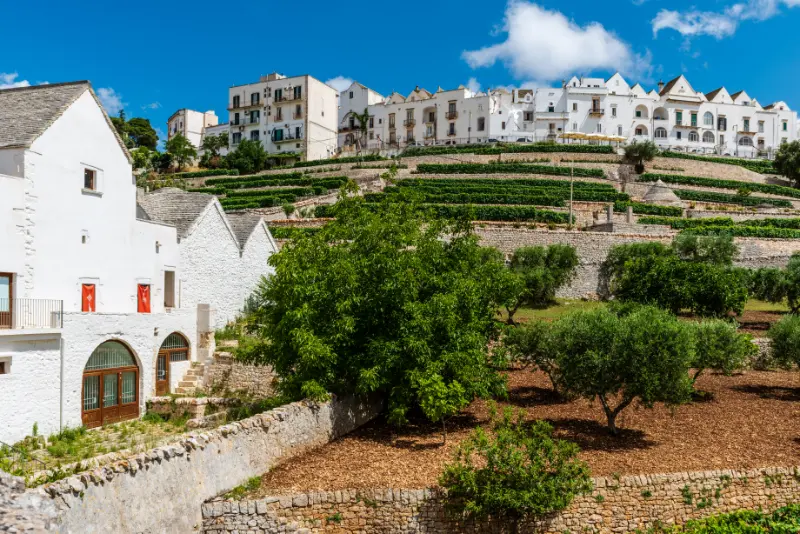
The Valle d’Itria is the part of Puglia that most closely matches the image many travellers have before arriving: trulli scattered between olive groves, pale-stone farmhouses, dry-stone walls and white hill towns rising above a patchwork of fields. Yet it is not one single attraction and it should not be treated as a quick stop between Alberobello and Ostuni.
The best experience comes from combining the towns with the countryside. Alberobello supplies the famous trulli, Locorotondo offers one of the cleanest and most attractive hill-town walks, Cisternino has a lived-in old centre and a strong food culture, Martina Franca adds Baroque architecture and a larger urban rhythm, while Ostuni sits on the edge of the valley and connects the interior with the Adriatic coast.
Where Is the Valle d’Itria?
The Valle d’Itria lies across parts of the provinces of Bari, Brindisi and Taranto. Its core is usually understood as the countryside around Alberobello, Locorotondo, Cisternino and Martina Franca, with Ostuni and Fasano often included in wider travel itineraries. This administrative patchwork matters less to a visitor than the landscape: the towns are close, but the rural roads between them are part of the attraction.
How Long Do You Need?
One day is enough for a highlights loop, but it will feel compressed. Two days let you see three or four towns without rushing lunch and sunset. Three nights are ideal if you also want a masseria, a winery, a countryside walk or a beach day on the Adriatic.
If you have only one day, do not try to enter every church and museum. Choose two towns for proper walks and one shorter stop. A realistic route is Alberobello early, Locorotondo before lunch, then Martina Franca or Cisternino in the late afternoon.
Best Towns in the Valle d’Itria
Alberobello
Alberobello is essential, but timing determines whether it feels magical or commercial. Arrive before the late-morning groups if possible. Rione Monti has the densest concentration of trulli and the most souvenir shops; Aia Piccola is quieter and gives a better sense of how the architecture fits into a residential district.
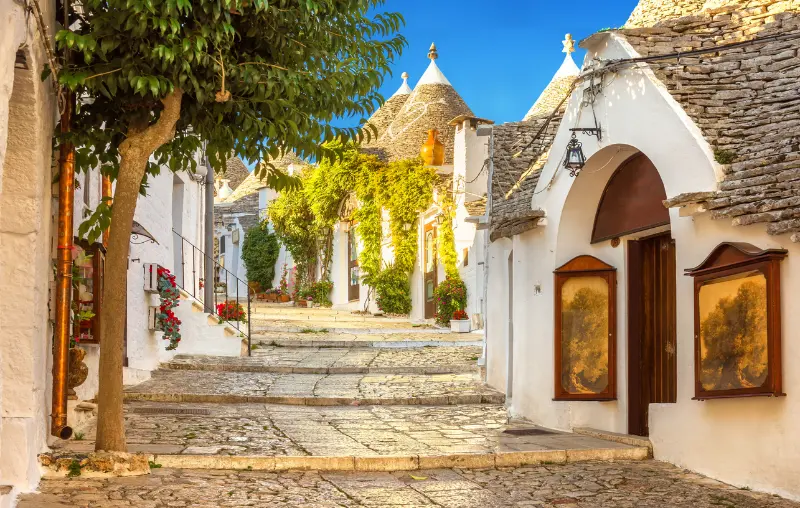
The terrace beside Santa Lucia is one of the easiest viewpoints over the trulli roofs. Spend around two to three hours if this is your first visit. If you have seen many trulli in the countryside and dislike busy tourist streets, you can shorten the visit and give more time to Locorotondo or Martina Franca.
Locorotondo
Locorotondo rewards slow walking more than monument-hopping. Enter the historic centre, follow the white lanes around the circular core, then make time for the panoramic edge overlooking the Valle d’Itria. The view is especially attractive in late afternoon when the low light picks out vineyards, trulli and dry-stone walls.
The old town is compact, so 90 minutes can be enough, but two or three hours work better if you stop for lunch. Locorotondo is also one of the easiest places to enjoy after day-trip crowds fade because the centre remains pleasant without requiring a long checklist of sights.
Cisternino
Cisternino feels more domestic and less staged than Alberobello. Piazza Vittorio Emanuele and the lanes around the historic centre lead to small courtyards, arches and viewpoints across the valley. The Belvedere area is worth reaching before sunset; the light over the countryside is more important here than any single monument.
Cisternino is particularly good around dinner time because of the local tradition of butcher shops that cook meat to order. Bombette are the obvious speciality, but the value of eating here is the format as much as the dish: choose carefully, avoid ordering too much at once, and remember that the old town becomes much busier on summer evenings.
Martina Franca
Martina Franca provides the strongest architectural contrast in the valley. Instead of an almost entirely white village, you get grander Baroque façades, noble palaces and a more substantial town centre. Start at Piazza XX Settembre, pass through Arco di Santo Stefano, see Palazzo Ducale, then continue toward the Basilica di San Martino and Piazza Plebiscito.
Allow at least three hours for the historic core, longer if you visit Palazzo Ducale or stop for lunch. The streets around Via Cavour and Via Mazzini become quieter than the main approach and are worth including before leaving.
Ostuni
Ostuni is not always treated as part of the strict core of the Valle d’Itria, but it combines naturally with it. The old town climbs toward the cathedral, so the best walking route is to accept the slope rather than repeatedly crossing it. Start lower down near Piazza della Libertà, follow the streets uphill, then loop back by a different side.
Ostuni is particularly attractive near sunset, but this is also when parking and central streets can be busiest in summer. If you are staying elsewhere in the valley, visiting in the late afternoon and remaining for dinner is often more rewarding than squeezing it into midday heat.
The Best Valle d’Itria Road Trip Route
A car gives you the freedom to turn the valley into a landscape journey rather than a sequence of town-centre car parks. The most satisfying drives are often on secondary roads between Locorotondo, Cisternino and Martina Franca, where trulli and masserie appear naturally rather than as isolated attractions.
For one full day, a practical order is:
- 08:00–10:30 Alberobello: walk Rione Monti and Aia Piccola before the busiest period.
- 11:00–13:00 Locorotondo: explore the old town and panoramic terraces.
- 13:00–15:00 lunch: stay in Locorotondo or drive into the countryside for a masseria-style meal.
- 15:30–18:00 Martina Franca: Baroque architecture and a slower afternoon walk.
- 18:30 onward Cisternino: belvedere, aperitivo and dinner.
This is still a full day. If you dislike changing towns repeatedly, remove either Martina Franca or Cisternino and give the remaining stop more time.
Where to Stop for Views and Photos
The Santa Lucia viewpoint in Alberobello is the obvious trulli panorama. In Locorotondo, use the panoramic edge of the historic centre rather than searching for a single “secret” balcony. In Cisternino, the belvedere facing the valley is at its best in the hour before sunset.
The countryside is more delicate. Do not stop on narrow rural roads simply because a trullo looks photogenic. Look for a proper pull-off, a farm entrance you are actually visiting, or an agriturismo where parking is permitted. The best photographs often come from staying at a masseria or winery where access is legitimate.
Parking and ZTLs
Historic centres in the Valle d’Itria are not places to improvise with a car. Alberobello, Locorotondo, Cisternino, Martina Franca and Ostuni all have central streets where access is restricted, limited or impractical. The safest routine is to follow signs to public parking before reaching the old core and finish on foot.
In Martina Franca, the multi-storey parking area at Piazza Mario Pagano is one of the most useful reference points; municipal rules and charging arrangements have changed, so check the signs on arrival rather than relying on an old blog post. In the smaller towns, parking a few minutes farther from the old centre is often faster than circling for a space near the entrance.
Can You Visit Without a Car?
Yes, but the experience changes. Trains and buses connect several towns, yet the rural landscape and masserie are much easier by car. If you stay in Bari or Monopoli, you can reach some central-Puglia towns by public transport, but a full Valle d’Itria loop in one day becomes harder.
For point-to-point public transport planning, Omio can help compare longer rail and coach legs. If the countryside is central to your trip, DiscoverCars is the more practical option for comparing rentals.
Where to Stay in the Valle d’Itria
Locorotondo for couples
Locorotondo is compact, attractive in the evening and easy to enjoy on foot. It works particularly well for couples who want restaurants and atmosphere without the scale of a larger town.
Martina Franca for restaurants and a larger town
Choose Martina Franca if you want a broader choice of services, more architecture and a town that remains active beyond the tourist core. It is also a good base for moving between Alberobello, Locorotondo and Cisternino.
Cisternino for food and village atmosphere
Cisternino is excellent for travellers who want a small old town and dinner traditions close at hand. It can feel very busy on summer evenings, so parking included with accommodation is a real advantage.
Countryside masseria or trullo for the full landscape experience
A rural stay is the most atmospheric choice, but check driving times carefully. A beautiful property can be ten kilometres from the nearest town along narrow lanes. That is wonderful in daylight and less convenient if you plan to drink wine at dinner in town every night.
Compare accommodation in and around the Valle d’Itria.
What to Eat
The food changes subtly from town to town. In Martina Franca, capocollo is the local product to look for. In Cisternino, grilled meat and bombette are part of the evening ritual. Around Locorotondo and Martina Franca, local wines add another reason to spend time in the countryside rather than racing back to the coast.
Do not turn every meal into a checklist of “Puglia foods”. The more useful approach is to order what suits the town: cured meats and wine around Martina Franca, grilled meat in Cisternino, bakery products for a quick lunch, and a slower masseria meal when you have time.
Best Time to Visit
May, June and September are the most comfortable months for a road trip. Days are long, walking is easier than in peak August heat, and the towns are lively without being at their most congested. July and August are still rewarding, but build the day around early starts, long lunches or pool time, and late-afternoon sightseeing.
In winter the valley becomes much quieter. Larger towns such as Martina Franca remain active, while countryside properties and seasonal attractions may reduce hours. Christmas can be atmospheric in several towns, but it is a different trip from the classic summer landscape-and-beach itinerary.
Valle d’Itria with Children
The biggest issue is not whether children will enjoy the towns; it is the combination of heat, cobbles, steps and repeated parking. Two towns in a day can be enough with young children. Alberobello is visually engaging, while a masseria with outdoor space can break up sightseeing more effectively than adding another church.
A stroller works on many central streets but can be awkward on uneven paving and steps. In summer, avoid making the most exposed hill-town walks between roughly late morning and mid-afternoon.
Best Nearby Excursions
From the valley you can easily combine the Adriatic coast around Monopoli, the beaches near Capitolo, the Castellana Caves, Torre Canne and the coastal side of Ostuni. If you are already spending several days in central Puglia, use one day for the towns and another for the coast rather than trying to do both properly in a single afternoon.
For bookable tours and activities, check current experiences on GetYourGuide.
Is the Valle d’Itria Worth Visiting?
Yes. It is one of the places where Puglia makes most sense as a region rather than a collection of famous Instagram stops. Alberobello may be the headline sight, but the real appeal comes from how the towns, roads, trulli, farms, vineyards and evening food culture fit together.
If you have only one day in Puglia, choose a single iconic destination. If you have four days or more, the Valle d’Itria deserves at least one full day and preferably two nights.
Frequently Asked Questions
What are the main towns in the Valle d’Itria?
The core towns are Alberobello, Locorotondo, Cisternino and Martina Franca, with Ostuni and Fasano often included in broader itineraries.
Do you need a car for the Valle d’Itria?
A car is not essential for every town, but it is the best way to explore rural roads, masserie, wineries and several places in one day.
Where is the best place to stay?
Locorotondo and Cisternino are excellent for village atmosphere, Martina Franca for services and architecture, and the countryside for a masseria or trullo stay.
Can you visit Alberobello and Locorotondo in one day?
Yes, easily. They combine very well, and adding a third town is realistic if you start early. Four major stops in one day is possible but usually less enjoyable.
How many days should you spend in the Valle d’Itria?
Two days is the sweet spot for most first-time visitors. Three nights are better if you also want countryside experiences, a winery or a beach day.