
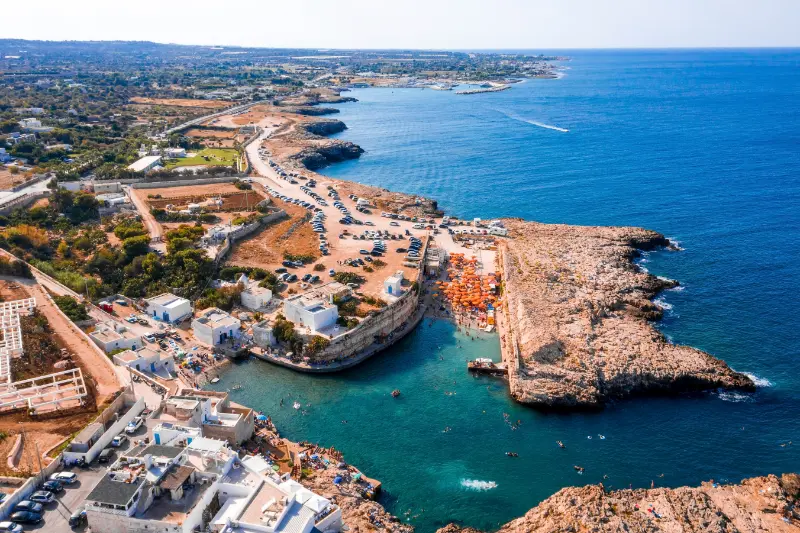
Ten days is enough to experience Puglia as a region rather than as a collection of famous postcards. You can begin with Gargano’s forested promontory and dramatic Adriatic coast, move through Bari and the limestone towns of central Puglia, then finish in Lecce and Salento where the landscape and architecture change again.
The route is ambitious but realistic because it moves mostly north to south. It is not a circular “see everything” plan. The key is to avoid driving back to the same base every night.
For this itinerary, a car is strongly recommended. You can do excellent parts of Puglia by train, but combining Gargano, Valle d’Itria countryside and the two Salento coasts in ten days is much easier with your own vehicle.
10 Days in Puglia at a Glance
- Day 1: Trani and Monte Sant’Angelo; sleep in Vieste.
- Day 2: Vieste and Gargano coast.
- Day 3: Gargano morning, then drive south to Bari.
- Day 4: Bari, Polignano a Mare and Monopoli.
- Day 5: Alberobello, Locorotondo and Cisternino.
- Day 6: Ostuni and Torre Guaceto; continue to Lecce.
- Day 7: Lecce.
- Day 8: Otranto and the Adriatic Salento coast.
- Day 9: Gallipoli or Porto Cesareo and the Ionian coast.
- Day 10: Santa Maria di Leuca, then departure from Brindisi if flight time allows.
If your flight schedule is poor, drop either the Gargano opening or the Leuca finale rather than turning Day 1 or Day 10 into a motorway sprint.
The Best Airports for This Route
Bari is the natural arrival airport. Brindisi is the ideal departure airport because it prevents a final drive all the way back north from Salento. Aeroporti di Puglia operates both airports, and using different arrival and departure points can save several hours on a point-to-point trip.
If an open-jaw ticket is significantly more expensive, a Bari round trip is still possible. In that case, finish Day 9 in Lecce or Porto Cesareo and use Day 10 to return north rather than continuing to Santa Maria di Leuca.
For ten days, rental-car terms matter. Compare car rental options in Puglia and check one-way fees if you plan to collect the car at Bari Airport and return it at Brindisi.
Day 1: Trani and Monte Sant’Angelo on the Way to Gargano
Do not drive directly from Bari Airport to Vieste unless you arrive late. Trani and Monte Sant’Angelo turn the transfer north into a real travel day.
Trani
Trani’s cathedral stands beside the sea rather than hidden inside a dense historic centre. From the harbour, walk toward Cattedrale di San Nicola Pellegrino and Castello Svevo. The cathedral exterior and its relationship with the waterfront are the main reasons to stop.
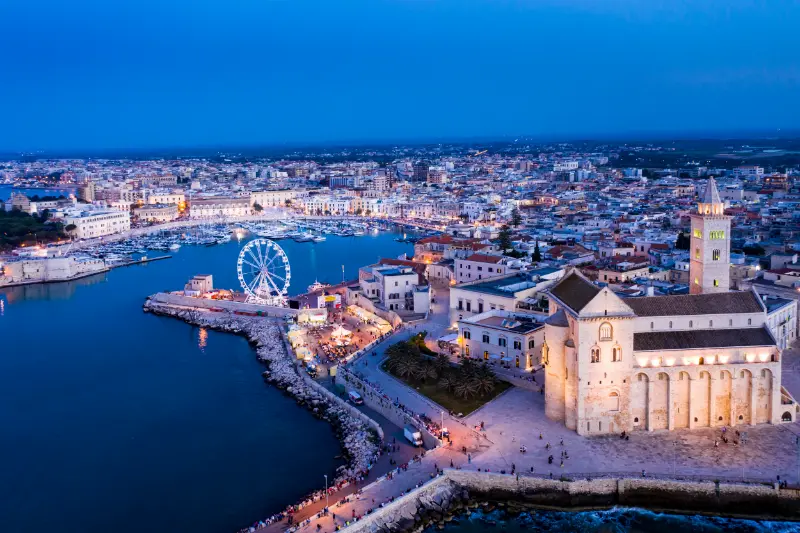
Allow two to three hours for Trani. If you land around lunchtime, have a simple meal near the harbour, walk the old streets and continue north.
Monte Sant’Angelo
Monte Sant’Angelo sits high above the Gargano and feels completely different from the coast. The Sanctuary of San Michele Arcangelo is the essential sight and part of the area’s UNESCO heritage. The steep lanes and broad views across the landscape make the town worth the detour even if you are not travelling for religious reasons.
Allow roughly two hours, then continue to Vieste before dark if possible. The final approach across Gargano can be slower than the map suggests, especially on winding roads.
Stay in or near Vieste. Compare accommodation in Vieste and check parking carefully if the property is inside the old town.
Day 2: Vieste and the Gargano Coast
Begin in Vieste’s historic centre. Walk the lanes around the cathedral and upper old town, then descend toward the seafront and the Pizzomunno sea stack.
The coast is the real priority today. Choose between a boat trip to sea caves, a beach day or a coastal drive toward Mattinata. Do not attempt all three at full length.
A boat trip is one of the best ways to understand Gargano’s cliffs and caves, particularly in calm conditions. If seas are rough, use the day for beaches such as Vignanotica or the coast around Mattinata instead.
Access to some coves involves steps or paths, and beach parking can fill quickly in summer. Start early and carry appropriate footwear rather than assuming every beach has a level promenade.
Return to Vieste for the evening. The old town is more enjoyable once beach traffic has subsided.
Day 3: Foresta Umbra, Then South to Bari
Use the morning for Gargano’s interior. Foresta Umbra is one of the most important contrasts in the region: dense woodland only a short drive from the bright limestone coast.
Choose one manageable walk rather than a long hike if you still need to drive south. The forest roads are scenic but slow, and wildlife crossings plus bends make average speeds lower than on the coastal plain.
After lunch, drive toward Bari. The transfer is substantial, so this is not the day to add Peschici, Tremiti and another town simply because they are nearby on the map.
Arrive in Bari in the late afternoon. Park outside Bari Vecchia or at your hotel, then walk to Piazza Mercantile and the old town for dinner.
Day 4: Bari, Polignano a Mare and Monopoli
This is a full day, but the geography is straightforward.
Morning in Bari
Visit Basilica di San Nicola first, then the cathedral and the lanes around Strada Arco Basso. If you already explored Bari Vecchia the previous evening, spend more time in Murat and along the seafront rather than repeating the same route.
Have focaccia barese for an early lunch, then leave the city before afternoon traffic builds.
Polignano a Mare
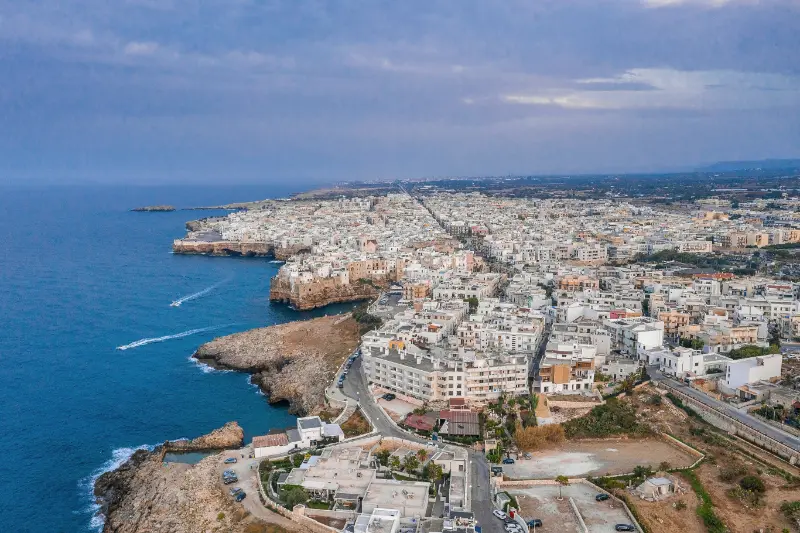
Stop for two to three hours. See Lama Monachile from the bridge, wander the old town and use the sea terraces for cliff views. If the beach is packed, do not waste time trying to secure a tiny patch of stones; Monopoli gives you easier swimming options later.
Monopoli
Finish the day in Monopoli. Walk Porto Vecchio, Castello Carlo V and the cathedral, then swim at Cala Porta Vecchia if conditions are good.
Monopoli is an excellent overnight base because the old town remains lively without requiring another drive after dinner. Compare places to stay in Monopoli if you want to be near the harbour and restaurants.
Day 5: Alberobello, Locorotondo and Cisternino
Start in Alberobello before 9:00. Walk Rione Monti, then cross to Aia Piccola. The latter is quieter and gives you a more balanced impression of the town.
Add Trullo Sovrano only if you want to understand a trullo interior. Otherwise, use the extra time for panoramic viewpoints and leave before the busiest midday period.
Continue to Locorotondo. One to two hours is enough for the white lanes and the valley panorama along the town’s edge.
Have lunch in Cisternino, where butcher shops cooking bombette provide a meal that genuinely belongs to the Valle d’Itria. Spend the late afternoon in the surrounding countryside or check into a masseria.
This is the day to slow down. If your accommodation has a pool, use it. Ten-day trips become tiring when every free hour is filled with another town.
Day 6: Ostuni and Torre Guaceto
In summer, reverse the usual sightseeing order: sea first, white city later.
Spend the morning at Torre Guaceto if you want protected nature, dunes and a less urban coastal landscape. Access rules, shuttle arrangements and parking can vary by season, so verify the reserve’s current information.
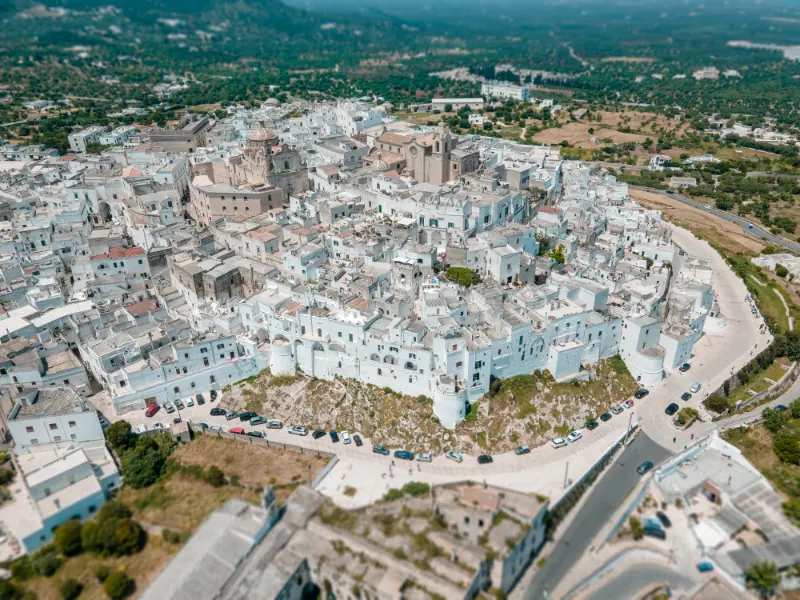
After lunch, continue to Ostuni. Enter from Piazza della Libertà, climb toward the cathedral and explore the upper lanes as the day cools.
Do not rush back down immediately. The outer edges of the old town provide views across the olive plain toward the Adriatic and are at their best in softer light.
Continue to Lecce in the evening. The drive is easy compared with Gargano, and arriving after sunset is preferable to cutting Ostuni short at the most attractive time of day.
Day 7: Lecce
Lecce is your deliberate slow day.
Start at Porta Rudiae and Piazza del Duomo, then walk to Piazza Sant’Oronzo and Basilica di Santa Croce. Visit interiors during the warmer middle hours and leave the late afternoon for wandering.
The city’s baroque architecture is detailed rather than monumental in scale. Look at balconies, columns, church portals and ordinary residential façades instead of treating the centre as a route between three famous squares.
For lunch, try rustico leccese; for coffee, caffè leccese; for dessert or breakfast, pasticciotto. At dinner, look beyond the busiest square terraces if you want a more local atmosphere.
Stay in Lecce for three nights. Compare accommodation in Lecce if you want to balance old-town atmosphere with parking access.
Day 8: Otranto and the Adriatic Salento Coast
Drive to Otranto early. The cathedral and its mosaic floor are the essential cultural stop. Then explore the old town, Castello Aragonese exterior and waterfront.
After lunch, drive south rather than returning immediately to Lecce. The coast toward Porto Badisco, Santa Cesarea Terme and Castro is rockier and more dramatic than the long sandy beaches on the Ionian side.
Choose one or two stops. Porto Badisco works for a swim in a smaller inlet. Castro adds a historic hill town above the water. Do not turn the route into a photographic drive-by at every bay.
Return to Lecce in the evening.
Day 9: Ionian Salento—Gallipoli or Porto Cesareo
Choose based on the type of day you want.
Gallipoli is better if you want an old town, harbour, churches and a sunset walk. Cross into the historic island centre in the morning, then spend the afternoon on a beach south of town.
Porto Cesareo and Torre Lapillo are better if the priority is pale sand and shallow water. In peak summer, arrive early because parking and traffic become intense.
Porto Selvaggio is the nature alternative. The bay is rocky and reached on foot through the protected landscape, so it is less suitable if you need easy access, a stroller or full beach services.
Whichever you choose, stay for sunset on the Ionian side if possible. The evening light is one of the main reasons to dedicate a separate day to this coast.
Day 10: Santa Maria di Leuca and Departure
Santa Maria di Leuca sits at the southern tip of Salento and makes a satisfying final destination because the route has now genuinely crossed the region from north to south.
Visit the monumental staircase, Basilica Santuario di Santa Maria de Finibus Terrae and the lighthouse area. The viewpoint over the harbour is more important than the idea of identifying an exact visible line where two seas meet; that popular description is symbolic rather than a permanent physical boundary you can always see.
If you have time, follow part of the coast north toward Marina Serra or Tricase Porto before turning toward Brindisi. If your flight leaves early, skip Leuca and use the final morning in Lecce instead.
How Much Time Is Spent Driving?
The route includes two significant transfer days: north to Gargano at the start and Gargano back to Bari on Day 3. After that, distances become much shorter.
This is why the route should not include Matera as an additional “quick stop.” Matera is excellent, but adding it means another major inland diversion. Replace a day rather than stacking it on top.
The same applies to the Tremiti Islands. They deserve at least a full day, ideally an overnight, and ferry schedules make them incompatible with a casual stop on the way south.
Parking and ZTL Rules
Assume historic centres are pedestrian or restricted until you verify otherwise. Bari, Monopoli, Ostuni, Lecce, Otranto, Gallipoli and many smaller towns use ZTLs or pedestrian zones.
Do not enter because your map app shows a route. Signs and camera controls matter more than the app. Hotels inside restricted areas may have procedures for authorized access, but you need instructions from the property.
At beach destinations, parking pressure is mostly a timing issue. Before 9:00 is far easier than late morning in July and August.
What to Pack for This Route
Bring shoes suitable for polished stone and uneven historic-centre paving, plus sandals or water shoes for rocky beaches. A light layer is useful in Gargano evenings and air-conditioned interiors even when Salento is hot.
Keep a small beach kit in the car so you can swim spontaneously without unpacking the entire suitcase. A reusable water bottle and sun protection are essential on inland sightseeing days.
Best Months for 10 Days in Puglia
June and September are the best balance for this exact route. Both support beach time while making long sightseeing days easier than August.
May is excellent for towns, Gargano walking and countryside, though sea temperatures are cooler. July is workable with early starts. August is the most demanding because Gargano beaches, Polignano, Alberobello and Salento all experience intense peak-season demand.
October works well if food, towns and road trips matter more than swimming.
10 Days Without a Car: What Should Change?
Do not copy this exact route. Gargano and remote Salento beaches make it inefficient.
A better car-free ten-day trip uses Bari, Monopoli and Lecce as bases, adds Trani by train, Alberobello as a dedicated excursion, and chooses coastal destinations served by seasonal links.
The Bari–Lecce corridor is particularly useful, and current regional services connect major stops such as Monopoli and Ostuni. Compare train and bus options if you are planning a public-transport version.
Is 10 Days Enough to See Puglia?
Ten days is enough to understand the region’s range, but there will still be places left for another trip. That is a good thing.
The strongest route gives Gargano two days, central Puglia four, and Salento four. It avoids spending every night in a different hotel and uses the region’s long north–south shape rather than fighting it.
Plan your stay
Frequently Asked Questions
Can I see Gargano and Salento in ten days?
Yes, if you travel point to point and accept that Gargano will receive only two to three days. A Bari arrival and Brindisi departure makes the route much more efficient.
Should I add Matera to this itinerary?
Only by replacing a full day. Do not add Matera between already full days because the inland detour and walking time deserve proper space.
How many nights should I spend in Vieste?
Two nights is the minimum for this route. Three is better if Gargano beaches and hiking are a priority.
How many nights should I spend in Lecce?
Three nights works very well because you can devote one day to Lecce, one to the Adriatic coast and one to the Ionian side without changing hotels.
Is this itinerary suitable for families?
Yes, but remove one village on Day 5 and shorten the long transfer days. Families often benefit from adding a pool afternoon or a full beach day rather than maintaining the adult sightseeing pace.