

Puglia is a region where the best experiences often happen between the famous sights. A guided walk can explain why Bari Vecchia feels different from Lecce. A boat trip reveals sea caves that cannot be seen from the road. An olive-oil tasting turns endless groves into something you can understand through flavour, while a cooking class makes orecchiette more memorable than simply ordering a plate at dinner.
The challenge is choosing experiences that add something to the trip rather than filling every free hour with reservations. Puglia rewards flexibility, so it is usually better to book a few high-value activities and leave space around them.
Take a boat tour along the coast
Puglia has two seas and a coastline that changes dramatically from area to area. Boat trips are therefore not interchangeable.
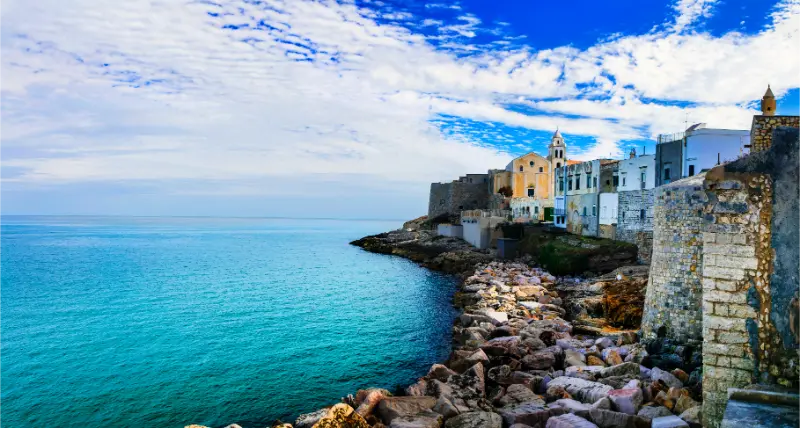
Around Polignano a Mare, excursions focus on limestone cliffs and sea caves. In the Gargano, boat routes can reveal high white cliffs, arches and bays between Vieste and Mattinata. In Salento, departures from places such as Otranto, Santa Maria di Leuca, Gallipoli or Porto Cesareo show different sides of the Adriatic and Ionian coasts.
Before booking, ask how long the trip lasts, whether the boat has shade, whether a swim stop is planned, what happens in rough weather and where exactly boarding takes place. A sunny forecast does not guarantee calm sea conditions.
For the classic cave experience, see our Polignano a Mare boat tours article.
Learn to make orecchiette
A pasta workshop is one of the easiest food experiences to fit into a Puglia itinerary. Orecchiette are closely associated with the region, and learning the shaping technique gives you a reason to notice differences in dough, sauces and local traditions afterwards.
In Bari, the streets of the old town are famous for women making pasta near their homes, but visitors should distinguish between respectfully observing a living neighbourhood and treating residents as a tourist performance. A booked class in a kitchen, masseria or cooking school can provide more time for explanation and participation.
Ask whether the class is hands-on, which recipes are included, how many people are in the group and whether the final meal is part of the experience. For families, also check the minimum age and session length.
Our food experiences in Puglia article offers more culinary ideas.
Taste olive oil at a working farm or mill
Olive trees shape much of Puglia’s landscape, but tasting oil with a producer helps explain why different areas and cultivars produce different profiles.
In the Terra di Bari DOP area, the Region of Puglia notes cultivars including Coratina, Cima di Bitonto/Ogliarola Barese and Cima di Mola, depending on the geographic designation. Coratina-based oils can be particularly intense, with bitterness and peppery sensations that surprise travellers used to milder supermarket oils.
A good tasting should explain harvest timing, extraction, storage and how to recognise freshness rather than simply selling bottles. The Region of Puglia’s Terra di Bari DOP page is useful background before visiting a producer.
If you are travelling in autumn, some farms may offer harvest-related activities, but these depend on the agricultural season and must be confirmed directly.
Visit a winery without turning the day into a race
Puglia is associated with wines such as Primitivo, Negroamaro and Nero di Troia, but the most interesting winery visit is not necessarily the one with the longest tasting list.
Choose a winery that fits the geography of your trip. Primitivo can connect naturally with Manduria and the Ionian side. Negroamaro is closely associated with Salento. Nero di Troia adds a northern Puglia perspective.
If you are driving, arrange a designated driver or book a transfer. A tasting is meant to be enjoyed, not calculated against legal limits.
Some wineries require advance reservations even outside high season. Ask whether the visit includes vineyards, cellar, food pairing and English-language guidance.
Read our Puglia Wine Guide before choosing an area.
Join a guided walk in Bari
Bari is easy to walk independently, but a good local guide can make the old town far more legible. The Basilica of Saint Nicholas, Norman-Swabian Castle, cathedral, old lanes and waterfront are all close together, yet the city’s history is layered enough that context matters.
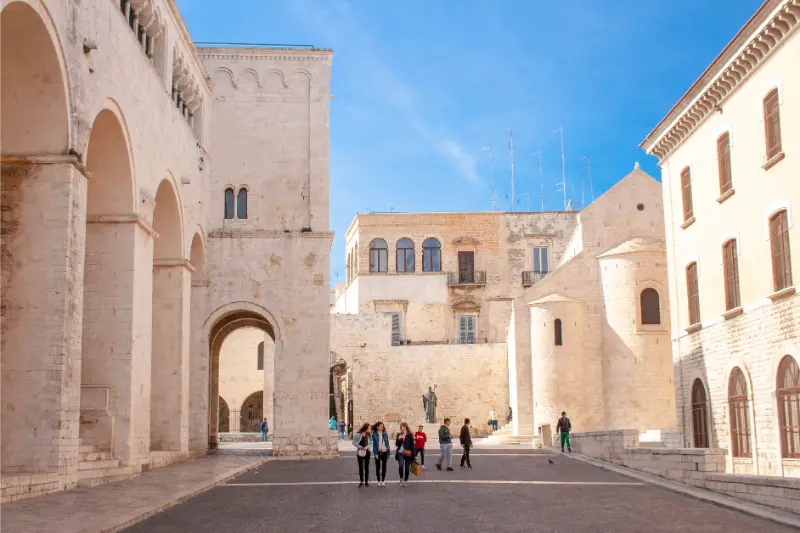
A guided tour is particularly useful at the beginning of a Puglia trip because it introduces themes that reappear elsewhere: Romanesque architecture, port history, religious traditions and local food.
Choose a small-group or private tour if you want time for questions. If the experience includes food tastings, ask in advance whether they replace a meal or are only small samples.
Explore Lecce with a specialist guide
Lecce is visually impressive even without explanation, but the Baroque stonework becomes more interesting when someone points out details you would otherwise pass by.
A guide can connect Basilica di Santa Croce, Piazza del Duomo, the Roman amphitheatre and the city’s layers of history without forcing you to read plaques in the midday heat.
For travellers interested in architecture, an evening or late-afternoon walk can be more enjoyable than a generic daytime tour. The local limestone changes appearance as the light softens, and the historic centre becomes lively around aperitivo time.
Use our Lecce Travel Guide to decide which areas you want a tour to cover.
Cycle through Valle d’Itria
Valle d’Itria is made for slower exploration: dry-stone walls, trulli, olive groves and white towns appear continuously rather than at one single viewpoint. Cycling or e-biking allows you to experience the countryside between destinations instead of jumping from car park to car park.
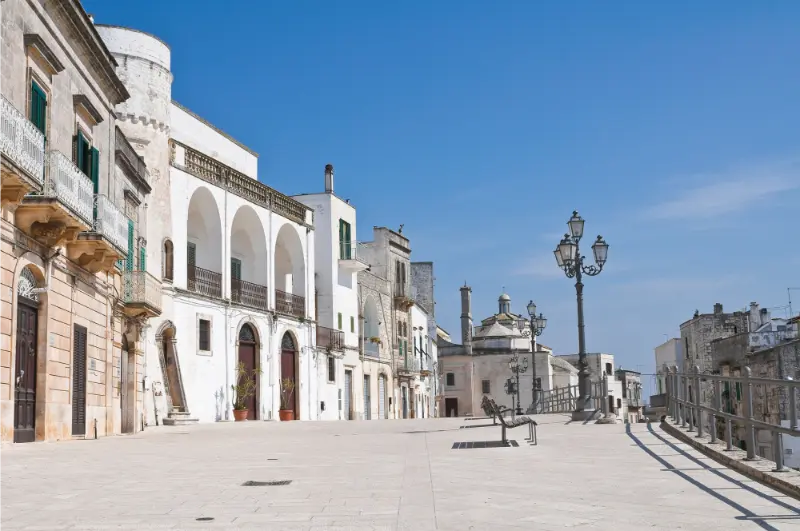
An e-bike can make the experience accessible to travellers who cycle occasionally but do not want a demanding workout. Guided routes are useful because rural lanes can be confusing and the most scenic roads are not always the routes suggested by standard navigation apps.
Ask about distance, elevation, traffic, helmet provision and support in case of a mechanical problem. In summer, morning departures are usually more comfortable than riding through the hottest hours.
See our Valle d’Itria Travel Guide for towns worth combining with the ride.
Discover Puglia’s caves underground
The Grotte di Castellana offer a very different type of experience from a sea-cave boat trip. The official operator currently offers a longer itinerary of roughly three kilometres and a shorter route of around one kilometre. The full visit reaches the famous Grotta Bianca.
Book according to your time and mobility rather than automatically choosing the longest option. The underground environment involves steps, walking and different temperatures from outside.
Current prices, tour times and ticket conditions are available on the official Castellana Caves website.
Our Castellana Grotte guide explains what else to see nearby.
Walk in Foresta Umbra with a nature focus
The Gargano’s Foresta Umbra is one of Puglia’s most valuable landscape contrasts. After days of dry stone and coastline, the shaded forest can feel like a different region.
You can walk independently on suitable routes, but a guided nature experience may be worthwhile if you want to understand the forest ecology rather than simply follow a trail. This is particularly useful for birdwatchers, families or travellers interested in the Gargano National Park beyond its beaches.
Do not overestimate distances in summer. Even shaded walks require water, appropriate shoes and realistic timing.
Plan with our Foresta Umbra guide.
Join a ceramics experience in Grottaglie
Grottaglie is one of Puglia’s strongest craft destinations. Its ceramics district gives visitors the chance to see workshops rather than only buy souvenirs from a generic gift shop.
A guided visit or hands-on workshop can explain local forms, decoration and production techniques. If you want to make something yourself, ask whether firing and shipping are included, because a freshly shaped ceramic object cannot simply be packed into a suitcase immediately.
The town works well as a cultural stop from Taranto or the Valle d’Itria. Our Grottaglie Travel Guide provides the practical context.
Experience a masseria as more than a hotel
A masseria stay can become an experience when the property still has a meaningful connection to agriculture, food or the surrounding landscape. Depending on the property, guests may find olive-oil tastings, cooking lessons, garden tours, farm visits or cycling routes.
Do not assume every hotel using the word “masseria” offers agricultural activities. Some are primarily luxury accommodations in restored rural buildings. If the farm element matters to you, ask what actually happens on site and whether activities are available during your stay.
The Region of Puglia’s tourism material highlights hands-on experiences linked to agriculture, food and local traditions. Its Puglia experiences page gives a useful overview of the kinds of activities found across the region.
Take a responsible wildlife or marine excursion
Puglia’s coast and wetlands offer opportunities for wildlife-focused experiences, from birdwatching near salt pans and lagoons to marine excursions in the Gulf of Taranto.
Choose operators that explain conservation and avoid experiences that promise guaranteed encounters with wild animals. Nature is not scheduled. A responsible operator should be comfortable explaining what happens if conditions or wildlife behaviour change the plan.
Margherita di Savoia, Lake Lesina and Lake Varano can all add a birdwatching or wetland dimension to a trip otherwise dominated by towns and beaches.
Hire a guide for archaeological Puglia
Sites connected with Magna Graecia, Messapian culture, Roman history and rupestrian settlements can be difficult to interpret without context. This is where a specialist guide can add more value than a general city walking tour.
Taranto’s MArTA museum is a natural anchor for Greek history. Manduria adds Messapian archaeology, while Gravina, Mottola, Massafra and other inland towns reveal rock-cut landscapes and churches.
If archaeology is a serious interest, consider one focused guided day rather than scattering brief ruin visits across the entire holiday.
Our Taranto and Manduria guides are good starting points.
How many tours should you book?
For a one-week trip, two or three booked experiences are usually enough. One coastal activity, one food or wine experience and one cultural or outdoor tour create variety without locking every day to a timetable.
Leave buffer time around weather-dependent activities. Boat trips can be postponed or cancelled because of sea conditions, so do not schedule them two hours before a non-refundable tasting on the other side of the region.
Also consider travel time. A “two-hour experience” can consume half a day if the meeting point is an hour from your accommodation and parking is difficult.
Private tour or small group?
Private tours cost more but can be valuable for families, photographers, travellers with mobility needs or anyone with a specific interest. You control the pace and can often shape the route.
Small-group tours are usually more economical and can be sociable, but check the maximum group size. A “small group” of twenty people feels very different from six.
For cooking and tasting activities, group size directly affects how hands-on the experience feels. If you want to cook rather than watch, ask how many workstations or instructors are available.
What to book in advance
Reserve experiences early when they have limited capacity: specialist cooking classes, private boat charters, small wineries, popular summer boat tours and guided cave slots. More flexible activities such as self-guided town walks can stay open.
In July and August, book earlier than you would in May or October. For weather-dependent activities, prefer cancellation terms that do not punish you for a decision made by the operator because conditions are unsafe.
The experiences most worth prioritising
For a first trip, a strong combination is one boat trip, one food or olive-oil experience and one guided cultural or outdoor activity. That gives you coast, flavour and context without making Puglia feel like a sequence of bookings.
The best experience is not necessarily the most expensive. A two-hour ceramics workshop, a morning ride through trulli country or a carefully explained olive-oil tasting can stay with you longer than an elaborate full-day package.
Use tours to understand the region more deeply, then leave enough unplanned time to enjoy what Puglia does best: long lunches, small streets, changing light, spontaneous beach stops and evenings that do not need a reservation.
Plan your stay