
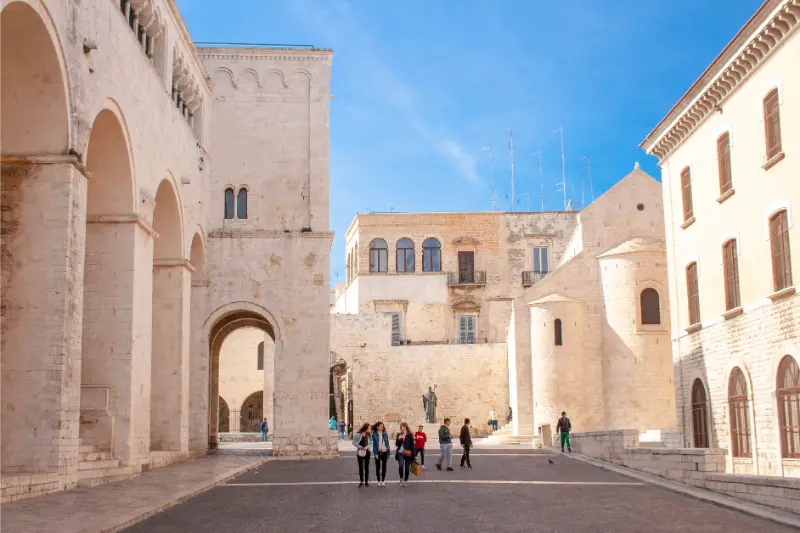
Bari is often treated as little more than the place where you land before setting off to explore Puglia. That is a mistake.
The capital of Puglia is one of southern Italy’s most interesting cities: a lively Adriatic port where medieval churches, narrow old-town streets, elegant nineteenth-century avenues, beaches and some of the region’s best street food all sit within walking distance of each other.
Bari does not have the polished, almost picture-perfect appearance of places such as Alberobello or Polignano a Mare. Its charm is different. It feels lived-in. Laundry hangs between balconies, fishermen gather by the harbour, locals stop for focaccia on their way home and, in the narrow streets of Bari Vecchia, pasta is still made by hand.
Spend at least a full day here and you will begin to understand the city. Stay for two or three nights and Bari also becomes an excellent base for exploring central Puglia.
In this Bari travel guide, you will find the best things to do, the places worth seeing, what to eat, where to stay, when to visit and the practical information you need to plan your trip.
Why Visit Bari?
Bari combines several sides of Puglia in one place.
You can start your morning wandering through Bari Vecchia, visit one of the most important churches dedicated to Saint Nicholas, eat a warm piece of focaccia for lunch, walk along the Adriatic in the afternoon and finish the day with a plate of orecchiette or seafood.
The historic centre is compact enough to explore largely on foot, while Bari Centrale railway station makes the city particularly convenient for travellers who want to visit other destinations without renting a car.
Bari is especially worth visiting for:
- Bari Vecchia, the atmospheric historic centre
- the Basilica of Saint Nicholas
- the impressive Norman-Swabian Castle
- traditional handmade orecchiette
- focaccia barese and panzerotti
- its long Adriatic seafront
- the elegant Murat district
- local markets and everyday city life
- easy day trips to some of Puglia’s best-known towns
If this is your first trip to the region, Bari also works well as either the first or final stop on a longer Puglia itinerary.
Best Things to Do in Bari
1. Get Lost in Bari Vecchia
If you do only one thing in Bari, make it a walk through Bari Vecchia, the city’s historic heart.
The old town occupies a maze of narrow lanes squeezed between the waterfront and the modern centre. Churches, small piazzas, arches, shrines and family homes appear around almost every corner.
And this is exactly the kind of place where following Google Maps too closely can make the experience worse.
Walk without worrying too much about your route.
You may find an elderly resident chatting from a balcony, children playing in a tiny square or a doorway opening onto a kitchen where lunch is being prepared.
Unlike historic centres that have become almost entirely tourist-oriented, Bari Vecchia still feels like a neighbourhood.
Among the streets you should eventually find are Strada Arco Basso, the Basilica of Saint Nicholas, Bari Cathedral and the streets surrounding Piazza Mercantile.
Tip: visit Bari Vecchia twice if you have time. Come once in the morning, when the streets are quieter, and again around sunset or after dinner. The atmosphere changes completely.
2. Walk Along the Street of the Orecchiette
One of the most photographed corners of Bari is Strada Arco Basso, now commonly known by visitors as the Street of the Orecchiette.
Here you can often see local women preparing trays of fresh pasta by hand outside their homes.
The small ear-shaped pasta called orecchiette is one of Puglia’s most recognisable foods, and watching the speed with which experienced hands turn tiny pieces of dough into perfectly shaped pasta is fascinating.
This is not a staged museum demonstration. The tradition belongs to the neighbourhood itself, which is part of what makes the experience so memorable.
Walk through respectfully, remember that these streets are people’s homes, and avoid treating residents as if they were simply part of a tourist attraction.
3. Visit the Basilica of Saint Nicholas
The Basilica di San Nicola is the most important religious monument in Bari and one of the city’s essential sights.
Located in Bari Vecchia, the Romanesque basilica houses the relics of Saint Nicholas, making Bari an important pilgrimage destination for Christians from both Western and Eastern traditions.
The exterior is striking in its simplicity, but make sure you also go inside and descend into the crypt.
Even if you are not religious, the basilica helps explain an important part of Bari’s identity.
Useful tip: this is an active place of worship rather than simply a tourist attraction, so dress appropriately and remain quiet during services.
4. See Bari Cathedral
A few minutes’ walk from the basilica stands another major example of Apulian Romanesque architecture: the Cathedral of San Sabino.
Built principally in the 13th century, the cathedral has the pale stone façade, rose window and restrained lines characteristic of Romanesque churches in Puglia.
Beneath it, the archaeological area preserves traces from different periods of Bari’s history.
Because the Basilica of Saint Nicholas receives so much attention, some visitors rush past the cathedral. It is worth visiting both, as they offer two different perspectives on Bari’s religious and architectural history.
5. Explore the Norman-Swabian Castle
At the edge of the old town rises the Castello Svevo di Bari, also known as the Norman-Swabian Castle.
Its history stretches back to the Norman period. The original fortress was built in the 12th century and was later transformed under Frederick II during the 13th century.
Today the castle operates as a museum as well as an impressive historic monument.
The castle is worth visiting not only for its architecture but also because it helps put Bari’s strategic importance on the Adriatic into perspective.
Allow roughly one to one and a half hours if you want to explore without rushing.
6. Walk on Bari’s City Walls
One of the best ways to see Bari Vecchia is from above.
Sections of the old defensive walls form an elevated pedestrian route around part of the historic centre. From here you can look over rooftops on one side and towards the Adriatic on the other.
It is particularly pleasant towards sunset, when the temperature drops and Bari begins its evening passeggiata.
7. Stop in Piazza Mercantile and Piazza del Ferrarese
Eventually almost every walk through central Bari leads to these two adjoining squares.
Piazza Mercantile was historically one of the city’s commercial centres and today is surrounded by cafés and restaurants.
A few steps away is Piazza del Ferrarese, an open square connecting the old town with the modern city and the seafront.
They are ideal places to stop for a coffee, an aperitivo or simply to watch everyday life unfold around you.
8. Walk Along Bari’s Lungomare
Bari’s relationship with the Adriatic is impossible to miss.
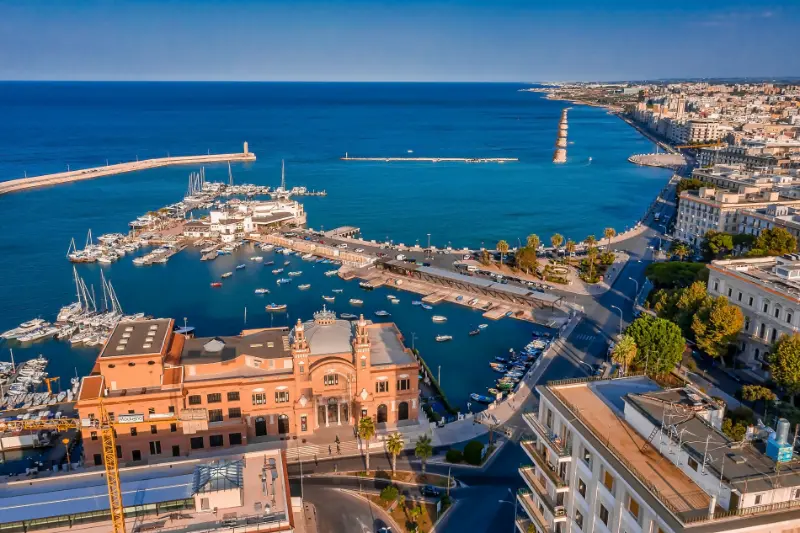
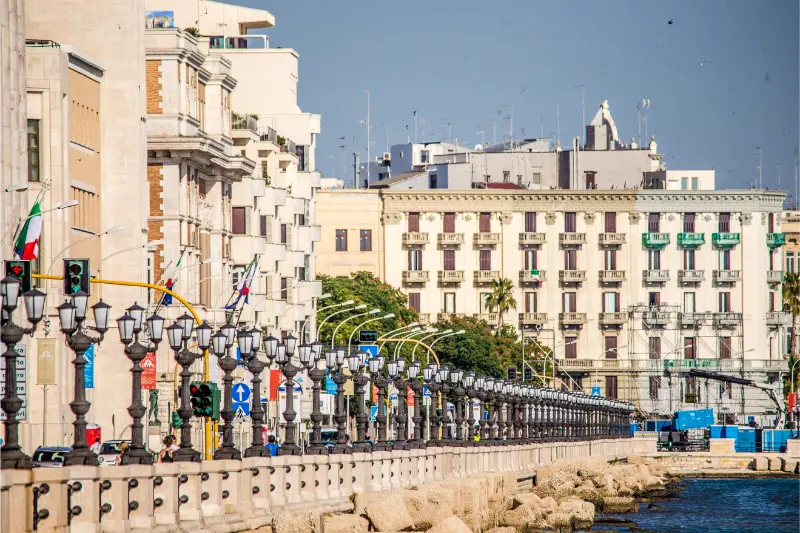
The lungomare, or seafront promenade, stretches for kilometres and is one of the best places in the city for a long walk.
Start near the old town and continue south past elegant early twentieth-century buildings, fishing boats and the city’s distinctive rows of street lamps.
The promenade is particularly beautiful around sunrise and sunset.
Do not expect the dramatic cliffs of Polignano a Mare here. Bari’s seafront is more urban, and that is precisely part of its appeal.
9. See Teatro Margherita
One of the most recognisable buildings on Bari’s waterfront is the Teatro Margherita, built directly over the sea on pillars.
Its position makes it immediately stand out during a walk between Bari Vecchia and the southern part of the lungomare.
Even when you are not visiting an exhibition inside, it is worth stopping here for photographs and views towards the old harbour.
10. Discover the Murat District
Cross Corso Vittorio Emanuele II and Bari changes character almost immediately.
You leave behind the narrow medieval streets and enter the orderly grid of the Murat district, developed during the nineteenth century.
This is the elegant, commercial side of Bari.
The two streets most visitors encounter are Via Sparano and Corso Cavour, where shops, cafés and grand architecture replace Bari Vecchia’s tiny lanes.
The district is also one of the best areas to stay if you want to be between Bari Centrale railway station and the old town.
11. Visit Teatro Petruzzelli
On Corso Cavour stands the imposing red façade of the Teatro Petruzzelli.
Opened in 1903, the theatre has long been one of Bari’s most important cultural landmarks. After being devastated by fire in 1991, it was rebuilt and reopened in 2009.
If there is a concert, opera or ballet during your visit, attending a performance is one of the best ways to experience the building.
12. See the Old Port at Molo San Nicola
For a glimpse of Bari’s maritime character, head towards Molo San Nicola, close to Teatro Margherita.
Fishing boats still form part of everyday life here.
Depending on when you arrive, you may see fishermen returning, preparing nets or working beside their boats.
This is one of those places where Bari feels less like a polished tourist destination and more like a working southern Italian city.
13. Go to the Beach at Pane e Pomodoro
Yes, you can go to the beach without leaving Bari.
Pane e Pomodoro is the city’s best-known urban beach and lies south of the centre along the waterfront.
Do not come expecting one of Puglia’s spectacular wild beaches. Instead, think of it as somewhere to cool down for a couple of hours between sightseeing, especially during summer.
If beaches are the main purpose of your holiday, there are far more scenic stretches of coast elsewhere in Puglia. For a city break, however, being able to finish a morning of sightseeing with a swim in the Adriatic is a welcome bonus.
What to Eat in Bari
Food is not an optional part of visiting Bari. It is one of the main reasons to come.
Some dishes are common throughout Puglia, but Bari has developed its own strong food culture, particularly when it comes to focaccia, panzerotti, seafood and street food.
Do not plan every meal around formal restaurants. Some of the most memorable things you will eat here may come wrapped in paper from a bakery.
Focaccia Barese
Start with focaccia barese.
It is usually thicker and softer than focaccia from some other parts of Italy, with a crisp base and a topping traditionally based around tomatoes, olives and oregano.
Good focaccia is moist inside, slightly oily, crispy around the edges and best eaten warm.
You will find bakeries all over Bari, especially in and around the old town.
The best way to eat it? Fresh from the bakery, preferably while walking towards the sea.
Panzerotto
Next comes the panzerotto.
Imagine a small half-moon of dough traditionally filled with tomato and mozzarella and then fried until crisp outside and wonderfully hot inside.
The first bite requires patience: the mozzarella can be extremely hot.
There are now many variations, but for your first panzerotto I would choose the classic tomato-and-mozzarella filling.
Orecchiette con le Cime di Rapa
Few dishes represent Puglia better than orecchiette con le cime di rapa.
The ear-shaped pasta is combined with turnip greens and traditionally flavoured with ingredients such as garlic, chilli and anchovy.
The slight bitterness of the greens is exactly what makes the dish work.
If turnip greens are out of season, you will find orecchiette served with many other sauces.
Sgagliozze
Walking through Bari Vecchia you may encounter sgagliozze: pieces of polenta cut into squares and fried.
They are simple, inexpensive and deeply linked to Bari’s street-food tradition.
Eat them hot from the paper bag.
Popizze
Another traditional fried snack is popizze.
These small pieces of fried dough are soft inside and golden outside and are often sold alongside other typical street foods.
Tiella Barese
For something more substantial, look for tiella barese, a baked dish traditionally combining rice, potatoes and mussels.
It is one of Bari’s most distinctive recipes.
The mussels release their flavour into the rice while the potatoes soften underneath and the top develops a slightly crisp finish.
If you want to understand Bari through food, this is a dish worth trying at least once.
Fresh Seafood
Bari has always looked towards the sea, so seafood naturally plays an important role in the local kitchen.
Menus may include grilled or fried fish, octopus, mussels, cuttlefish and other Adriatic seafood.
Raw seafood also has a strong tradition in Bari. If you want to try it, choose a reputable restaurant or fishmonger where the product has been stored and handled correctly.
Burrata and Local Cheese
Although burrata is particularly associated with the area around Andria, you will find it throughout Bari.
Fresh burrata with good bread, tomatoes and extra-virgin olive oil is one of those meals that proves Puglian cooking does not need to be complicated.
Also look for stracciatella, the creamy filling found inside burrata.
Where to Stay in Bari
For most first-time visitors, three areas stand out.
Bari Vecchia
Choose Bari Vecchia if atmosphere matters most.

You will be steps from the Basilica of Saint Nicholas, Bari Cathedral, restaurants and some of Bari’s most characteristic streets.
The downside is that accommodation can be located inside narrow pedestrian lanes and may be less convenient if you have a car or a lot of luggage.
Best for: couples, short city breaks and travellers who want historic atmosphere.
Murat
For most visitors, Murat is probably the most practical all-round choice.
You can walk to Bari Vecchia while remaining closer to shops, Bari Centrale railway station and the modern city.
There is also a wide choice of hotels and apartments.
Best for: first visits, travellers arriving by train and visitors using Bari as a base for day trips.
Madonnella
South-east of the centre and close to the lungomare, Madonnella has a more residential atmosphere.
It is worth considering if you prefer staying slightly away from Bari Vecchia’s busiest streets while remaining within walking distance of the main sights.
Best for: longer stays and travellers who enjoy being close to the waterfront.
How Many Days Do You Need in Bari?
You can see Bari’s principal attractions in one full day, but two days is much better.
With one day you can cover Bari Vecchia, the Basilica of Saint Nicholas, the cathedral, the castle, Murat and the seafront.
With two days you have time to slow down, visit museums or the theatre, enjoy the beach and devote more attention to food.
Three or more nights make sense if you want to use Bari as a base for exploring central Puglia.
Bari in One Day: Suggested Itinerary
Morning
Start early in Bari Vecchia.
Walk through Strada Arco Basso, see the orecchiette makers and continue to the Norman-Swabian Castle.
After the castle, walk to Bari Cathedral and then the Basilica of Saint Nicholas.
Lunch
Keep lunch simple and local.
Pick up some focaccia barese, try a panzerotto or choose a traditional trattoria serving Puglian dishes.
Afternoon
Walk towards Piazza Mercantile and Piazza del Ferrarese, then continue along the waterfront.
See Teatro Margherita before entering the Murat district.
Walk along Via Sparano and Corso Cavour and stop to admire Teatro Petruzzelli.
Evening
Return towards Bari Vecchia for dinner.
Order orecchiette, tiella or seafood and finish your day with an evening walk along the lungomare.
Bari becomes especially enjoyable after the heat of the afternoon has disappeared.
Best Day Trips from Bari
One of Bari’s biggest advantages is its location. Several of Puglia’s most famous destinations can be reached as day trips.
Polignano a Mare
With white houses perched above the Adriatic and the famous Lama Monachile beach between cliffs, Polignano a Mare is one of the easiest additions to a Bari trip.
It works especially well for visitors travelling without a car.
Monopoli
A little farther south, Monopoli combines a beautiful historic centre, fishing harbour and nearby beaches.
If you have enough time, Polignano and Monopoli can even be combined into one longer day.
Alberobello
The UNESCO-listed trulli of Alberobello make it one of the most distinctive towns in Puglia.
It is more touristy than many other towns in the region, but seeing the concentration of conical stone houses for the first time is still remarkable.
Matera
Matera is technically in the neighbouring region of Basilicata rather than Puglia, but Bari is often used as a gateway to the city.
Its ancient cave neighbourhoods, the Sassi di Matera, make it one of southern Italy’s extraordinary destinations.
If your itinerary allows it, staying overnight is preferable to treating Matera as a rushed excursion.
How to Get to Bari
By Plane
Bari is served by Bari Karol Wojtyła Airport (BRI), located northwest of the city centre.
The airport is connected with central Bari by train, bus, taxi and private transfer services.
If Bari is your first stop and you are only visiting the city, renting a car immediately is usually unnecessary. Much of central Bari is easier to explore on foot.
A rental car becomes more useful when you leave Bari to explore smaller towns, beaches and the Puglian countryside.
By Train
Bari Centrale is one of the main railway hubs in southern Italy.
Its location is extremely convenient: from the station you can walk along Via Sparano towards the historic centre rather than needing another transfer.
Regional rail connections also make Bari useful as a base for several destinations along the Adriatic coast.
Getting Around Bari
For sightseeing, walking is the best way to explore Bari.
The central area containing Murat, Bari Vecchia, the waterfront and most major monuments is relatively compact.
Public buses are useful for destinations farther from the historic centre.
Cycling can also be enjoyable along parts of the waterfront, although Bari Vecchia’s busiest narrow alleys are better explored on foot.
A car is unnecessary for the historic centre and can actually become inconvenient because of traffic restrictions, limited parking and narrow streets.
Best Time to Visit Bari
April to June
For many travellers, this is one of the best periods to visit Bari.
Temperatures are generally pleasant for sightseeing, daylight hours are long and you avoid some of the most intense summer heat.
May is particularly interesting because Bari celebrates Saint Nicholas, its patron saint.
July and August
Summer brings hot weather, lively evenings and the possibility of combining sightseeing with the beach.
It is also the period when walking through the city in the middle of the afternoon can become tiring.
In summer, explore early, slow down during the hottest hours and head outside again later in the afternoon.
September and October
Early autumn can be an excellent compromise between warm weather and fewer peak-season visitors.
The sea can remain inviting, especially in September.
Winter
Bari remains a working city throughout the year, so it does not close down in winter in the way some smaller seaside destinations do.
This can be an interesting season for travellers interested primarily in food, architecture and everyday local life rather than beaches.
Is Bari Safe?
Bari is generally straightforward to visit, including around the main tourist areas.
As in other busy European cities, normal precautions make sense: keep an eye on phones, wallets and bags around crowded stations, public transport and busy streets.
Bari Vecchia is lively in the evening, with residents, families and visitors filling its streets and squares.
Is Bari Worth Visiting Without a Car?
Absolutely.
In fact, Bari is one of the easiest places in Puglia to visit without a car.
The historic centre is walkable, Bari Centrale is centrally located and rail connections make several nearby coastal destinations accessible.
If your trip focuses on Bari, Polignano a Mare and Monopoli, travelling by train can be easier than driving.
A rental car becomes much more valuable if your itinerary includes countryside masserie, remote beaches, small inland villages or multiple stops through the Valle d’Itria and southern Puglia.
Bari Travel Tips
- Do not rush Bari Vecchia. The pleasure comes from wandering rather than simply ticking off landmarks.
- Eat street food. A restaurant-only visit means missing an important part of Bari’s food culture.
- Wake up early at least once. Bari Vecchia in the morning feels completely different from the busiest hours of the day.
- Carry comfortable shoes. Uneven stone streets and long walks along the seafront add up quickly.
- Respect churches. Saint Nicholas Basilica and Bari Cathedral remain active religious buildings.
- Avoid driving into the historic centre. If you are travelling around Puglia by car, choose accommodation with clear parking arrangements.
- Keep some room for spontaneous food stops. In Bari, the smell coming from a bakery can easily change your lunch plans.
Frequently Asked Questions About Bari
Is Bari worth visiting?
Yes. Bari is worth visiting for its atmospheric old town, Romanesque churches, castle, seafront and exceptionally strong street-food culture. It also provides a useful base for exploring central Puglia.
Is one day enough for Bari?
One day is enough to see Bari’s main landmarks, but two days give you a much better experience and allow time to explore without rushing.
What is Bari famous for?
Bari is particularly known for Saint Nicholas Basilica, Bari Vecchia, handmade orecchiette, focaccia barese, panzerotti and its Adriatic waterfront.
What food should I try in Bari?
At minimum, try focaccia barese, panzerotti, orecchiette, sgagliozze and tiella barese. Seafood and burrata are also excellent choices.
Can you walk around Bari?
Yes. Most attractions that first-time visitors want to see are concentrated around Bari Vecchia, Murat and the lungomare and are best explored on foot.
Does Bari have beaches?
Yes. Pane e Pomodoro is Bari’s best-known urban beach and can be reached easily from the city centre.
Where should I stay in Bari for the first time?
For convenience, Murat is an excellent choice because it sits between Bari Centrale and the historic centre. Choose Bari Vecchia instead if atmosphere and historic surroundings are your priority.
Is Bari a good base for exploring Puglia?
Yes, particularly if you are travelling by train. Destinations including Polignano a Mare and Monopoli work particularly well from Bari, while a car opens up many more possibilities inland.
Plan your stay
Final Thoughts: Why Bari Deserves More Than a Stopover
Bari will probably not be the place in Puglia that looks most dramatic on your Instagram feed.
And that may be exactly why it deserves your time.
The city is not simply a collection of monuments. Its real attraction is the mixture of everyday life, food, history and the Adriatic.
You notice it while walking through Bari Vecchia in the morning. You taste it in a piece of focaccia eaten straight from the bakery. You see it in fishermen working beside the old harbour and families walking along the lungomare in the evening.
Visit the Basilica of Saint Nicholas and the castle, certainly. Walk through Via Sparano and photograph the waterfront.
But leave some time with no itinerary at all.
Get lost in Bari Vecchia, follow the smell of a bakery, sit in a piazza and watch the city.
That is when Bari becomes much more than the place where your journey through Puglia begins.
It becomes one of the places you remember.
Explore more of this area: for a wider route, nearby towns, beaches, where to stay and practical planning, see our Bari & Central Puglia Travel Guide.
2 thoughts on “Bari Travel Guide: Best Things to Do, See & Eat”