
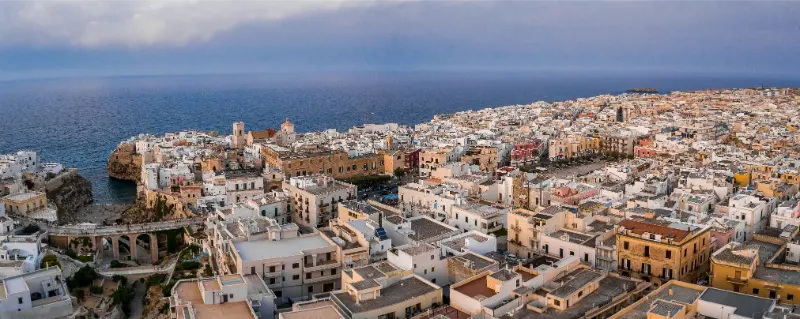
Few places capture the beauty of coastal Puglia quite like Polignano a Mare. White houses rise above dramatic limestone cliffs, narrow streets suddenly open onto panoramic terraces overlooking the Adriatic, and at the bottom of a rocky gorge lies Lama Monachile, one of the most photographed beaches in southern Italy.
But Polignano a Mare is much more than its famous postcard view. Walk beyond the bridge and the busiest streets and you will discover a compact historic centre filled with stone alleys, small squares, balconies suspended above the sea and quiet corners where you can experience the atmosphere of an authentic Puglian coastal town.
Spend a little more time here and you can explore sea caves by boat, swim in small rocky coves, visit the nearby village of San Vito, taste fresh seafood and enjoy one of the most beautiful stretches of the Adriatic coast.
This guide covers the best things to do in Polignano a Mare, the most beautiful beaches, what to eat, how to get there, where to stay and useful travel tips for planning your visit.
Why Visit Polignano a Mare?
Polignano a Mare is located on the Adriatic coast of Puglia, south of Bari and just north of Monopoli. Its position makes it one of the easiest destinations to include in a trip through central Puglia.
The first thing that makes Polignano special is its landscape. Much of the old town stands directly above high limestone cliffs, with white buildings appearing almost to rise from the rock itself.
Over centuries, the Adriatic Sea has carved caves, arches and small coves into the coastline. This combination of historic architecture and dramatic nature is what gives Polignano a Mare its unmistakable character.
The town is also surprisingly compact. You can see its main attractions in one day, although staying for at least one night allows you to experience Polignano early in the morning and in the evening, when many day visitors have already left.
Best Things to Do in Polignano a Mare
1. Admire Lama Monachile from Above
For most travellers, Lama Monachile is the image that first comes to mind when thinking about Polignano a Mare.
Also known as Cala Porto, this small pebble beach sits at the end of a natural rocky gorge, surrounded by towering limestone cliffs and the buildings of the historic centre.
One of the best viewpoints is from the bridge crossing the gorge. From here you can see the pale pebbles, turquoise water and vertical rock walls that make Lama Monachile one of the most recognisable beaches in Puglia.
If possible, visit early in the morning. The light is beautiful and the beach is generally quieter than later in the day.
2. Walk Down to Lama Monachile Beach
After enjoying the view from above, walk down to Lama Monachile Beach.
This is not a long sandy beach. It is a relatively small cove covered mainly with smooth pebbles, and during July and August it can become extremely crowded.
If you plan to swim, water shoes can be very useful, both for walking over the pebbles and for entering the sea more comfortably.
Lama Monachile is worth visiting primarily for its extraordinary setting. If your priority is spending an entire day relaxing on the beach, some of the smaller coves outside the town centre may be a better choice.
3. Explore Polignano a Mare Old Town
Enter the historic centre through Arco Marchesale, also known as Porta Grande, and you will immediately find yourself in a maze of narrow stone streets, arches, whitewashed houses and tiny squares.

This is one of those places where following a strict itinerary is unnecessary. Simply walk through whichever alley looks interesting and allow yourself to get slightly lost.
Many streets eventually lead to panoramic terraces suspended above the Adriatic. These viewpoints are among the most beautiful places in Polignano and offer a completely different perspective from Lama Monachile.
Take your time here. The charm of the old town is found as much in its balconies, stone staircases and hidden corners as in its main monuments.
4. Visit Piazza Vittorio Emanuele II
At the heart of the historic centre is Piazza Vittorio Emanuele II, one of the main gathering places in the old town.
Here you will find the Chiesa Matrice di Santa Maria Assunta, together with Palazzo dell’Orologio and several historic buildings.
The square is small and atmospheric, making it a good place to stop before continuing through the nearby alleys and panoramic terraces.
5. Look for Poetry Around the Old Town
One of the most unusual details of Polignano a Mare can be found on its walls, doors and staircases.
Short poems, verses and literary quotations appear throughout the historic centre, transforming an ordinary walk into a small treasure hunt.
Do not look only at the sea and the buildings. Occasionally look down at the steps or towards the walls and doorways: some of Polignano’s most charming details are easy to miss.
6. Take a Boat Tour of the Sea Caves
If you choose only one paid experience in Polignano a Mare, a boat tour along the coast is one of the best options.
The coastline looks completely different from the sea. From a boat you can appreciate just how dramatically the old town rises above the cliffs and explore some of the caves carved into the limestone.
Among the best-known sea caves are Grotta Palazzese, Grotta delle Rondinelle, Grotta Ardito and Grotta delle Monache.
Many excursions also include time for swimming when sea conditions permit. Kayak and stand-up paddle tours are good alternatives for travellers who prefer a more active experience.
For a first visit, seeing Polignano from the water is particularly worthwhile. Walking through the town shows you its streets and buildings; seeing it from the Adriatic helps you understand the extraordinary geography of the coast.
7. See Grotta Palazzese
Grotta Palazzese is one of the most famous sea caves in Polignano a Mare.
Today it is particularly well known because part of the cave is occupied by a luxury restaurant built into the limestone cliff.
You do not need to dine there to appreciate the setting. One of the best ways to understand the scale and location of the cave is to see it from the sea during a coastal boat excursion.
8. Visit the Domenico Modugno Statue
A short walk from Lama Monachile brings you to the statue of Domenico Modugno, one of the most famous people born in Polignano a Mare.
Modugno became internationally famous thanks to the song Nel blu dipinto di blu, better known around the world as Volare.
The bronze statue shows the singer with his arms spread wide towards the town and sea.
Continue walking behind the statue towards the waterfront for another excellent view of Polignano’s cliffs and coastline.
9. Visit the Pino Pascali Museum
Polignano a Mare is not only about beaches and sea views. Travellers interested in contemporary art can visit the Fondazione Museo Pino Pascali.
The museum is dedicated to Pino Pascali, an important Italian artist born in Polignano, and hosts exhibitions of contemporary art.
Its location overlooking the sea also makes the museum an interesting stop during a walk along the coast.
Opening hours and exhibitions can change during the year, so it is advisable to check the museum’s current information before visiting.
10. Discover San Vito and Its Abbey
A few kilometres north of central Polignano is the small coastal settlement of San Vito.
The main landmark is the impressive Abbazia di San Vito, which stands directly beside the sea. Nearby you will also find a small harbour, fishing boats, rocky bathing areas and a historic coastal tower.
San Vito has a quieter atmosphere than central Polignano and is well worth including if you have more than one day or are travelling by car.
You can combine a visit with some of the beaches and coves along this section of the coast.
Best Beaches in Polignano a Mare
One important thing to know before visiting Polignano is that this part of the Puglian coast is very different from areas known for long sandy beaches.
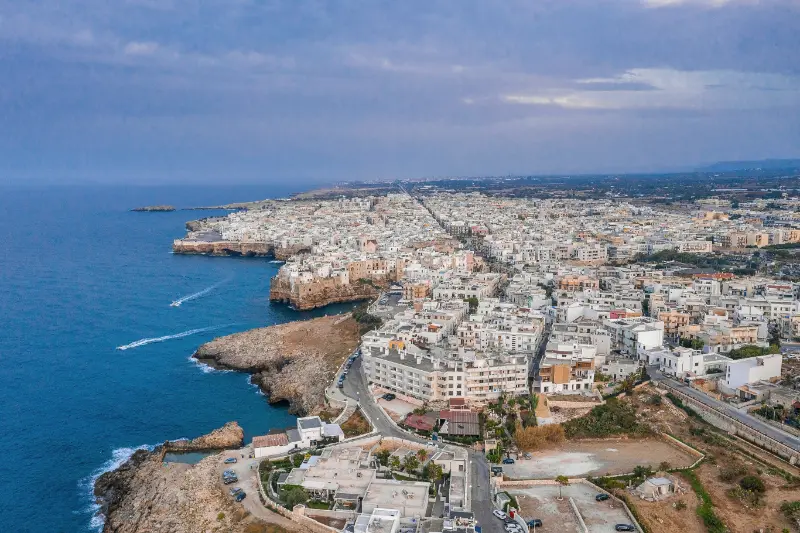
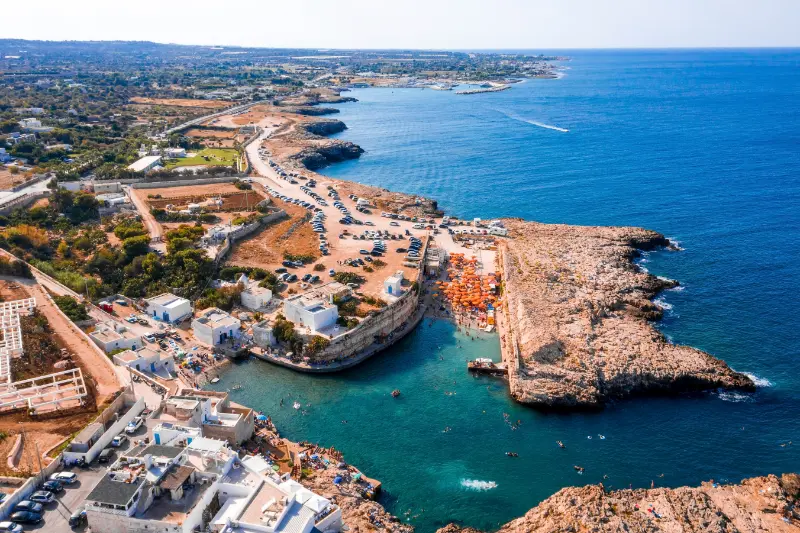
Around Polignano you will find mainly limestone cliffs, rocky swimming spots, pebble beaches and small coves. This is exactly what makes the landscape so spectacular.
Lama Monachile
Best for: iconic views, photography and a first swim in Polignano.
Lama Monachile is the beach everyone should see at least once, even if you are not planning to spend the day swimming.
The combination of white pebbles, turquoise water, cliffs and historic buildings creates one of the most memorable coastal landscapes in Puglia.
The main disadvantage is its popularity. In July and August, arrive early if you want enough space to sit comfortably.
Cala Paura
Best for: swimming, snorkelling and a more local atmosphere.
Close to the Domenico Modugno statue, Cala Paura consists of small rocky inlets and platforms overlooking clear water.
It feels very different from Lama Monachile and is often used more as a place for swimming than as a traditional beach where you lie on the sand.
Ponte dei Lapilli
Best for: travellers looking for a quieter pebble cove.
Heading north towards San Vito, Ponte dei Lapilli is another attractive coastal spot with pale stones and clear Adriatic water.
It requires a little more effort to reach than the beaches in the town centre, which can make it a good alternative when Polignano is particularly busy.
Porto Cavallo
Best for: families and travellers looking for easier access to the sea.
Near San Vito, Porto Cavallo has a small sandy area together with rocky sections.
The water close to the shore can be more practical for families than some of the deeper rocky swimming spots closer to central Polignano.
Porto Contessa
Close to San Vito is the small cove of Porto Contessa.
It can easily be combined with a visit to the abbey and other beaches north of Polignano, particularly if you are travelling by car.
San Vito Beach
The main attraction here is the scenery.
You can enjoy the Adriatic with the historic abbey and coastal tower forming the backdrop, creating one of the most distinctive seaside views around Polignano.
Cala San Giovanni
Best for: travellers who prefer a more traditional beach experience.
If you are specifically looking for sand rather than pebbles and rocks, Cala San Giovanni is one of the options to consider outside the historic centre.
What to Eat in Polignano a Mare
Food should be part of your experience in Polignano rather than simply something squeezed between sightseeing stops.
Thanks to its position on the Adriatic, fresh seafood plays an important role in local cuisine.
Depending on the restaurant and season, you may find grilled fish, fried seafood, octopus, mussels and seafood pasta.
One traditional Puglian dish worth trying is riso, patate e cozze, a baked combination of rice, potatoes and mussels.
Polignano has also become famous for its fish sandwiches, often prepared with octopus, tuna or fried seafood and served as a quick lunch close to the historic centre.
Another local speciality is Caffè Speciale, a sweet coffee associated with Polignano and traditionally prepared with coffee, cream, lemon zest and amaretto.
And of course, you are still in Puglia. Look for focaccia, burrata, orecchiette, seasonal vegetables and local extra virgin olive oil.
How Long Should You Spend in Polignano a Mare?
Half a Day
Half a day is enough to see Lama Monachile, walk through the historic centre, visit the main viewpoints and stop for lunch or an aperitivo.
However, during summer this can feel rushed.
One Full Day
For most first-time visitors, one full day is ideal.
You can explore the old town in the morning, visit Lama Monachile, enjoy lunch, take a boat tour in the afternoon and stay for sunset and dinner.
Two Days
Two days are worthwhile if you want to spend more time at the beach, explore San Vito, visit the Pino Pascali Museum or enjoy Polignano when the day-trip crowds have disappeared.
If you are travelling around Puglia, staying one night is often the best compromise.
One Day in Polignano a Mare: Suggested Itinerary
Morning
Arrive early and start with Lama Monachile. First admire the view from the bridge and then walk down to the beach.
Afterwards, enter the historic centre through Arco Marchesale and explore Piazza Vittorio Emanuele II, the church and the small streets leading towards the panoramic terraces.
Lunch
Stop for seafood, a fish sandwich or another traditional Puglian speciality.
If you only have one day, an informal lunch is often a good choice because it leaves more time for exploring.
Afternoon
Take a boat tour of the sea caves. This is one of the best ways to see Grotta Palazzese and appreciate Polignano’s dramatic cliffs from the water.
After the boat trip, walk towards the Domenico Modugno statue and continue along the waterfront.
Sunset and Evening
Return to the historic centre and choose one of the terraces overlooking the Adriatic for sunset.
Finish the day with dinner and an evening walk through the illuminated streets of the old town.
How to Get to Polignano a Mare
From Bari by Train
Polignano a Mare is one of the easiest coastal destinations in Puglia to visit without a car.
Regional trains connect Bari with Polignano a Mare and continue south towards destinations such as Monopoli, Ostuni and Lecce.
The railway station is located within walking distance of the historic centre.
Always check the current timetable before travelling, particularly on Sundays, public holidays and during periods of railway works.
By Car
A car is useful if Polignano is part of a longer road trip through Puglia.
It gives you more flexibility for visiting San Vito, surrounding beaches, Monopoli, Alberobello and the Valle d’Itria.
However, parking close to the historic centre can be difficult during summer. It is usually better to leave your car outside the oldest part of town and continue on foot.
From Bari Airport
From Bari Karol Wojtyła Airport, you can first travel towards Bari and then continue south by regional train.
If Polignano is the first stop of a longer trip through Puglia, renting a car may be more convenient, especially if you plan to visit inland villages and beaches that are difficult to reach by public transport.
Best Time to Visit Polignano a Mare
May and June
Late spring and early summer are among the best periods for sightseeing. Days are long, temperatures are usually pleasant and the town is easier to explore than during peak summer.
July and August
This is the liveliest period of the year, with beaches, restaurants and boat excursions operating at full summer pace.
It is also the busiest period. Lama Monachile can become extremely crowded, particularly around midday.
If you visit in July or August, start your day as early as possible.
September
September is an excellent month for visiting coastal Puglia. The sea is still warm, summer services are generally still available and crowds usually become lighter as the month progresses.
October to April
Polignano remains beautiful outside the summer season.
If your priorities are photography, food and exploring the old town rather than swimming, travelling during the cooler months can be very rewarding.
Some beach services and boat excursions may operate less frequently outside the main tourist season.
Useful Travel Tips for Polignano a Mare
- Wear comfortable shoes. The historic centre has stone streets, steps and uneven surfaces.
- Bring water shoes. They are particularly useful at Lama Monachile and other rocky or pebble beaches.
- Start early during summer. This is especially important if you want to enjoy Lama Monachile before the largest crowds arrive.
- Do not visit only Lama Monachile. The old town, panoramic terraces, sea caves and San Vito are equally important parts of the experience.
- Consider a boat tour. Much of Polignano’s coastline cannot be fully appreciated from land.
- Check sea conditions before swimming or taking a boat excursion. Wind and waves can affect coastal activities.
- Avoid dangerous cliff jumping. Professional diving events take place under controlled conditions and should not be imitated.
- Stay overnight if possible. Early morning and evening are often the most pleasant times to explore the historic centre.
Is Polignano a Mare Good for Families?
Yes, but choosing the right beach can make a significant difference.
The historic centre is enjoyable with children, although there are steps, stone streets and plenty of walking.
Lama Monachile is beautiful but not necessarily the easiest beach for families, especially when crowded. Pebbles, limited space and the rocky environment may make other beaches around Polignano more comfortable.
Porto Cavallo and other beaches outside the centre may be more practical depending on sea conditions and the age of your children.
Where to Stay in Polignano a Mare
Historic Centre
Choose the old town if atmosphere is your main priority.
You will be surrounded by restaurants, small streets and panoramic viewpoints, with Lama Monachile only a few minutes away on foot.
The disadvantages are limited vehicle access, stairs and potentially more noise during busy summer evenings.
Around the Town Centre and Railway Station
Staying just outside the historic centre is often the most practical solution.
You remain within walking distance of the main attractions while making arrival with luggage and access to the railway station easier.
San Vito and the Coast
Accommodation outside central Polignano is a good choice if your priority is relaxation, coastal scenery and beach time rather than nightlife and sightseeing.
A car is generally more useful when staying in these areas.
Best Places to Visit Near Polignano a Mare
Monopoli
Monopoli is one of the easiest places to combine with Polignano a Mare.
It has a beautiful historic centre, an old harbour, a castle and numerous small coves along the coast.
Alberobello
Famous for its unique trulli, Alberobello provides a completely different landscape from the Adriatic coast.
Combining Alberobello and Polignano in one day is possible, although spending more time in each destination makes for a more relaxed experience.
Castellana Grotte
The spectacular cave system of Castellana Grotte is one of the most interesting attractions inland from Polignano.
Locorotondo
Locorotondo is one of the prettiest villages in the Valle d’Itria and combines particularly well with Alberobello on a day trip from the coast.
Bari
Puglia’s regional capital is much more than an airport gateway.
Bari Vecchia, the seafront, historic churches and local street food make Bari an excellent addition to an itinerary that includes Polignano a Mare.
Is Polignano a Mare Worth Visiting?
Yes, Polignano a Mare is absolutely worth visiting.
Lama Monachile deserves its reputation, but the town becomes much more interesting once you move beyond the famous photograph.
Walk through the old gateway, explore the white stone streets, stop at the balconies overlooking the Adriatic, taste local seafood, try a Caffè Speciale and, if possible, see the cliffs from a boat.
Polignano can be extremely busy in summer, but there is a reason it remains one of the most popular destinations in Puglia.
Few towns combine historic streets, dramatic cliffs, clear Adriatic water, sea caves and Puglian food in such a compact area.
Give it a full day, or better still stay until the evening, and Polignano a Mare becomes much more than one of Puglia’s most photographed places.
Polignano a Mare FAQ
What is Polignano a Mare famous for?
Polignano a Mare is famous for its dramatic limestone cliffs, historic centre, sea caves and Lama Monachile, the pebble beach below the old town. It is also the birthplace of Italian singer Domenico Modugno.
Is one day enough for Polignano a Mare?
Yes. One full day is enough to explore the historic centre, see Lama Monachile, visit the main viewpoints and take a boat excursion. Staying overnight allows you to experience the town when it is quieter.
Can you visit Polignano a Mare without a car?
Yes. Polignano a Mare is well connected by regional train with Bari and other towns along the Adriatic coast, and the railway station is within walking distance of the historic centre.
Does Polignano a Mare have sandy beaches?
Most beaches around central Polignano are rocky or pebbly. Lama Monachile is a pebble beach. Some beaches farther from the historic centre have sandy sections and can be more suitable for travellers looking for a traditional beach experience.
Is Lama Monachile free?
Yes. Lama Monachile is a public beach and can be reached on foot directly from the town centre. Because it is relatively small, it can become very crowded in summer.
What is the best time to visit Polignano a Mare?
For pleasant weather, swimming and fewer crowds, May, June and September are among the best months. July and August offer the liveliest summer atmosphere but are also the busiest.
Should I stay in Polignano a Mare or Monopoli?
Choose Polignano a Mare for dramatic cliffs, panoramic views, sea caves and a romantic coastal atmosphere. Choose Monopoli if you prefer a larger historic centre, an old harbour and easier access to several beaches. Since the two towns are close to each other, visiting both is an excellent option.
Explore more of this area: for a wider route, nearby towns, beaches, where to stay and practical planning, see our Bari & Central Puglia Travel Guide.