

Gargano National Park is one of the places that most clearly challenges the usual image of Puglia. Instead of endless olive groves and flat countryside, this corner of northern Puglia rises dramatically from the Adriatic, combining limestone cliffs, dense forests, mountain villages, pilgrimage routes, wetlands, sea caves and some of the region’s most striking beaches.
The park occupies much of the Gargano promontory in the province of Foggia, the mountainous projection often described as the “spur” of Italy’s boot. Its best-known destinations include Vieste, Peschici, Monte Sant’Angelo and the Foresta Umbra, but limiting a visit to those places means missing much of what makes the area special.
What really distinguishes the Gargano is the variety packed into relatively short distances. You can walk beneath centuries-old beech trees in the morning, descend to a white-cliff beach in the afternoon and spend the evening wandering through a medieval town above the sea.
It is also a destination that rewards careful planning. Roads are winding, distances on a map can be deceptive, summer parking can be difficult and many of the most rewarding places are scattered across the promontory rather than concentrated around a single town.
If you want to experience Gargano National Park properly rather than simply drive through it, allow at least three days. Four or five days is considerably better.
Why Visit Gargano National Park?
There are several good reasons to include the Gargano in a Puglia itinerary, but the strongest is its extraordinary diversity.
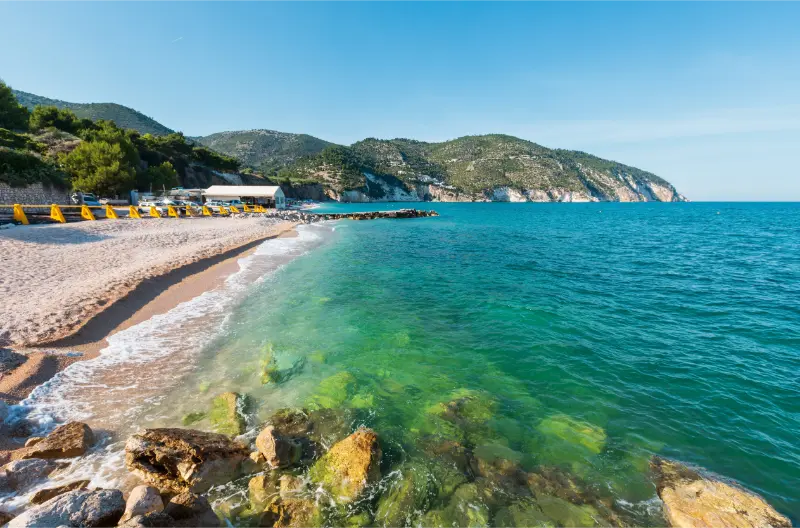
Along the coast between Mattinata, Vieste and Peschici, pale limestone cliffs alternate with sandy bays, pebble beaches and small coves reached by steep roads or walking paths. Inland, the landscape changes quickly into the Foresta Umbra, a vast woodland occupying the higher part of the promontory.
The Gargano’s old-growth beech forests form part of the UNESCO World Heritage property protecting ancient and primeval beech forests of Europe, making the area important not only for its scenery but also for its natural heritage.
Cultural sites are equally significant. Monte Sant’Angelo has been a major pilgrimage destination for centuries, while coastal towns such as Vieste and Peschici preserve compact historic centres built on cliffs overlooking the Adriatic.
The result is a part of Puglia that works particularly well for travellers who do not want to choose between beaches, hiking, historic villages and nature.
Best Places to Visit in Gargano National Park
Foresta Umbra
If you visit only one natural area away from the coast, make it the Foresta Umbra.
The forest occupies the high interior of the Gargano and feels surprisingly different from the beaches only a relatively short drive away. At around 700 to 800 metres above sea level, temperatures can be noticeably cooler, especially in the morning and late afternoon.
The most practical place to begin is the central area around Laghetto d’Umbra and the visitor facilities, reached from the roads crossing the forest between Vieste, Monte Sant’Angelo and Vico del Gargano.
Laghetto d’Umbra sits at approximately 790 metres above sea level. The small lake itself is pleasant, but it should not be considered the main attraction. Its real value is as an easy reference point and starting area for exploring the surrounding woodland.
A short visit of around one hour gives you an introduction to the forest, but two to four hours is much more rewarding if you intend to walk.
The official trail network includes routes connecting Laghetto d’Umbra, Falascone, Murgia, Lago d’Otri, Sfilzi, Caritate and other parts of the forest.
Do not assume that every route is a perfectly maintained tourist path. Conditions can vary after storms, heavy rain or forestry work, so it is sensible to check local signage and current park information before committing to a longer route.
Early morning is particularly enjoyable. Roads are quieter, wildlife is more active and light filters attractively through the trees. During July and August, the Foresta Umbra is also one of the best places to escape the strongest heat along the coast.
Vieste
Vieste is the most practical coastal base for a first visit to Gargano National Park.
The town occupies a rocky promontory between long beaches, with its historic centre rising above the Adriatic. The old town is compact but steep, consisting of white houses, narrow streets, staircases and viewpoints stretching between the Cathedral of Santa Maria Assunta and the San Francesco area at the tip of the peninsula.
Allow around two hours to explore the historic centre without rushing.
A good route starts near Piazza Vittorio Emanuele II and continues towards the cathedral before entering the lanes around Via Pola and Via Judeca. From there, continue towards the San Francesco area and the cliff edge.
This direction works particularly well because the walk gradually leads towards the sea views rather than forcing you to repeatedly climb and descend the same streets.
In summer, late afternoon is one of the best times to explore. Around 18:00 the light begins to soften and the heat becomes more manageable. After dinner the busiest central streets become much more crowded.
Vieste is also an excellent base geographically. It sits roughly midway along the most scenic eastern coast of the Gargano, making it convenient for excursions north towards Peschici and south towards Vignanotica, Baia delle Zagare and Mattinata.
Drivers should avoid trying to enter the narrow historic centre. Traffic restrictions and pedestrian areas affect parts of central Vieste, particularly in summer.
The area around Lungomare Europa can be more practical for parking if you are willing to walk into the centre. Parking conditions change seasonally, so current signs and municipal regulations should always take priority over older online information.
Pizzomunno and Spiaggia del Castello
Immediately south of central Vieste stands Pizzomunno, the tall white limestone monolith that has become one of the symbols of the Gargano.
It rises directly beside Spiaggia del Castello, one of the easiest beaches to combine with sightseeing in Vieste.
If you are staying in town, there is no need to make a separate excursion. Combine the beach with an early-morning or evening walk along Lungomare Enrico Mattei.
Spiaggia del Castello is broad and sandy, making it considerably easier for families than some of the small pebble coves farther south. The seabed is generally more gradual and there are numerous beach clubs, bars and accommodation options nearby.
Early morning is particularly good for photographs of Pizzomunno because the beach is quieter and the light falls from the Adriatic side.
Peschici
Peschici is smaller than Vieste and immediately feels more compact.
Its white historic centre occupies a rocky promontory above the sea, with narrow alleys, small squares, shops and terraces overlooking the coast.
A realistic visit takes around 90 minutes to two hours. Allow longer if you plan to stop for lunch or combine the old town with the beach below.
Do not simply walk through the busiest commercial lanes and leave. Continue towards the castle side of the historic centre and the cliff edge, where the relationship between the village, beach and coastline becomes much clearer.
Late afternoon works particularly well in Peschici. The white façades take on warmer colours and the strongest midday heat has passed.
Parking near the centre can become difficult in July and August. If possible, arrive before 10:00 or later in the afternoon rather than around lunchtime, when both beach traffic and day visitors compete for spaces.
Monte Sant’Angelo
Monte Sant’Angelo sits high above the southern side of the Gargano and is one of the most historically important places in the national park.
The town is best known for the Sanctuary of San Michele Arcangelo, whose sacred cave has attracted pilgrims for centuries.
However, the sanctuary is only part of the reason to visit.
After seeing the religious complex, walk through the Junno district, where rows of low white houses descend along the hillside. Continue towards the castle and the panoramic edges of town for views across the surrounding landscape.
Compared with Vieste and Peschici, Monte Sant’Angelo feels much more like a mountain settlement than a coastal resort.
Allow at least two to three hours.
It combines naturally with the Foresta Umbra. Visiting the forest and Monte Sant’Angelo on the same day is far more efficient than returning to the coast between the two.
Mattinata
Mattinata receives less attention than Vieste or Peschici, but it makes an excellent base for exploring the southern Gargano coast.
The town itself is relatively quiet and does not have the same dramatic historic centre as Peschici, but its location is highly practical.
The coastal road north from Mattinata towards Vieste passes close to Vignanotica, Baia delle Zagare and some of the most spectacular cliff scenery in the Gargano.
Mattinata is therefore particularly suitable if your priorities are beaches, kayaking, coastal walks and quiet evenings rather than nightlife.
The Mattinata to Vieste Coastal Road
Driving the coastal road between Mattinata and Vieste is one of the essential Gargano experiences.
Do not judge the journey by distance alone. The road curves repeatedly around the limestone cliffs and is not a route to rush.
The most scenic stretch follows the SP53 north of Mattinata, where elevated sections reveal pine-covered slopes, sea stacks, hidden coves and open views across the Adriatic.
Allow at least 90 minutes for the drive if you intend to stop occasionally. Half a day is more realistic if you include a beach.
In summer, avoid stopping randomly at the side of the road for photographs. Several sections have little or no safe shoulder. Use proper lay-bys and established parking areas.
The coast generally photographs particularly well in the morning, when the eastern side of the promontory receives stronger light.
Baia delle Zagare
Baia delle Zagare, also known as Baia dei Mergoli, is one of the classic landscapes of the Gargano.
High white cliffs, pale water and offshore limestone sea stacks make it one of the most recognisable stretches of coastline in Puglia.
However, visitors should know that reaching the beach can require more planning than at the large public beaches around Vieste.
Access arrangements can vary and some approaches are connected with nearby accommodation or controlled routes from the coastal road.
For many travellers, seeing the bay from the surrounding coastal viewpoints and walking in the area is just as rewarding as spending several hours on the beach.
If time is limited, it can make sense to admire Baia delle Zagare from above and use Vignanotica for swimming, where access is generally more straightforward.
Baia di Vignanotica
Vignanotica is one of the best choices for travellers who want the classic white-cliff Gargano landscape without relying on a resort beach.
The shoreline is largely composed of pale pebbles rather than soft sand and is backed by an imposing limestone cliff.
The water can become deep relatively quickly, so swimming shoes are useful and families with very young children may find the sandy beaches around Vieste easier.
Access is from the coastal road between Mattinata and Vieste. Parking arrangements vary according to the season, and in the busiest periods you may need to walk or use locally organised access from parking areas farther from the beach.
Arrive early in July and August. Vignanotica is relatively narrow and fills more quickly than the long beaches around Vieste.
There is another reason not to arrive too late: because of the high cliffs, parts of the beach lose direct sunlight earlier than open stretches of coast.
The Mergoli–Vignanotica Coastal Trail
One of the most rewarding short coastal walks in the Gargano connects the Mergoli area with Vignanotica.
The route follows an old mule track through Mediterranean vegetation and pine forest before descending towards the coast. It is often known locally as the Sentiero dell’Amore.
The appeal lies in the contrast between shaded vegetation and sudden openings towards the Adriatic.
The walk is worthwhile even if reaching the beach is not your main objective.
Wear proper footwear. Limestone, loose stones and dry pine needles can make parts of the descent slippery.
In summer, start early. Beginning an exposed coastal walk around midday in July or August is unnecessarily tiring and can make the return journey particularly uncomfortable.
Trail conditions can change, so check local information before setting out.
Sea Caves and Boat Trips from Vieste
The coast south of Vieste contains numerous sea caves, natural arches and cliff sections that cannot be properly appreciated from the road.
A boat trip is therefore one of the few classic tourist activities in the Gargano that genuinely provides a perspective you cannot easily reproduce on land.
Most excursions travel south from Vieste along the coast towards the Mattinata area, passing caves, cliffs and small bays.
Morning departures are often attractive because the light is good along the east-facing coast and sea conditions can be calmer, although weather and wind matter more than the exact departure time.
Trips may be altered or cancelled when sea conditions are unsuitable.
If you have only one day in the Gargano, a boat trip is not essential. With three or four days, it becomes much easier to include without sacrificing inland attractions.
The Trabucchi Coast
Between Vieste and Peschici you will notice large wooden fishing structures extending over rocky sections of the coastline.
These are trabucchi, traditional fishing machines built with timber platforms, poles and nets.
They are an important part of the cultural landscape of the Gargano rather than merely decorative structures.
The coastal road north of Vieste is worth driving partly because the landscape constantly alternates between sandy bays, rocky promontories and trabucchi.
There is little reason to stop at every one. Choose an accessible trabucco or viewpoint and combine it with a beach or your drive towards Peschici.
Lakes of Lesina and Varano
The northern Gargano has a completely different character from the cliff-lined coast around Vieste.
Lago di Lesina and Lago di Varano are large coastal lagoons separated from the Adriatic by narrow strips of land.
They are particularly interesting for wetlands, birdlife and slower forms of nature tourism.
They are worth including if you have at least four or five days or if birdwatching is an important part of your trip.
On a short first visit, however, they can reasonably be skipped in favour of the Foresta Umbra and eastern coast. Their beauty is quieter and less immediately dramatic.
Best Hiking Trails in Gargano National Park
Foresta Umbra Trails
The Foresta Umbra contains the most extensive hiking network in the park.
Official routes include connections between Laghetto d’Umbra, Falascone, Murgia, Lago d’Otri, Sfilzi, Caritate and Ginestra.
For a first visit, beginning around Laghetto d’Umbra is considerably easier than attempting an improvised cross-forest route.
Monte Calvo
Monte Calvo is the highest summit of the Gargano massif and offers a very different landscape from the coast.
The attraction is not an alpine-style summit but the wide views across the promontory, Gulf of Manfredonia and surrounding plains.
On especially clear days, visibility can extend towards the Tremiti Islands and distant Apennine ridges.
Carry sufficient water, particularly outside the cooler months, and avoid exposed routes during the hottest hours of summer.
Vieste to Monte Sant’Angelo Pilgrimage Route
Experienced walkers interested in history as well as landscape can consider the old pilgrimage routes connecting the Vieste area with Monte Sant’Angelo.
The complete route is long and demanding and should not be treated as a casual day hike.
It requires advance route planning, suitable footwear, sufficient water and a realistic understanding of distance and elevation.
Best Beaches in Gargano National Park
Best for Families: Spiaggia del Castello
This long sandy beach in Vieste offers easier access, extensive services and a generally more family-friendly setting than the smaller pebble coves farther south.
Best for Scenery: Vignanotica
Choose Vignanotica for white cliffs, pale pebbles and clear water. It is beautiful but less convenient with toddlers, pushchairs or large amounts of beach equipment.
Best for Iconic Landscapes: Baia delle Zagare
This is the classic Gargano sea-stack landscape, although reaching the beach itself can require more organisation.
Best for Combining Beach and Town: Peschici
Peschici works particularly well if you want to spend part of the day swimming and then walk into the historic centre for the late afternoon and evening.
What About Hidden Beaches?
The coast between Vieste and Peschici contains numerous smaller bays, but it is better to choose according to access, sea conditions and parking rather than chase lists of supposedly secret beaches.
In August, a beach described online as hidden is rarely genuinely unknown.
Where to Eat in the Gargano
Food in the Gargano reflects both its coastal and mountainous geography.
In Vieste and Peschici, seafood naturally dominates many menus. Look for relatively focused menus featuring Adriatic fish, mussels, cuttlefish and simple pasta dishes rather than restaurants offering an enormous selection designed to satisfy every possible tourist.
The busiest old-town streets in Vieste are convenient but also tend to be the most tourism-oriented. Walking a few streets away from the main evening flow often leads to quieter dining rooms and a less hurried atmosphere.
In Monte Sant’Angelo and the inland villages, menus change noticeably. Local cheeses, caciocavallo podolico, grilled meats, vegetables, legumes and bread become more prominent.
What to Eat in the Gargano
One product particularly associated with Monte Sant’Angelo is pane di Monte Sant’Angelo, traditionally prepared in large loaves.
Buying it from a bakery is a better way to appreciate it than treating it simply as the bread basket accompanying a restaurant meal.
The Gargano is also known for citrus cultivation, particularly around Vico del Gargano and the northern part of the promontory.
Along the coast, concentrate on local seafood dishes rather than generic regional dishes that can be found everywhere in Puglia.
Where to Stay in Gargano National Park
Vieste: Best for First-Time Visitors
Choose Vieste if you want the widest choice of restaurants, accommodation, beaches, evening activity and boat excursions.
It is the most balanced base for combining the coast with the Foresta Umbra.
Peschici: Best for Couples and Atmosphere
Peschici is smaller and more intimate in the evening. It works particularly well if you prefer a compact historic centre and want to explore the northern Gargano.
Mattinata: Best for the Southern Coast
Mattinata is a good base if Vignanotica, Baia delle Zagare, kayaking and coastal drives are more important than nightlife.
Monte Sant’Angelo: Best for Culture and Hiking
Staying inland works well if your priorities are the sanctuary, Foresta Umbra and hiking rather than daily beach access.
Rodi Garganico: Best for the Northern Gargano
Rodi Garganico can be useful for Lago di Varano, the northern coastline and connections towards the Tremiti Islands.

How to Get to Gargano National Park
By Car
For most travellers, a car remains the easiest way to explore the Gargano.
The real challenge is not reaching the promontory but moving between attractions once you are there.
Foresta Umbra, small beaches, trailheads, viewpoints and inland villages are scattered across mountainous terrain.
Roads are generally manageable, but many coastal and forest sections are winding. Avoid planning days purely according to kilometre counts.
By Train and Bus
Foggia is the most useful major railway hub for reaching the Gargano.
During summer, seasonal bus and combined rail connections operate towards Vieste and other destinations on the promontory. Services and timetables can change from year to year, so check Trenitalia and Ferrovie del Gargano shortly before travelling.
If you are visiting without a car, staying in Vieste or Peschici is considerably easier than choosing isolated accommodation in the forest or along remote parts of the coast.
Public transport can take you between major towns, but it is less practical for reaching trailheads, secluded beaches and several viewpoints in a single day.
Getting Around Gargano National Park
Driving 25 kilometres in the Gargano is not equivalent to driving the same distance through flatter areas of Puglia.
Expect bends, elevation changes and slower traffic during the summer.
A common planning mistake is trying to combine Peschici, Foresta Umbra, Monte Sant’Angelo, Vignanotica and Vieste in a single day.
It may be technically possible, but it produces far too much time in the car.
A better approach is to group destinations geographically.
- Vieste and a coastal boat trip
- Peschici and the northern coast
- Vignanotica, Baia delle Zagare and Mattinata
- Foresta Umbra and Monte Sant’Angelo
This reduces unnecessary driving and makes the trip much more enjoyable.
Best Time to Visit Gargano National Park
May and June
These are among the best months for hiking and sightseeing.
The landscape is green, temperatures are usually suitable for walking and coastal towns are lively without the pressure of peak August.
The sea can still feel cool in May but becomes increasingly pleasant during June.
July
July works well for combining beaches and hiking if you organise the day carefully.
Walk early, use the Foresta Umbra during hotter hours and save historic centres for the late afternoon and evening.
August
August is the most challenging month logistically.
The coast is at its liveliest, but traffic, parking and beach crowding can significantly affect the experience.
Start early. Reaching a small beach around 08:30 rather than 11:00 can make a bigger difference than choosing one famous beach over another.
September
September is one of the best months for the Gargano.
The sea usually retains much of its summer warmth while crowds fall considerably after the main Italian holiday period.
Spring and October
These periods are excellent for villages and walking, although beach services and boat excursions are reduced and the weather is less predictable.
Visiting Gargano National Park with Children
The Gargano works well for families provided activities are chosen carefully.

The Foresta Umbra is one of the easiest ways to introduce children to the natural side of the park because you can enjoy short walks without committing to a demanding hike.
The broad sandy beaches around Vieste are generally more convenient than Vignanotica and other pebble coves.
A boat trip can also work well with children when the sea is calm.
Less suitable are long exposed summer hikes, beaches requiring steep descents and some historic-centre routes with pushchairs.
Vieste, Peschici and Monte Sant’Angelo all include slopes, steps and uneven paving.
How Long Do You Need in the Gargano?
One day provides only a brief introduction.
Two days allows you to combine one section of coast with the Foresta Umbra and Monte Sant’Angelo.
Three days is a sensible minimum for a meaningful first visit.
Four or five days allows time for beaches, villages, hiking and a boat excursion without turning the trip into a sequence of long drives.
A week is not excessive if you enjoy slow travel and nature.
One-Day Gargano Itinerary
If you have only one day, do not attempt to see the entire park.
Start early in Vieste and walk through the old town before the busiest hours.
Then drive south towards Vignanotica, stopping at one safe coastal viewpoint along the way.
Spend late morning and the first part of the afternoon at Vignanotica.
Continue towards Mattinata and then inland towards Monte Sant’Angelo.
Visit the sanctuary and walk through the Junno district in the late afternoon.
This is already a full day.
If your priority is nature rather than beaches, replace Vignanotica with two or three hours in the Foresta Umbra.
Two-Day Gargano Itinerary
Day 1: Vieste and the Southern Coast
Begin in Vieste and spend the first part of the morning exploring the historic centre.
Continue towards the Mattinata coast and choose between spending several hours at Vignanotica or walking part of the Mergoli–Vignanotica trail.
Return to Vieste for an evening walk and dinner.
Day 2: Foresta Umbra and Monte Sant’Angelo
Leave the coast early and drive into the Foresta Umbra.
Start around Laghetto d’Umbra and allow at least two hours for walking and exploring the forest.
Continue to Monte Sant’Angelo for lunch and spend the afternoon visiting the sanctuary, historic centre and panoramic areas.
This itinerary provides a much more representative impression of the Gargano than spending both days moving from beach to beach.
Three to Five Days in Gargano National Park
With three days, add Peschici and the northern coastline.
With four days, include either a boat trip from Vieste or a longer hike in the Foresta Umbra.
With five days, consider Vico del Gargano, Rodi Garganico, Lago di Varano or Lago di Lesina.
Travellers interested in hiking, slow travel and beaches can comfortably stay longer.
What to Skip If You Have Limited Time
With only one or two days, skip the northern lagoons unless birdwatching or wetlands are a specific interest.
You also do not need to visit every coastal resort. Vieste and Peschici provide sufficiently different experiences to justify seeing both, while adding every smaller seaside town can consume valuable time.
There is also little benefit in spending an entire day driving from one famous beach to another.
Choose one excellent beach and use the remaining time for the Foresta Umbra or Monte Sant’Angelo.
The Gargano is much more rewarding when you experience its variety rather than simply collect famous locations.
Is Gargano National Park Worth Visiting?
Yes, especially if your idea of Puglia extends beyond beaches and whitewashed towns.
The Gargano offers a combination that is difficult to find elsewhere in the region: extensive forest, mountain roads, dramatic cliffs, pilgrimage history, traditional fishing structures and beaches surrounded by limestone scenery.
Travellers looking exclusively for easy beach clubs and minimal driving may find flatter areas of central Puglia or Salento more convenient.
But if you enjoy road trips, nature, hiking and landscapes that change dramatically within a short distance, Gargano National Park is one of the most rewarding areas of Puglia.
The main mistake is treating it as a quick detour.
Give it several days and the Gargano becomes much more than a beach destination: it is one of the places that best demonstrates just how geographically varied Puglia can be.
Plan your stay
Frequently Asked Questions
How many days do you need in Gargano National Park?
Three days is a sensible minimum for Vieste, the southern coast, Foresta Umbra and Monte Sant’Angelo. Four or five days is better if you also want to visit Peschici, take a boat trip and explore the northern Gargano.
Do you need a car to visit the Gargano?
You can reach major towns such as Vieste and Peschici by public transport, particularly in summer, but a car makes exploring the national park considerably easier.
Where is the best place to stay in Gargano National Park?
Vieste is the best all-round choice for a first visit. Peschici works well for couples and atmosphere, Mattinata for the southern coast and Monte Sant’Angelo for inland exploration.
Is Foresta Umbra worth visiting?
Yes. It is one of the experiences that most clearly distinguishes the Gargano from the rest of Puglia. Even travellers who are not serious hikers should allow at least one or two hours there.
Can you visit Foresta Umbra and the beach on the same day?
Yes. In summer, one practical option is to visit the coast in the morning and spend the hotter part of the afternoon in the cooler forest.
Which is better, Vieste or Peschici?
Vieste offers more accommodation, restaurants, excursions and long sandy beaches. Peschici is smaller and has a more compact old-town atmosphere. For a first visit, Vieste is usually the more practical base.
What is the best beach in the Gargano?
There is no single best beach. Vignanotica is excellent for dramatic scenery, Spiaggia del Castello is better for convenience and families, while Baia delle Zagare offers the classic Gargano sea-stack landscape.
Is Gargano National Park suitable for hiking in summer?
Yes, but timing is important. Woodland trails can be comfortable even in summer, while exposed coastal and mountain walks should be done early in the morning.
Can you visit Gargano National Park as a day trip from Bari?
It is possible, but it is not the best way to experience the area. The Gargano is large, mountainous and requires substantial driving between attractions. Staying at least one night is strongly preferable.
Is the Gargano different from Salento?
Very much so. Salento is generally flatter and strongly focused on beaches, historic towns and coastal resorts. The Gargano combines beaches with cliffs, extensive forests, mountain roads and hiking, creating a noticeably wilder landscape.
Explore more of this area: for a wider route, nearby towns, beaches, where to stay and practical planning, see our Gargano & Daunia Travel Guide.