
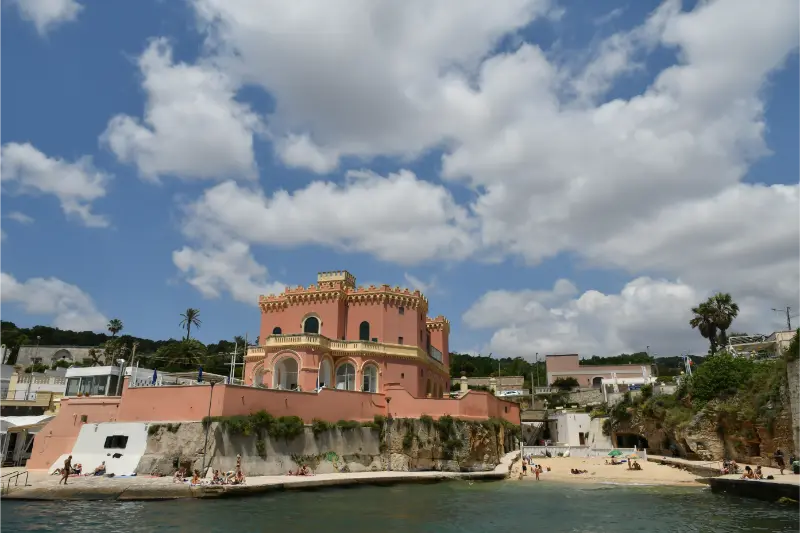
Salento is one of the few places in Italy where choosing a beach is not simply a matter of deciding which stretch of sand looks prettiest. The peninsula is bordered by two very different coastlines: the Adriatic to the east and the Ionian to the west, with Santa Maria di Leuca marking the transition at its southern end.
On the Adriatic side, the coast is more dramatic. Limestone cliffs, sea caves, rocky swimming spots, pine-backed coves and compact sandy bays alternate between San Foca, Torre dell’Orso, Otranto, Porto Badisco and the coast south toward Santa Maria di Leuca.
On the Ionian side, the scenery changes noticeably: longer sandy beaches, dunes and shallow turquoise water become more common around Pescoluse, Torre San Giovanni, Gallipoli, Porto Cesareo, Torre Lapillo and Punta Prosciutto.
This means there is no single best beach in Salento. The right choice depends on whether you want shallow water for children, snorkelling, a long sandy shore, a wild coastal walk, easy access from town or a place where the landscape matters as much as swimming.
This guide follows the coastline from the Adriatic to the Ionian Sea and focuses on the beaches that are genuinely worth building a trip around, together with several smaller swimming spots that can be more rewarding than simply chasing the most famous names.
Adriatic or Ionian: Which Side of Salento Has the Best Beaches?
The easiest way to understand Salento’s coastline is to think in terms of two different beach holidays.
The Adriatic is generally the better choice if you enjoy varied scenery, cliffs, rocky swimming platforms, sea caves and combining beach time with towns such as Otranto. The Ionian is usually preferable for long sandy beaches, shallow water and classic all-day beach days.
Wind can completely change that judgement.
A beach that looks almost Caribbean on a calm morning can become uncomfortable when an onshore wind creates waves, floating seaweed or murky shallows. One of the most useful habits in Salento is therefore not deciding your beach several days in advance. Check the wind direction in the morning and, if you have a car, choose the more sheltered coast.
Because the peninsula is relatively narrow, crossing from one side to the other is entirely realistic. If the Adriatic is rough, the Ionian may be calm, and vice versa.
That flexibility is one of Salento’s biggest advantages over destinations where you are committed to a single coastline for the entire holiday.
The Best Beaches in Salento at a Glance

- Torre dell’Orso is one of the best all-round beaches on the Adriatic.
- Baia dei Turchi combines clear water, sand and a protected natural setting near Otranto.
- Porto Badisco is better for atmosphere, swimming and scenery than for a traditional sandy-beach day.
- Marina Serra is one of the most interesting rocky swimming stops.
- Pescoluse is among the strongest choices for families wanting sand and shallow Ionian water.
- Torre San Giovanni offers a good compromise between beach facilities and a lively seaside base.
- Porto Selvaggio is the best choice for nature and walking rather than convenience.
- Torre Lapillo is one of the easiest Ionian beaches to recommend to first-time visitors.
- Punta Prosciutto has some of the clearest-looking shallow water on the western side of Salento.
Best Beaches on the Adriatic Coast of Salento
Torre dell’Orso
Torre dell’Orso is one of Salento’s most recognisable beaches and one of the rare famous beaches that still deserves its reputation.
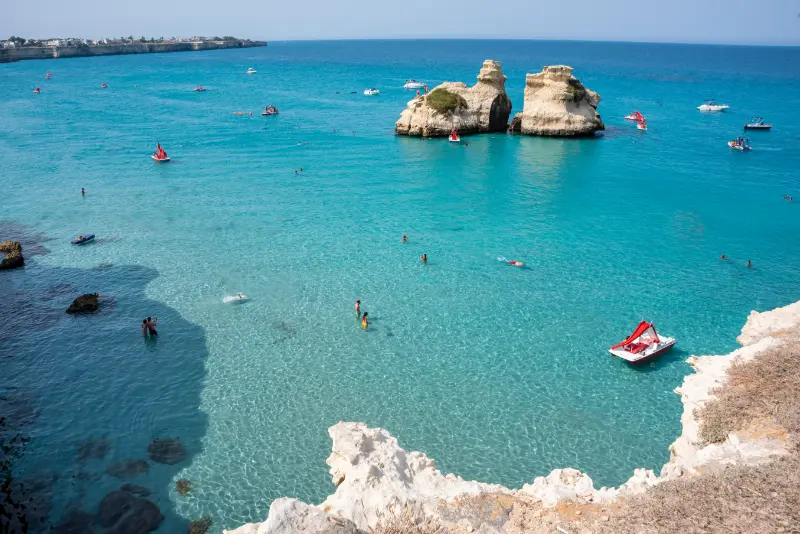
The bay lies in the municipality of Melendugno, north of Otranto. It forms a broad crescent of pale sand backed partly by pine trees, with the limestone stacks known as Le Due Sorelle rising offshore near the southern side of the bay.
The beach works particularly well for families because much of the entry into the water is gradual, although conditions depend heavily on the wind.
The most attractive view of Torre dell’Orso is not necessarily from the middle of the sand. Walk toward the southern end and look back across the curve of the bay toward the town; the shape of the coastline becomes far clearer from here.
For photographs of Le Due Sorelle, early morning is preferable. The eastern orientation makes sunrise particularly attractive and the beach is dramatically quieter before the main summer crowds arrive.
When to Go to Torre dell’Orso
In July and especially August, Torre dell’Orso can become extremely busy from late morning onward. Arriving before around 9:00 makes a noticeable difference both for parking and for finding a comfortable section of free beach.
By late afternoon, the atmosphere improves again as some day visitors begin leaving.
Parking at Torre dell’Orso
Do not expect to drive directly to the sand in peak summer and immediately find a convenient space. Use designated parking areas around the resort and walk the final section.
Parking systems and restrictions can change from one summer to another, so always follow current signs and municipal regulations rather than relying on old information found online.
Allow at least half a day here if you want to swim properly. If you are touring rather than spending the day on the beach, two or three hours combined with nearby Torre Sant’Andrea works well.
Torre Sant’Andrea
A few kilometres south of Torre dell’Orso, Torre Sant’Andrea offers a completely different experience.
This is not primarily a sandy beach. The attraction is the limestone coastline itself: arches, stacks, sculpted rocks and intensely coloured water.
The best-known formations sit close to the coast and can be admired from paths above the cliffs before descending toward the swimming areas.
Torre Sant’Andrea is particularly enjoyable first thing in the morning, when the rock formations are quieter and the sunlight reaches the Adriatic from the east.
It is less convenient for families with very young children than Torre dell’Orso because access involves rocky surfaces and there is no broad, gently shelving sandy beach.
If you only have one day on the Melendugno coast, spend the morning at Torre dell’Orso and stop at Sant’Andrea afterward rather than treating them as two separate beach days.
A 45- to 90-minute stop is enough if you mainly want the view and a quick swim.
San Foca
San Foca receives less international attention than Torre dell’Orso, yet it can be a better practical choice for travellers who want a beach integrated into a functioning seaside town.
There are stretches of sand around the harbour area, together with cafés, restaurants and an evening promenade. The central sections are easier for travellers who dislike isolated beaches or want to combine swimming with lunch without moving the car again.
San Foca becomes lively on summer evenings, and the waterfront is particularly pleasant after the strongest daytime heat has passed.
The sea is attractive, but if your only priority is dramatic scenery, Torre Sant’Andrea and the Otranto coastline are stronger choices.
Baia dei Turchi
Baia dei Turchi is one of the best-known natural beaches near Otranto and one of the places where planning your arrival makes a genuine difference.
The bay lies north of Otranto within the Alimini coastal area. It has sandy sections, clear water and Mediterranean vegetation behind the shore rather than continuous urban development.
During summer, do not assume you can simply leave your car beside the pine forest. Protected areas around the coast are subject to access and parking restrictions, and the sensible approach is to use authorised parking and expect a walk or seasonal transfer for the final approach.
This extra effort is exactly why Baia dei Turchi feels different from an urban beach.
Is Baia dei Turchi Worth Visiting?
Yes, but not at any time of day.
Arriving around noon in August means experiencing the beach at its least appealing: strong heat, crowded access paths and limited space near the most popular sections.
Go in the morning instead.
Three to five hours is enough unless you specifically want a full beach day.
If you are staying in Otranto, a good sequence is Baia dei Turchi in the morning, lunch back toward Otranto, then the historic centre and waterfront later in the afternoon.
Alimini
The Alimini coast is sometimes overshadowed by Baia dei Turchi, but it is arguably more practical for travellers who want a straightforward beach day.
The coast north of Otranto provides longer sandy stretches, beach clubs and more space than the compact coves farther south.
Families often find this easier than repeatedly carrying bags along natural access paths.
Choose Alimini when comfort and time in the water matter more than finding the most dramatic photograph. Choose Baia dei Turchi when setting and landscape are the priority.
Otranto’s Town Beaches
Otranto itself has surprisingly useful swimming spots.
The central waterfront is not where you will find the wildest scenery in Salento, but staying here allows you to swim without getting into a car.
This makes Otranto particularly attractive for travellers combining beach time with sightseeing.
A practical summer day is to swim early, return to your accommodation during the hottest hours and explore the old town from late afternoon onward.
Otranto is considerably more rewarding in the evening than in the middle of a hot August day, when the stone streets and busy central lanes can feel crowded.
Porto Badisco
South of Otranto, the coastline becomes increasingly rugged.
Porto Badisco is one of the most rewarding stops along this stretch.
Rather than an enormous beach, it is a sheltered inlet surrounded by low rocky coastline. The appeal lies in swimming, snorkelling and the intimate shape of the bay.
It is also a good example of a place that is best visited without turning it into an all-day destination.
Two or three hours is generally sufficient.
Combine it with the coastal road south toward Santa Cesarea Terme or Castro. The journey itself is part of the experience, with repeated views of the Adriatic from elevated stretches of road.
Santa Cesarea Terme
Santa Cesarea Terme is not the place to choose if your idea of a beach holiday involves kilometres of sand.
Instead, expect cliffs, platforms, rocky entries and deep blue water.
The town rises steeply above the sea, so short walks can involve more climbing than the map suggests.
This is an excellent stop for confident swimmers and travellers who enjoy rocky coastal scenery. Families carrying pushchairs, beach toys and large coolers will usually find flatter Ionian resorts easier.
The coastal road and viewpoints above the town can be more memorable than spending an entire day in one swimming spot.
Castro Marina
Castro is another place where the relationship between village and sea matters more than having one headline beach.
The marina, rocky coastline and clear water are ideal for swimming and boat trips, while Castro’s upper town sits above the coast.
If you enjoy snorkelling or rocky swimming, Castro deserves several hours.
If you only want sand, continue elsewhere.
Marina Serra
Marina Serra, on the Tricase coast, is one of the places worth adding even if it does not appear in every list of Salento’s best beaches.
Its best-known swimming area is formed by a natural rocky pool protected from the open sea by limestone.
The result can be wonderfully clear and calm in suitable conditions.
However, this is not a conventional beach. There are rock surfaces, steps and limited comfortable space for laying out towels.
It works best as an early-morning swim or a stop of one or two hours while driving the coastal road.
In peak summer, arriving early matters because the swimming area is relatively compact.
Santa Maria di Leuca: Where the Two Coasts Meet
Santa Maria di Leuca sits at the southern tip of Salento and makes a natural turning point in a coastal itinerary.
It is often described as the meeting point of the Adriatic and Ionian seas. In practical travel terms, what matters is that the character of the coastline changes as you round the peninsula.
Do not visit Leuca expecting its central beach to be the finest in Salento.
Its strengths are different: the seafront, monumental villas, lighthouse, sanctuary, harbour and boat trips along the cave-filled coast.
The viewpoint near the Basilica of Santa Maria de Finibus Terrae and the lighthouse is particularly attractive toward the end of the day.
If you only have a few hours, spend them on the waterfront and upper viewpoint rather than searching for a perfect beach in the town centre.
Best Beaches on the Ionian Coast of Salento
Pescoluse
The coast around Marina di Pescoluse is one of the safest recommendations for travellers who want classic Ionian Salento: pale sand, shallow water and long stretches suitable for a relaxed beach day.
It is particularly strong for families.
The strongest feature is not dramatic landscape but easy swimming. The seabed remains shallow along many sections and the sandy coastline extends far enough that you can usually find a slightly different atmosphere simply by walking away from the busiest access points.
Mid-August is another story: expect significant crowds.
If possible, arrive before 9:00 or come after 16:30.
The light becomes softer toward evening and the Ionian orientation makes this side of Salento especially attractive around sunset.
Torre Pali
A little north of Pescoluse, Torre Pali has a more lived-in seaside-village feel.
Its tower stands partly surrounded by water and gives the shoreline an instantly recognisable landmark.
The beach has less international fame than Pescoluse but can be more convenient for travellers staying locally.
If you are driving north from Leuca, Torre Pali is worth a short stop even when Pescoluse remains the main beach destination.
Torre San Giovanni
Torre San Giovanni is one of the best bases on the southern Ionian coast if you want both beaches and evening life within the same area.
Around the town are extensive sandy sections, while the centre provides restaurants, cafés, accommodation and a promenade.
The combination is useful for families who do not want to drive every evening.
Compared with Pescoluse, Torre San Giovanni feels more like a proper resort town. Compared with Porto Cesareo, it is better positioned for exploring the southernmost part of Salento.
Punta della Suina
Closer to Gallipoli, Punta della Suina is one of the most attractive combinations of pine vegetation, rocky edges and small sandy sections.
It feels more enclosed than the long open beaches farther south.
The water can be exceptionally clear when conditions are calm.
It is particularly attractive in late afternoon, both for the softer light and because this is the Ionian side of Salento.
Do not expect solitude during high season. Its reputation means July and August can be extremely busy.
Gallipoli and Baia Verde
Baia Verde is useful rather than subtle.
It offers sand, beach clubs, easy access from the Gallipoli area and a strong summer social scene.
Young travellers interested in beach clubs and nightlife may prefer staying here to quieter Pescoluse or Porto Selvaggio.
Families and couples wanting a calmer landscape may prefer other sections of the Ionian coast.
Gallipoli itself is better treated as an afternoon and evening destination.
Spend the hottest part of the day on the beach, then reach the old town later, when walking around the walls and narrow streets becomes more comfortable.
Porto Selvaggio
Porto Selvaggio is one of the most distinctive coastal experiences in Salento because it feels like a nature excursion rather than a conventional beach resort.
The bay lies within the protected coastal landscape of Nardò and is reached through Mediterranean vegetation.
The shore is largely pebbly and rocky rather than a broad sandy beach.
The water can also feel cooler than at nearby open sandy beaches because of freshwater springs.
This is the beach to choose if you want shade from pine trees, a walk through nature and clear water rather than rows of umbrellas.
Getting to Porto Selvaggio
Expect to walk.
That is part of the experience and also the main reason it may not suit everyone.
Seasonal transport arrangements can sometimes reduce the walking required, but these services should always be checked shortly before visiting.
Wear footwear suitable for paths rather than arriving in thin beach flip-flops.
How Long to Stay at Porto Selvaggio
Allow at least half a day.
Trying to squeeze Porto Selvaggio into a 45-minute stop does not make much sense because the walk is part of the visit.
A good plan is to arrive in the morning, swim and relax until early afternoon, then continue toward Santa Caterina or Porto Cesareo.
Santa Caterina
Santa Caterina is small, elegant and very different from the long sandy resorts farther north.
Rocky swimming points line the coast and the settlement has a pleasantly compact atmosphere.
It works particularly well as a base for couples who want restaurants and evening walks without the scale of Gallipoli.
Parking becomes more difficult in peak season around the waterfront, so accepting a slightly longer walk is often less frustrating than circling the lowest streets repeatedly.
Porto Cesareo
Porto Cesareo has become one of Salento’s most popular seaside bases because it combines shallow Ionian water with restaurants, accommodation and access to several of the region’s best-known beaches.
The town beach itself is not the main reason to come.
Use Porto Cesareo as a base for Torre Lapillo, Punta Prosciutto and the surrounding coastline.
The centre becomes busy on summer evenings. Seasonal traffic restrictions and ZTL rules can apply, so check current signs carefully before driving into central streets.
If you are staying outside the centre, walking in for dinner is often easier than trying to park close to the waterfront at peak evening time.
Torre Lapillo
Torre Lapillo is arguably the best all-round Ionian beach for first-time visitors.
The beach is long enough to offer several different sections, the seabed is shallow, and services are easier to find than at wilder Punta Prosciutto.
This is a good choice for families who want beautiful water without giving up every practical convenience.
The drawback is popularity.
By mid-morning on a hot August day, access roads and parking areas can already feel very busy.
If your accommodation is within walking distance, that convenience can be more valuable than staying somewhere theoretically prettier.
Punta Prosciutto
Punta Prosciutto sits farther north along the Porto Cesareo coastline, close to the border with the province of Taranto.
This is one of the beaches most responsible for the “Caribbean Salento” cliché: pale sand, shallow transparent water and dunes behind the shore.
The mistake is imagining it as an isolated secret.
It is extremely well known and can become heavily crowded in summer.
The Best Way to Visit Punta Prosciutto
Go early.
Before 9:00, you have a much better chance of experiencing why the beach became famous in the first place.
Later in the morning, parking becomes harder and the busiest sections lose some of their visual appeal simply because of the number of visitors.
There are both free and managed stretches along the wider coastline.
Which Salento Beaches Are Best for Families?
For small children, the Ionian side is generally the easiest choice.
Pescoluse, Torre San Giovanni, Torre Lapillo and parts of Punta Prosciutto offer sandy entries and long shallow sections.
Torre dell’Orso can also work very well when the Adriatic is calm.
Rockier places such as Torre Sant’Andrea, Marina Serra, Castro and Porto Selvaggio are visually interesting but require more attention with toddlers because of uneven surfaces, slippery rocks, steps or walking approaches.
Best Beaches in Salento for Snorkelling
For underwater visibility and rocky scenery, consider Torre Sant’Andrea, Porto Badisco, Castro, Marina Serra, Porto Selvaggio and Santa Caterina.
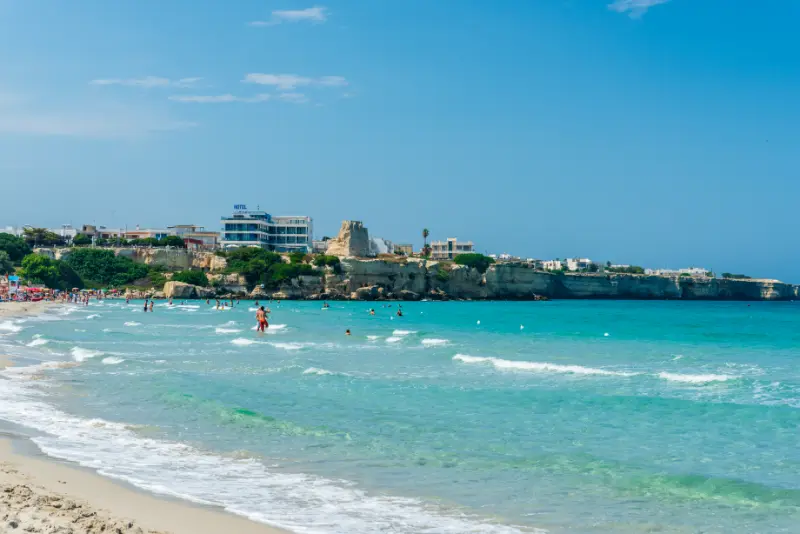
The advantage of rocky coastlines is that the underwater landscape is generally more interesting than on featureless sandy beaches.
Water shoes can be useful if you plan to spend several days exploring these areas.
Best Salento Beaches for Sunrise and Sunset
The geography makes this relatively simple.
For sunrise, choose the Adriatic.
Torre dell’Orso, Torre Sant’Andrea and stretches around Otranto work particularly well in early morning light.
For sunset, head west.
Pescoluse, Torre San Giovanni, Gallipoli, Santa Caterina, Porto Cesareo, Torre Lapillo and Punta Prosciutto all face the Ionian side.
One of the easiest mistakes is leaving an Ionian beach too early simply because the swimming day feels finished. In summer, staying until the sun drops toward the horizon can be one of the most enjoyable parts of the day.
How to Choose a Beach According to the Wind
Wind should influence your plans more than online rankings.
If the wind is blowing strongly onto the Adriatic coast, try the Ionian side.
If the Ionian is rough, consider Torre dell’Orso, Otranto or another more sheltered eastern bay.
This strategy works especially well if you are staying inland around Lecce, Maglie or another central Salento town rather than directly on one coast.
A drive of less than an hour can sometimes completely change the conditions you experience.
Do You Need a Car for the Beaches of Salento?
For a beach-focused trip, a car is the most practical option.
Rail links are useful between some towns, but many of the best beaches lie outside railway centres.
Without a car, choose your accommodation carefully.
Staying in Otranto, Torre dell’Orso, Torre San Giovanni, Gallipoli or Porto Cesareo allows you to reach at least some beaches on foot.
Seasonal bus and shuttle services also operate in parts of Salento, but routes and frequencies can change each summer.
Trying to explore both coastlines extensively by public transport during a short holiday is considerably less efficient than travelling by car.
Parking at Salento Beaches
Parking is one of the biggest practical differences between visiting Salento in June and visiting in August.
At famous beaches such as Torre dell’Orso, Baia dei Turchi, Punta della Suina, Porto Selvaggio, Torre Lapillo and Punta Prosciutto, the sensible strategy is to arrive early and accept a short walk.
Avoid informal parking on dunes, scrubland or woodland edges, particularly in protected coastal areas.
Also pay close attention to ZTL and seasonal access signs when entering resort centres such as Porto Cesareo, Otranto and Gallipoli.
Parking regulations can change yearly, so signs displayed locally should always take priority over information found in older travel guides.
Where to Stay for the Best Beaches in Salento
Otranto: Best for Adriatic Beaches and Sightseeing
Choose Otranto if you want beaches combined with a historic town, restaurants and pleasant evenings without having to drive after dinner.
Baia dei Turchi, Alimini, Porto Badisco and the Melendugno coast are all natural excursions.
It is also one of the better options for travellers without a car because you still have restaurants, evening walks and swimming within town.
Torre dell’Orso: Best for a Beach-First Holiday on the Adriatic
Stay here if you want to walk to a sandy beach every morning.
It is especially convenient for families who do not want to load the car every day.
Santa Maria di Leuca: Best for Exploring Both Coasts
Leuca works well for travellers who plan to drive frequently.
You can move north toward Pescoluse on the Ionian side or toward Marina Serra, Castro and Otranto on the Adriatic side.
Its own central beaches are not the strongest reason to stay.
Torre San Giovanni: Best for Families in Southern Salento
You get extensive sandy coastline, restaurants and evening activity without needing to commute constantly.
Gallipoli: Best for Nightlife
Choose Gallipoli or Baia Verde if evenings and beach clubs matter as much as the sea.
The trade-off is congestion and heavier crowds in peak summer.
Porto Cesareo or Torre Lapillo: Best All-Round Ionian Base
Porto Cesareo gives you more restaurants and evening activity.
Torre Lapillo places you closer to a major sandy beach.
Families who value walking to the sea may actually find Torre Lapillo more convenient.
Best Time to Visit the Beaches of Salento
June
June is one of the best months.
Days are long, beaches are considerably less crowded than in August and most seasonal businesses are operating.
The water can still feel fresh early in the month.
July
July offers reliably hot beach weather and a full summer atmosphere.
Crowds increase substantially, particularly at weekends.
August
August is the busiest period.
Around Ferragosto on 15 August, expect full beaches, expensive accommodation, congested coastal roads and difficult parking.
The beaches are still beautiful, but your schedule matters.
Arrive early, avoid moving between major resorts around late morning and consider swimming again after 17:00 rather than spending every hour under the strongest midday sun.
September
For many travellers, September is the best compromise.
The sea remains warm, families tied to school holidays begin leaving and the intensity of August declines.
Some seasonal services gradually reduce later in the month.
May and October
These months are excellent for coastal walking and sightseeing.
Swimming is possible on warm days, but conditions are less predictable and many beach establishments may operate reduced services.
A Three-Day Salento Beach Itinerary
Day 1: Melendugno and Otranto
Start at Torre dell’Orso before 9:00.
Spend two or three hours swimming, then drive the few minutes to Torre Sant’Andrea for the limestone formations.
Continue toward Otranto.
Have lunch away from the beach, then visit the historic centre later in the afternoon when the heat softens.
Finish with an evening walk along Otranto’s waterfront.
Day 2: Southern Adriatic Coast
Drive from Otranto toward Porto Badisco.
Continue through Santa Cesarea Terme and Castro.
Stop for a swim at Marina Serra before reaching Santa Maria di Leuca.
This day is about scenery, coastal roads and rocky swimming rather than lying on one sandy beach for eight hours.
Day 3: Ionian Sea
Start early at Pescoluse if you are based in southern Salento.
After lunch, continue toward Torre San Giovanni or Gallipoli.
If you prefer fewer kilometres, remain around Pescoluse and Torre San Giovanni until sunset.
Travellers based farther north should instead dedicate the day to Porto Selvaggio, Torre Lapillo and Punta Prosciutto rather than trying to include the southern Ionian coast.
A Seven-Day Salento Beach Itinerary
- Day 1: Torre dell’Orso and Torre Sant’Andrea
- Day 2: Baia dei Turchi and Otranto
- Day 3: Porto Badisco, Castro and Marina Serra
- Day 4: Pescoluse and Torre San Giovanni
- Day 5: Gallipoli and Punta della Suina
- Day 6: Porto Selvaggio and Santa Caterina
- Day 7: Torre Lapillo and Punta Prosciutto
This route also demonstrates why spending the entire holiday in one beach resort means missing much of what makes Salento different from a typical Mediterranean beach destination.
Where to Eat During a Salento Beach Trip
The best strategy is not necessarily eating directly beside the most famous beach.
Restaurants attached to high-traffic beach areas naturally focus on convenience and seasonal demand.
For dinner, towns such as Otranto, Castro, Gallipoli, Nardò, Porto Cesareo and Lecce provide far more choice.
Along the coast, look for seafood and dishes that genuinely belong to the local area rather than ordering a generic catalogue of Puglian food.
Around Gallipoli and Porto Cesareo, fish and seafood are natural choices.
A puccia salentina is one of the most convenient lunches on a beach day because it is filling, quick and easy to eat without spending two hours in a restaurant.
Rustico leccese is another useful snack to look for in bakeries and bars.
In the south, try a pasticciotto in the morning rather than treating it only as a dessert.
For longer dinners inland, dishes using ciceri e tria, seasonal vegetables and local pasta provide a better picture of Salento cooking than limiting the trip to beachfront seafood restaurants.
Beaches That May Not Be Worth a Long Detour
Not every famous name deserves half a day of driving.
If you are staying near Otranto and have only two days, there is little reason to cross all the way to Punta Prosciutto simply because it appears on lists of Salento’s most beautiful beaches.
Torre dell’Orso, Baia dei Turchi and the Otranto coastline provide a much more coherent trip.
The same logic works in reverse.
If you are staying around Porto Cesareo, do not spend hours driving to Pescoluse merely to find another sandy Ionian beach. Torre Lapillo and Punta Prosciutto provide a similar type of beach much closer.
Salento becomes far more enjoyable when you group beaches geographically instead of trying to collect famous names.
Is Salento Worth Visiting for Its Beaches?
Absolutely, but not because every beach looks identical to a tropical island.
What makes Salento unusually rewarding is variety.
Within one relatively compact peninsula, you can swim beside white limestone stacks in the morning, walk through a pine forest to a rocky bay the next day and spend the following afternoon in knee-deep turquoise water on a long Ionian beach.
The strongest trips mix those landscapes rather than spending seven days searching for increasingly similar stretches of pale sand.
If there is one rule worth remembering, it is this: do not choose tomorrow’s beach only from photographs.
Check the wind, look at where you are starting from, arrive early at the most famous places and choose the coast that makes sense that particular day.
That approach will improve a Salento beach holiday more than any ranking ever could.
Plan your stay
Frequently Asked Questions
Which side of Salento has the clearest water?
Both coasts can have exceptionally clear water. Conditions depend heavily on wind and sea state. The Ionian around Torre Lapillo, Punta Prosciutto and Pescoluse is famous for shallow turquoise water, while rocky Adriatic locations such as Porto Badisco, Castro and Marina Serra can offer excellent underwater visibility.
What is the best sandy beach in Salento?
There is no single winner, but Torre Lapillo, Punta Prosciutto, Pescoluse and Torre dell’Orso are among the most consistently rewarding choices.
Which beach in Salento is best for children?
Pescoluse, Torre Lapillo and Torre San Giovanni are strong options because of their sandy shores and generally gradual entry into the water. Torre dell’Orso is another good option when sea conditions are calm.
Which beach should I visit near Lecce?
For an Adriatic beach day, Torre dell’Orso is one of the easiest high-quality choices. San Foca is more convenient if you prefer a town setting with cafés and restaurants nearby.
Which beaches are closest to Otranto?
Otranto has its own town swimming areas, while Baia dei Turchi and the Alimini beaches lie immediately north of town. Porto Badisco lies south along the Adriatic coast.
Is Porto Selvaggio sandy?
No. Porto Selvaggio is primarily a natural rocky and pebbly bay reached through the protected park landscape. Visit for nature, walking, clear water and shade rather than for a classic sandy beach.
Can I visit Salento beaches without a car?
Yes, but you need to choose your base carefully. Staying directly in Otranto, Torre dell’Orso, Gallipoli, Torre San Giovanni or Porto Cesareo reduces the need for daily transport. Seasonal bus and shuttle services also operate in some coastal areas.
When are Salento beaches least crowded?
June and September are considerably easier than August. During July and August, arriving before 9:00 or returning in the late afternoon is one of the best ways to experience the most famous beaches with fewer people.
Is the Adriatic or Ionian coast better for sunset?
The Ionian coast. Pescoluse, Gallipoli, Porto Cesareo, Torre Lapillo and Punta Prosciutto are particularly suitable for late-afternoon and sunset beach time.
How many days do you need for the beaches of Salento?
Three days gives you a useful introduction, but five to seven days is much better if you want to experience both coastlines without spending most of the holiday driving.